 +1-480-241-8198
 +44-7428758945
 +61-1300-332-888
 +91 9811400594
Salesforce has been extremely ambitious, which is obvious from its attempt to control as much space as possible within its enterprise ecosystem. From Marketing Cloud and Agentforce to automation and data management, the company’s venture has left customers navigating rising costs, corresponding products, and a gradually more closed ecosystem.
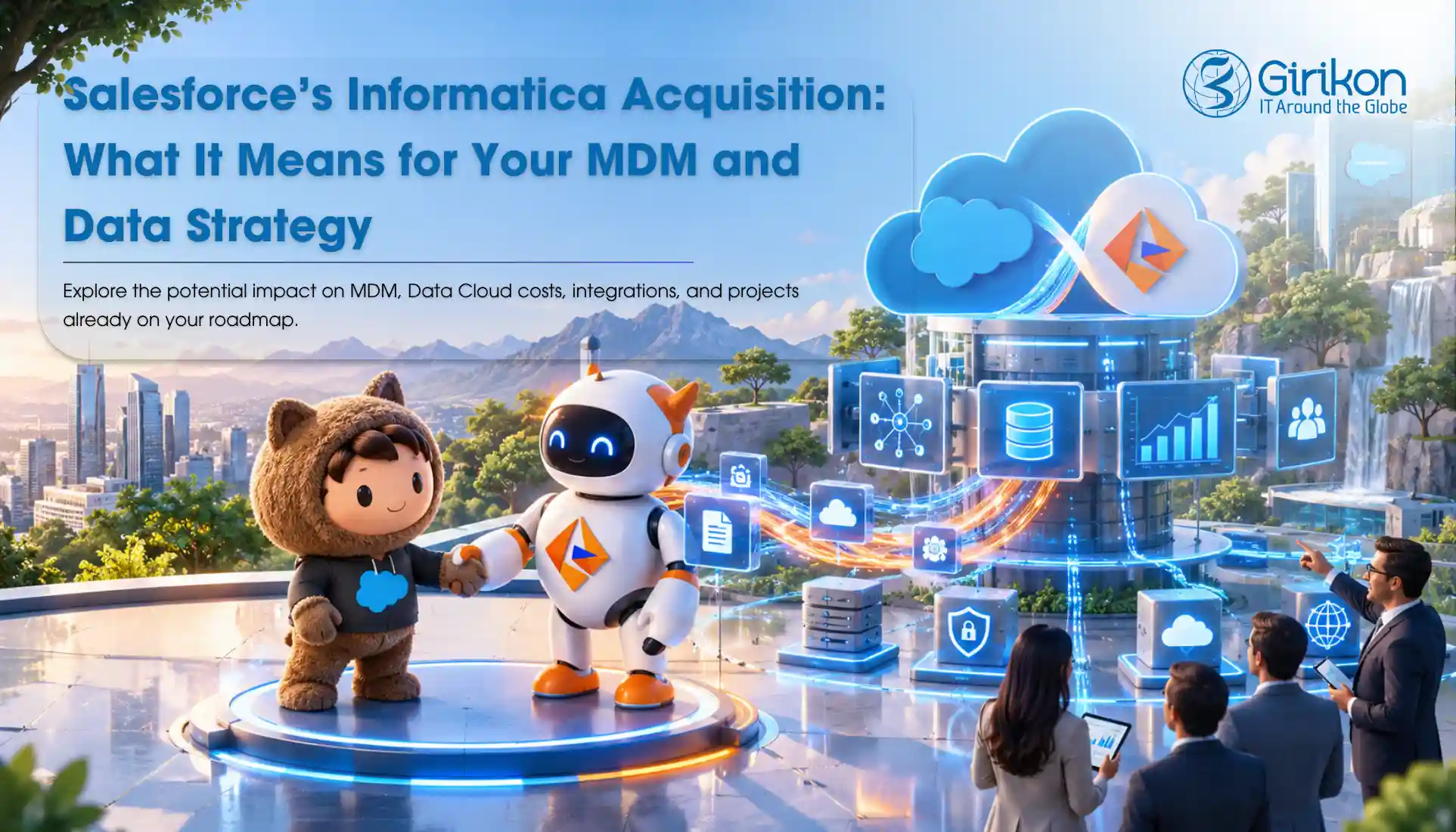
While the Data Cloud platform announced a few years back by Salesforce facilitated the integration of enterprise data between Salesforce sales and marketing clouds with other enterprise systems, the platform failed to offer features for ensuring data governance, managing data quality, and data labelling.
This is where Salesforce Informatica comes to the picture and shines. About two-third of informatica MDM systems are installed to amalgamate customer data and a certain percentage to unify product data. Salesforce has established itself as the dominant enterprise CRM system but lacks advanced data unification capabilities and governance framework. Now, after acquiring Informatica, Salesforce’s vision will be backed with what couldn’t be offered out of the box by Data Cloud.
For organizations that are already leveraging Salesforce Data 360, MuleSoft, or Informatica, the acquisition puts several key questions on the table regarding their data strategy, costs, architecture, and authority. Should their Salesforce MDM strategy change? Will Informatica MDM overlap or complement with Data 360? What happens to existent integration plans, and how must data governance evolve? The acquirement brings the enterprise capabilities of Informatica in data integration, cataloging, quality, management of metadata, privacy, MDM, governance, lineage, and observability into Salesforce. These capabilities are expected to fortify Data 360 and create a broader base for Agentforce and other AI capabilities.
The Major Shift: Why is MDM Becoming More Strategic
Prior to acquisition, enterprises positioned Salesforce as the client-facing CRM while using Informatica MDM as a data-management layer through Salesforce, ERP, SAP, commerce, and other applications. That architecture still remains a viable approach, but Salesforce can now connect these capacities more closely. Informatica MDM Salesforce helps establishments create reliable records by matching, refining, establishing, and governing data across multiple sources. For instance, client data may dwell in Salesforce, financial data in SAP, orders in an ERP, and product or supplier data in independent systems. Integration alone cannot ensure precise, consistent data. MDM creates a reliable record, while integration disperses that information across applications.
Informatica vs. MuleSoft: Different Roles in Data Architecture
After the acquisition, one of the key queries that arises is whether MuleSoft and Informatica now overlap. Though there might be some functional overlaps, mainly in data integration, the two platforms serve different purposes. While Informatica focuses on data governance, quality, labeling, and Master Data Management, MuleSoft, on the contrary, is primarily focused on application integration, connectivity, API’s, event processing, and workflow arrangement.
In simple words, Informatica answers, “What is reliable data?” while MuleSoft answers, “How do we hook up and move that data?” Consequently, MuleSoft investments should not be viewed as redundant. MuleSoft can serve as the connectivity layer that disperses master data managed by Informatica across Salesforce and other enterprise applications.
What Happens to Your Salesforce Data 360 Bill?
This is a crucial consideration for architects, procurement teams and CIOs. Salesforce’s procurement of Informatica does not ensure that the capabilities of Informatica will automatically become free or that every workload will be incorporated in an existing Salesforce subscription.
Data 360 has its own pricing model, which is based on consumption. This includes Flex Credits and profile-based valuing. While Flex Credits are priced at $500 per 100,000 credits, Profiles are rated at $240 per 1,000 profiles every year. Enterprise Profiles are set at a price of $420 per 1,000 profiles per year. Actual pricing depends on each client’s contract and configuration.
Data 360 utilization varies based on processing, amalgamation, questioning, segmentation, activation, flowing, and real-time pipelines. Therefore, companies must evaluate which assignment runs on which platform and how that load is charged. Connected architecture may enhance capabilities, but tighter integration does not mean lower total costs by default.
What will Happen If Your Integration Scope Require Changing?
A Salesforce integration flow planned like this:
SAP → MuleSoft → Salesforce Data 360
Might require reviewing whether the current architecture needs an extra data-management layer:
SAP → Informatica MDM → MuleSoft → Data 360 → Salesforce/Agentforce
However, this does not mean every project requires Informatica. If the objective is just to shift customer data from SAP into MuleSoft, Salesforce may be enough. But if you require finding duplicate clients across multiple systems, create one reliable customer record, define data proprietorship, optimize data quality, track data source, and share authentic data across applications then Informatica MDM could add value.
The Salesforce-Informatica combination offers a key lesson: Keep data at the center of your problem—not the product.
What Could Be Done with Your MDM Roadmap?
If your organization already has an Informatica MDM program, do not stop it just because just because Salesforce acquired it.
- Already Implemented: If have already implemented an MDM solution, start by recording the current setup. Document the currently used platform, existing rules for data-quality, governance, integration, and more. This helps you assess what is going well and what improvements are needed. Avoid migrating an existing MDM solution totally because Salesforce is now maintaining Informatica.
- Currently Being Designed: If your MDM proposal is still in the initial stages, this is a good time to reexamine the architecture. Ensure whether the capabilities of Informatica could ease your data-management approach, mainly if Salesforce, Data 360, and MuleSoft are crucial aspects of your technology environment. The goal should be to figure out the right blend of capabilities rather than include another platform needlessly.
- Future MDM Initiatives: For future MDM projects, the architecture should be kept flexible besides avoiding tightly associated reliance between platforms. The key capabilities of data mastering, integration, governance and activation should be clearly demarcated. This approach makes it simpler to shift platforms, expand to new domains, or initiate new technologies without revamping the whole architecture.
Final Takeaway:
The acquisition of Informatica should not mean migrating your MDM platform, improving your MuleSoft architecture, or supposing higher Salesforce costs. Rather, consider it as an opportunity to review your complete data strategy. Salesforce Master Data Management approach, Informatica MDM needs, data-quality processes, governance structure, Agentforce roadmap etc., should be reexamined. The roles of these platforms complement each other: Informatica helps launch reliable enterprise data, MuleSoft orchestrates and connects that data, Data 360 activates it inside Salesforce, and Agentforce can leverage that data to back intelligent actions.
About Author

Jaya is a technical content specialist with 14 + years of experience - especially in the B2B space. Her forte lies in changing complex technologies into compelling narratives that educate, engage and drive business growth. Over the years, she has honed her skills of creating all types of marketing copies including white papers, landing pages, thought leadership articles and website copies that support lead generation, brand positioning, and client engagement. She is also passionate about creating content strategies that outline the future of customer engagement. She is currently associated with Girikon as a Content Manager where she heads the Content function.
Share this post on: