+1-480-241-8198
 +44-7428758945
 +61-1300-332-888
 +91 9811400594
Growth has a way of changing what businesses expect from their CRM. The platform that is perfectly suitable for a business with a small sales team and simple processes might stop supporting the business as it continues to scale. New markets, growing teams, extended sales cycles, and higher customer expectations require a solution that can accommodate the growing needs of a business.
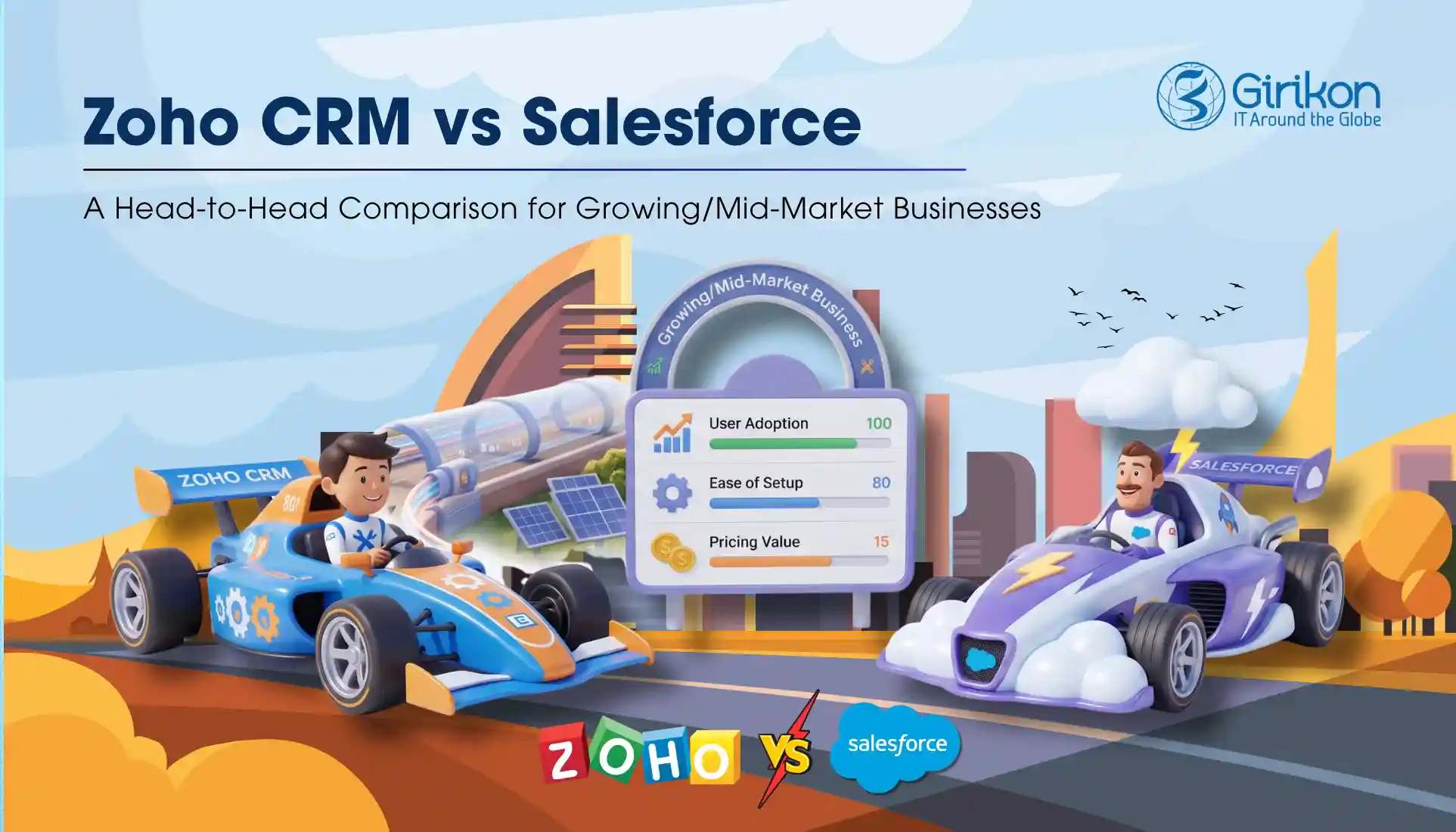
At this point, it makes sense to make Zoho vs Salesforce comparison especially for mid-size and growing businesses. Both prominent solutions help organizations handle customer relationships and sales processes, but the way they grow with your business is completely different. Here, it is not about choosing from the solutions with the biggest feature lists, but rather the one that meets your business needs now and in the future.
Why Growing Businesses Need to Evaluate CRMs Differently
The consequences of CRM choices become significantly irreversible for growing mid-market businesses. A setup that runs smoothly on a smaller scale often starts showing gaps as the business grows, and processes become harder to manage manually. That is why CRM evaluation is an integral element of long-term business planning.
Growing and mid-sized businesses usually consider CRM solutions based on the following aspects:
- Scalability as customer and sales volumes increase
- Automation capabilities that reduce manual effort
- Reporting and forecasting visibility
- Integration with existing business systems
- User adoption across different teams
- Total cost of ownership over time
For most of the growing businesses, the list of top CRMs often narrows down to only two names: Zoho CRM and Salesforce. These two platforms perform all necessary CRM functions, such as lead management, sales funnel management, reporting, automation, and customer relations management, which is why they frequently surface in the mid-market CRM comparison.
Zoho CRM
Zoho CRM appeals to many growing businesses because it combines CRM functionality with a larger suite of business tools. From marketing to customer support, finance and collaboration, Zoho CRM allows teams to manage several business functions from a connected environment.
Salesforce
Salesforce is known for its ability to adapt to different business requirements. Organizations often use it not only for customer relationship management but also for advanced automation, integrations, and workflow management across multiple departments. With such a comprehensive ecosystem, a Zoho CRM vs Salesforce comparison becomes quite inevitable while evaluating the CRM solution for scaling purposes.
Zoho vs Salesforce: Where the Two Platforms Actually Differ
Both platforms handle the fundamentals of CRM well. Both handle core CRM functions well — the difference shows up when business complexity increases.
1. Platform Philosophy and Scalability
Zoho CRM Accessibility & breadth
Zoho CRM is built around accessibility and breadth. Its broader ecosystem allows growing businesses to operate on marketing, finance, and support tools without having to deal with multiple software vendors. Thus, appealing to growing businesses operating from one platform.
Salesforce Depth & adaptability
Salesforce is built around depth and adaptability. Its architecture is designed to handle increasing complexity — larger teams, more sophisticated workflows, and multi-department operations — without requiring a platform change. For organizations planning a significant scale, this distinction in the Zoho vs Salesforce evaluation often becomes the deciding factor.
2. Automation and Workflow Depth
Zoho CRM Standard workflows + Zia
Zoho CRM supports automation with the help of standard workflow processes and AI assistance, Zia. For most growing businesses, these capabilities handle standard sales processes effectively without requiring technical resources.
Salesforce Flow Builder + Einstein AI
Salesforce provides more advanced automation through Flow Builder, Process Builder, and Einstein AI. These tools support complex, multi-condition workflows across departments — making Salesforce the stronger fit for organizations where automation requirements are likely to grow significantly over time.
3. Integration and Ecosystem
Zoho CRM Own product ecosystem
Zoho CRM works well within its own product ecosystem and can connect with external tools through available integration options. The integration is specifically smooth for businesses already using other Zoho products.
Salesforce AppExchange breadth
Salesforce operates as one of the largest CRM ecosystems available — with multiple AppExchange integrations covering virtually every business function. For organizations with complex or non-standard integration requirements, this ecosystem depth is a meaningful advantage in any mid-market CRM comparison.
4. Pricing and Total Cost of Ownership
Zoho CRM Lower entry-level pricing
Salesforce vs Zoho pricing reflects their different positioning. Zoho CRM offers significantly lower entry-level pricing with more functionality included at each tier — making it accessible for growing businesses managing budget carefully.
Salesforce Higher tiers, one platform
Salesforce licensing is pricier in comparable tiers, and advanced functionalities demand a higher edition or add-ons. But for organizations relying on multiple tools anyway, it’s worth considering the ability to do everything through one Salesforce CRM.
For businesses evaluating which CRM is better, Zoho or Salesforce, the answer is rarely about price alone. It is about which platform’s total cost aligns with the operational value it delivers at the scale the business is planning for.
When Does Zoho to Salesforce Migration Make Sense?
Growth exposes limitations of a platform that once felt sufficient. Most organizations begin using Zoho to eventually realize that their requirements need better CRM capabilities. At the point where the automation and integration needs cannot be handled by the existing system anymore, it becomes time to migrate.
The triggers are usually consistent:
-
Automation requirements exceed what standard workflow rules can handle
-
Reporting and forecasting visibility becomes insufficient for leadership decisions
-
Integration demands grow beyond the existing ecosystem
-
Cross-department workflows require greater control compared to what the current platform offers
At this point, the question no longer remains about Zoho vs Salesforce; the real concern revolves around the platform that is more suitable for the business at present and going forward.
Conclusion
The right CRM is rarely the one that fits best today. It is the system that creates the least friction in the future. Both Zoho CRM and Salesforce serve growing businesses well but at different stages and different scales. The decision of Zoho vs Salesforce is a matter of one important question: is the platform chosen for where your business is today and for where it is headed going forward?
About Author

Akanksha is a technical content writer with 3+ years of experience creating content for IT services, software development, and Salesforce consulting companies. She specializes in SEO-focused content, technical storytelling, and marketing assets that drive visibility, engagement, and business growth.
Share this post on: