+1-480-241-8198
 +44-7428758945
 +61-1300-332-888
 +91 9811400594
Selecting a CRM system is no longer based on its functionality. Rather, it is an investment in a solution that will be able to support business sales strategy, customer experience, and company growth in the coming future.
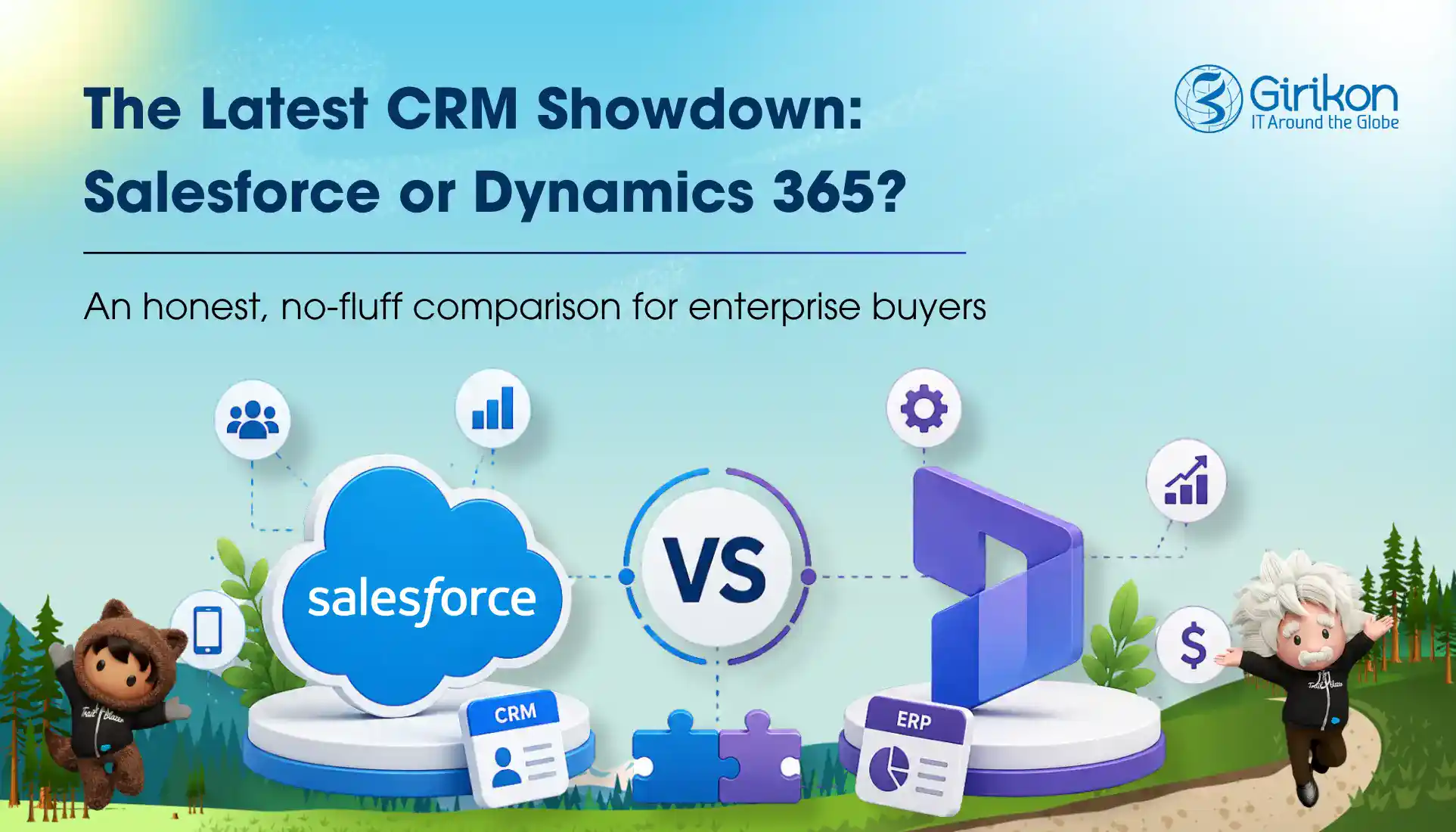
However, the selection process is becoming increasingly difficult as Salesforce and Microsoft Dynamics 365 continue to expand their capabilities.
After having researched a few articles comparing Salesforce vs Dynamics 365, one gets a feeling that there’s a lot of hype going on about one being superior to the other. But there’s no clear winner here. It all depends on business goals, existing technology ecosystems, budget, etc.
This blog provides a fair and buyer-oriented comparison of both the platforms, providing insight into where Salesforce outshines its competitor and where it’s outshined by Dynamics 365. Find out which CRM best suits your company in 2026.
Salesforce vs Dynamics for Enterprise: A Quick Comparison
| Features | Salesforce | Microsoft Dynamics 365 |
|---|---|---|
| Best for | Sales-focused and customer-centric organization | Businesses using the Microsoft ecosystem |
| AI | Einstein AI, Agentforce | Microsoft Copilot |
| Customizations | Highly flexible | Strong |
| Integrations | AppExchange Ecosystem | Native Microsoft Integrations |
| Scalability | SMBs to global enterprises | Mid-market to enterprise |
| CRM + ERP | CRM-first platform | Combined with ERP capabilities |
Scroll the table sideways on smaller screens.
At first glance, it seems that both platforms have similar functionality. But the greatest difference between these two is the way they approach growth within the organization. Salesforce revolves around building better connections with customers whereas Dynamics 365 focuses on connecting customer engagement with finance and other operations.
Customer Experience vs Business Operations
Here comes the first main difference.
The Salesforce software is made specifically with the customer as the center point of every process. Customer engagement is facilitated by all possible processes including lead management, sales, customer service, and marketing to make closing deals easier.
Microsoft Dynamics 365 covers a wider range of processes. In addition to having a CRM suite, it also has processes involving finance, operations, inventory, supply chain, and customer services in one package. This solution can be particularly beneficial for organizations that want to integrate customer interactions and their operational processes.
Which solution would suit your organization best?
For organizations that prioritize building a customer relationship and better sales performance, Salesforce may provide more advanced experience.
For organizations that have processes requiring higher operational efficiency and already use Microsoft solutions, Dynamics 365 might bring more benefits.
AI Capabilities: Which Platform Is Better Prepared for 2026?
In the current era, the Dynamics 365 vs Salesforce 2026 comparison has been greatly affected by the use of artificial intelligence (AI).
Both software products invest heavily in AI but for different reasons.
Salesforce uses Einstein AI and Agentforce in sales, service, and marketing. Using these tools, customers can get a summary of conversations, recommendations on next steps, prioritize leads, automate processes, and get personal recommendations. The main idea of the use of AI in this situation is to improve communication with clients and the efficiency of the Salesforce.
Microsoft Dynamics 365 uses Microsoft Copilot in CRM and other solutions that Microsoft provides. People can compose emails, make summaries of conversations, automate processes, create reports, and analyze information using Outlook, Teams, and Excel.
The preferable solution will depend on how AI can be implemented in your organization.
Salesforce will be the preferred choice if AI assists your sales department and communication with customers.
Microsoft Dynamics 365 will be the optimal solution if you need AI in different departments of your business.
Customization and Flexibility
Every organization has its own way of selling, approving orders, and making reports.
This is where Salesforce stays ahead of the curve.
Salesforce allows firms to customize all aspects of the system from objects to workflows to dashboards and automation. As the organization grows, additional business processes can be introduced without changing the CRM.
Although Dynamics 365 also supports personalization, its real value comes from its ability to extend Microsoft’s universe, and not from being an open CRM system.
For organizations that have rapidly changing business models or industry-related needs, Salesforce may turn out to be more flexible.
Integration: Which Ecosystem Fits Better?
No CRM can operate effectively on its own. It must be connected to marketing software, communications channels, accounting programs, analytics tools, support applications, and industry-specific systems.
Salesforce has developed an extensive ecosystem including business applications through AppExchange offering thousands of pre-built integrations available.
Dynamics 365 is taking another approach.
It is not the volume of integration options that makes it special but the quality of integration with tools as Microsoft 365, Teams, Outlook, Power BI, Azure, and SharePoint. For the businesses that have already invested in Microsoft’s ecosystem, collaboration and data exchange between departments have become much easier.
The better ecosystem depends entirely on the current tech stack of any organization.
When you are already using Microsoft products in your business, Dynamics 365 seems like a natural extension.
For businesses that use multiple business applications from various vendors, Salesforce is normally the better choice.
Still weighing the two against your actual stack?
We implement Salesforce and we integrate with Microsoft estates every week, so we will tell you plainly which one your requirements point to — including when the answer is not Salesforce.
Pricing: Look Beyond Subscription Costs
One of the most popular questions is Dynamics 365 vs. Salesforce pricing.
The truth is that no solution is cheaper across the board.
Both use modular pricing based on the required products, user licenses, AI features, and any other services your company needs.
More importantly is to think about the total cost of ownership (TCO), not monthly subscriptions.
This covers the following:
- Implementation
- Customizations
- Training
- Third-party integration
- Administration
- Support & maintenance
- Scalability opportunities
Salesforce becomes increasingly costly when companies move from one cloud solution to another or introduce advanced AI functionality. Dynamics 365 may prove more affordable for those who have already paid Microsoft enterprise licenses; however, all other factors need to be accounted for.
Instead of asking “Which CRM is cheaper?”, ask yourself “Which CRM will bring me more value in the next five years?”
Wrapping Up
There is no standardized solution when it comes to choosing between salesforce and dynamics 365 since the two solutions differ greatly based on their underlying design philosophy. Salesforce is designed to be a powerful and customized AI-powered CRM system for those who seek to improve customer experience. Dynamics 365 is ideal for those companies which need their CRM system to integrate well with finance and operations and, generally speaking, Microsoft ecosystem.
To choose a CRM system, it is important to think about your business requirements in the long run, such as your business goals, current technological infrastructure, and growth expectations.
Get a straight answer before you sign a multi-year licence.
Girikon is a certified Salesforce consulting partner that also implements and integrates Microsoft Dynamics. That means the recommendation you get is based on your requirements, your existing stack and your five-year TCO — not on which platform we happen to sell.
- Requirements & fit assessment
- Total cost of ownership modelling
- Salesforce and Dynamics implementation
- Migration and integration between both
Shortlisting right now? Call +1‑480‑241‑8198 (USA)
About Author

Sakshi specializes in creating high-quality, SEO-driven content focused on Salesforce, CRM, and business automation. She writes blogs, landing pages, solution pages, case studies, and thought leadership content that simplifies complex Salesforce concepts, highlights business value, and helps organizations make informed CRM decisions.
Share this post on: