 +1-480-241-8198
 +44-7428758945
 +61-1300-332-888
 +91 9811400594
CRM or customer relationship management platforms have been helping businesses deliver more engaged interactions with customers, boost teams’ productivity, streamline business operations, and more. However, organizations can only drive revenue, maintain, and improve customer relationships when it has been successfully adopted at scale. The issue doesn’t lie with these deployments underperforming but with the way it was adopted, carrying costs that accumulate long before they become visible. This is why it becomes essential for businesses to not only understand how to successfully implement CRM platforms like Salesforce but also understand the costs of poor CRM adoption challenges.
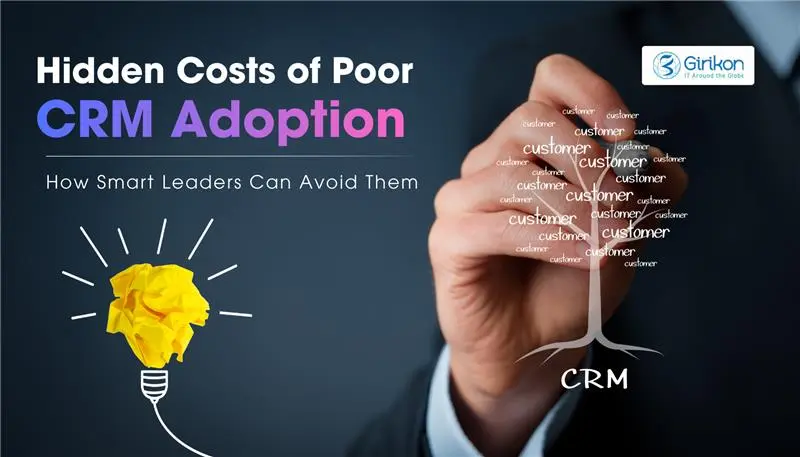
Therefore, in this blog, we’ll discuss why businesses need CRM, some common CRM user adoption issues, and how to fix them with CRM adoption best practices. In addition, we’ll also explain how hiring a CRM consulting services company can help you avoid paying the cost of poor CRM adoption.
4 Reasons Why High CRM Adoption Matters to Businesses
Adoption is not measured by who logged in. It’s measured by whether the system produces reliable data, teams reference it before making decisions, and whether the outputs like reports, forecasts, and activity records reflect what’s happening in the business. These are the same standards followed by successful companies that use salesforce, where CRM adoption is defined by consistent usage, accurate data, and operational trust across teams. Those conditions describe a CRM that has been adopted, which we’re discussing below:
1. A Pipeline That Reflects Actual Sales Activity
Sales forecasting often relies on informal corrections. Leaders adjust numbers they know are off for instance, an agent overstating confidence, or pipeline stages left untouched since the last review. These fixes point to a deeper issue: poor adoption. When pipeline data is accurate and current, forecasting shifts. Quarterly targets, headcount, and territory planning can be based on real data instead of leadership’s best guess.
2. Service Continuity Across Customer Touchpoints
When a customer is dealing with three different teams pre-sale, post-sale, and renewal, she kinda assumes those people will share the right context. But if your org doesn’t have strong adoption, that assumption is often not met. Past commitments end up being unknown to the service folks, and the earlier complaints that were logged but never actually resolved just pop up again, with no clear acknowledgment. Then, during renewal conversations the account manager shows up without any real visibility into what the relationship has actually gone through.
This isn’t just a small inconvenience, it tends to signal to the customer that the organization isn’t steering the relationship on purpose. This matters even more in healthcare, because continuity, accuracy, and coordinated communication heavily affect trust and those long-term partnerships. However, with proper CRM integration, used consistently across every customer-facing function, these gaps get prevented, and you get real continuity.
3. Automation Grounded in Reliable Data
CRM offers a lot of automation capabilities such as triggers, reminders, sequences, task assignments, among others. Most companies pay for all these features but hardly use them all. This is partly because configuration takes time, but mostly because automation is only as good as the data feeding it. With a high adoption, you can create a clean, consistent data layer that makes automation reliable, and execute tasks as specified and expected.
4. Reporting With Actual Decision-Making Value
When data quality is consistently maintained through strong adoption practices, CRM reporting becomes a reliable leadership tool. Stage conversion rates, time-in-stage analysis, activity volume by segment, win and loss pattern analysis; these outputs are analytically meaningful only when the data behind them is trustworthy. Poor adoption is what makes the difference between a CRM as a system of record and a CRM as a management tool.
What are the Hidden Costs of Poor CRM Adoption?
Adoption failure is kind of especially expensive, mostly because it’s not really visible. The consequences are there, but they often just, don’t get pinned on the right reason. You might miss a revenue goal, see a quarter forecast that s inaccurate, or have a customer who just doesn’t renew—each one looks obvious on the surface, while the less obvious “source” sits hiding in CRM non-use. So that’s why partnering with an experienced hubspot crm consultant matters a lot, they help teams push for steady adoption, make the data cleaner, and make sure the CRM is actually supporting revenue growth instead of quietly sabotaging it.
Pipeline Leakage from Inconsistent Follow-Up
Opportunities that receive no follow-up at the right moment don’t remain available. When sales teams manage their pipelines outside the CRM—informally, through personal notes or memory—the timing of outreach becomes unpredictable. High-value leads go uncontacted at the point of maximum interest, while late-stage deals lose momentum because no one in the system flags stalled engagement. These breakdowns not only result in lost revenue but also contribute to one of the key challenges sales teams CRM adoption efforts face: declining trust in the system. As CRM data becomes incomplete and unreliable, teams increasingly bypass the platform, reinforcing poor adoption habits and further reducing CRM effectiveness.
Poor adoption drives underperformance that leads to neglect and eventually causes wasted potential. As a result, even for many companies that use salesforce, the CRM can become a recurring drag on results instead of a growth driver, draining budget while delivering less than promised.
Sustained Cost Against Unrealized Value
CRM contracts including licensing, implementation, integrations, and ongoing support represent a significant annual expenditure. That expenditure does not scale with adoption levels. So, when you’re paying enterprise rates for a system being used at partial capacity, you’re funding a gap between what was purchased and what is being realized, every year as the contract runs.
The business case at the time of purchase assumed full adoption but when that assumption fails, the projected return does not materialize. However, the cost is low. Eventually, you end up with systems added to your budget without delivering the expected outcomes.
Data Quality That Erodes Over Time
Improper use will result in improper records with duplicate contacts being collected, history of activities creates gap, or the deal stages aren’t updated in real-time. The poorer the data in the system is, the less the willingness of the users depend on it, which further widens the gap. Users who would have normally interacted with the platform to start working around it since the records they come across cannot be trusted to take any action. Moreover, campaigns are run on outdated contact lists and service teamwork without the knowledge of the latest interactions.
Therefore, outdated or poor data quality impacts the entire sales cycle, but this becomes severe because poor CRM adoption makes it challenging to detect data degradation on time. As a result, it takes an in-depth remediation process, which is typically more expensive than a regular maintenance process would have been.
Retention Risk Among High-Performing Employees
Friction in core tools shapes how people experience their work. When sales professionals view the CRM as an administrative burden rather than a performance asset, disengagement follows. Low CRM adoption reveals a hidden cost that is attrition of top talent because high-performing employees expect systems to enhance productivity. But when the CRM creates friction, they disengage quickly, first from the tool, then from the role.
The impact is significant as turnover among high performers disrupts pipeline continuity, delays client engagement, and erodes team morale. New recruitment and ramp-up costs compound the loss, while institutional knowledge and customer trust slowly disappears.
A CRM that blocks daily workflow doesn’t simply miss adoption targets; it impacts retention of the very employees who sustain growth. This is why businesses must avoid tool-related dissatisfaction. As it rarely surfaces in exit interviews, yet it quietly drives departures.
Customer Experience Degraded by Internal Disconnection
The quality of the customer experience is shaped in part by how effectively internal teams share information. When CRM adoption is uneven, that information flow breaks down. Customers repeat themselves and receive responses that contradict what they were told previously. In addition, account conversations proceed without reference to relationship history that should have been visible to everyone involved.
The customer rarely attributes this to a data management failure but to the organization, leading to higher downstream effect on renewal rates and referral behavior.
Strategic Decisions Made on Incomplete Information
CRM data informs decisions about headcount, market investment, product priorities, and growth targets. When that data is the product of uneven adoption, accurate in some teams, inconsistent in others, with fields selectively populated across the board, the decisions it informs carry risk that is not immediately apparent.
For instance, a forecast that is built on records that are 60 percent populated and variably accurate can look credible in a report. But when management makes decisions about it, it doesn’t work. Because the data quality issue is rarely examined as the forecast miss is attributed to external factors instead.
Compounding Resistance to Subsequent Change
Technology initiatives that fail to deliver their stated value create organizational skepticism that persists. Teams that went through a CRM deployment which did not improve their work have a rational basis for doubting the next initiative. That skepticism does not resolve itself between projects, and it accumulates. Organizations with a history of underdelivering adoption efforts find it progressively more difficult to execute operational change.
The barrier is not technical capability, and it gradually erodes organizational trust in the change process itself. That erosion is one of the more significant and least quantified costs of sustained adoption failure which many businesses fail to pay attention to in due time.
How to Avoid the Hidden Costs of CRM Adoption Challenges: 5 Tips
Here are the best ways you can avoid paying the hidden costs of CRM adoption challenges:
Tip 1: Match Real Workflows
Configure CRM to reflect actual daily practices, not idealized ones. Remove unnecessary fields, simplify data entry, and align stage definitions with real milestones. When you directly engage users to identify friction points, it helps the system mirror real-world case scenarios; therefore, the less resistance and workarounds occur.
Tip 2: Role-Based Training
Generic platform training rarely changes behavior. Instead, build short, role-specific sessions showing how CRM supports daily objectives. If you reinforce this over time with practical use cases, you don’t only get feature knowledge but demonstrate how consistent CRM use directly benefits each function’s outcomes.
Tip 3: Enforce Standards
Adoption improves when CRM discipline is embedded in management routines. Define clear standards such as update frequency, required fields, and activity logs, and use them in pipeline reviews, accountability checks, and performance assessments. Expectations become operational norms only when tied to real consequences and management practice.
Tip 4: Use Peer Champions
Peer influence drives durable change. Identify individuals who use CRM effectively and give them recognition, platforms, and opportunities to share practices. Their credibility builds trust, spreads practical insights, and strengthens adoption more effectively than formal training alone.
Tip 5: Continuous Refinement
Adoption must evolve with business changes. As organizations expand, addressing growing companies CRM implementation challenges becomes essential to maintaining system effectiveness and user engagement. Build structured feedback loops to track data quality, gather user input, and spot configuration gaps. Once insights are collected, act visibly on findings to maintain confidence. Ignoring feedback causes engagement to erode, but acting on it sustains long-term adoption and ensures the CRM continues to support evolving business needs.
How a CRM Consulting Services Partner Can Help
There’s no doubt CRM has helped businesses in multiple ways. From improving workflows and enhancing customer engagement to streamlining processes, it does it all. However, these benefits can only be fully realized when businesses work with experienced salesforce agencies and overcome poor CRM adoption challenges that lead to poor data quality, lost pipeline visibility, and a poor changeset outlook
The best way to mitigate these challenges is to follow the best practices guide shared in this blog. But if you want to gain the true value out of your CRM investment, you can seek assistance from a CRM consulting partner. The partner’s certified experts can help you overcome these risks, refine workflows, and ensure the platform meets your user expectations and grows as your business does.
FAQs
What is the real cost of poor CRM adoption?
When teams struggle to adopt the CRM, it makes licensing and setup sunken costs in a very short time. In addition, data remains dispersed, sales transparency is decreased, and agents make decisions based on incomplete or inaccurate information.
Why do CRM user adoption issues keep surfacing?
The primary reasons are the lack of clarity of the process or insufficient training or absence of a clear benefit visible to the end of users. If CRM starts becoming an additional burden and not a means of easing their work, usage of the platform suffers.
How can CRM consulting services help with CRM adoption?
Here are different ways, a reliable CRM consulting partner can help you in following CRM adoption best practices:
- Assist you with a systematic and detailed audit in finding out the root causes of low adoption
- Offers training and workshops for users and the work process
- Build adoption plans to address resistance, incentives, and communication gaps
- Monitor usage patterns and refine processes, ensuring adoption remains high beyond the initial rollout
What are the biggest CRM adoption challenges sales teams face?
One of the biggest CRM adoption challenges sales teams face is low user engagement. Reps often view CRMs as time-consuming —especially if data entry is manual or workflows are overly complicated. Poor training, lackluster management support, and unclear benefits can further erode adoption. Inaccurate or incomplete data also undermines trust in the system. To improve CRM adoption, focus on user-friendly processes, proper onboarding, automation, and demonstrating how your CRM helps sales teams close deals faster and better manage customer relationships.
About Author

Anjali is a technical content writer and strategist with 9 years of experience, bringing expertise in creation and strategy for IT services, software development, and Salesforce consulting companies. She excels at developing SEO-driven storytelling and technical narratives, and in crafting marketing assets that boost visibility, accelerate sales, and deliver measurable business growth.
Share this post on: