 +1-480-241-8198
 +44-7428758945
 +61-1300-332-888
 +91 9811400594
Life sciences and healthcare share the same cause – health. Yet, they differ in the goals they pursue. While life sciences dive deep into discoveries to find new approaches for treatment, healthcare draws from these findings for treatment and recovery of people’s health. Both work toward the patient; however, the processes that help get there are entirely different.
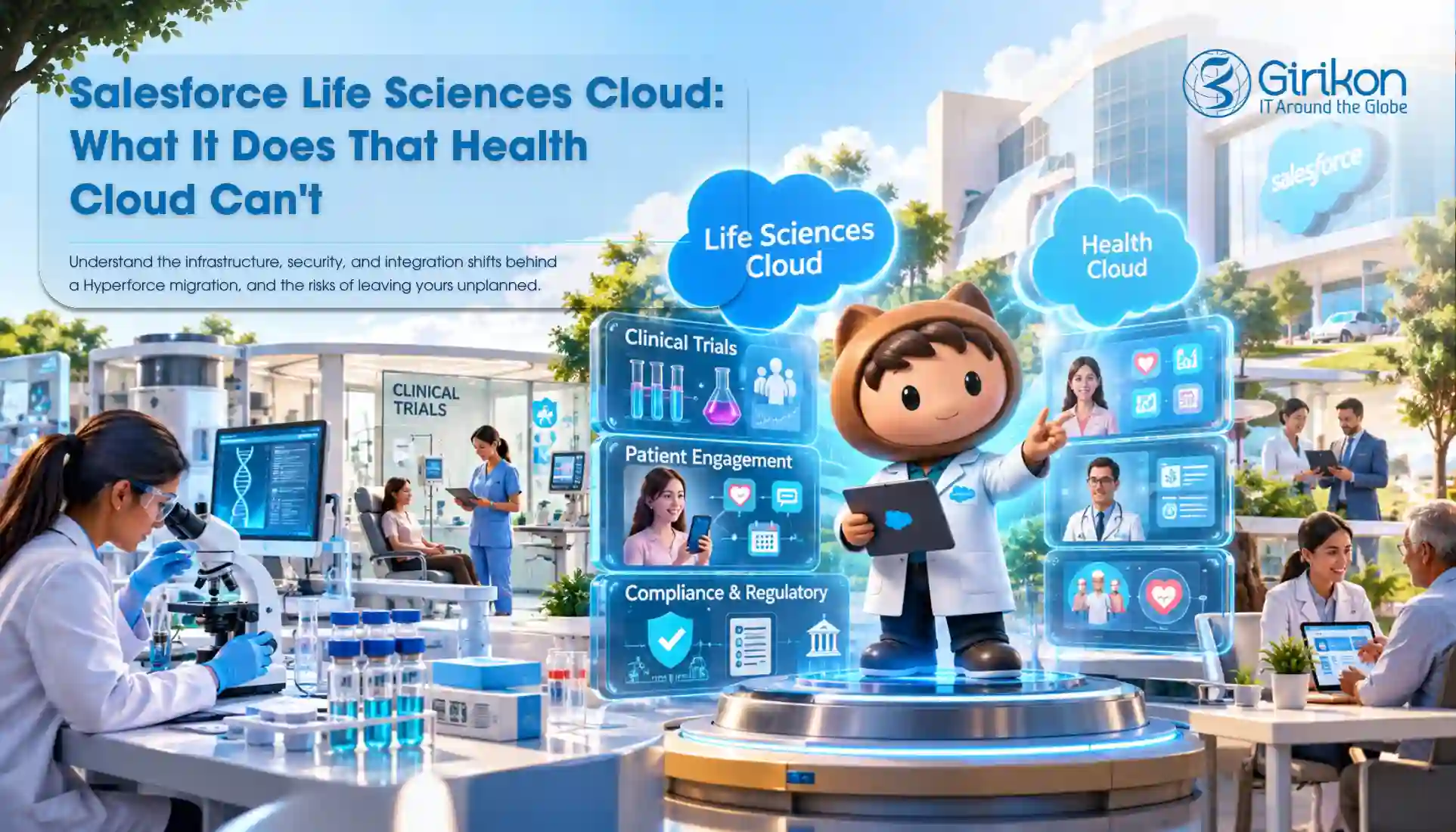
Salesforce recognizes the differences by providing two platforms that are designed specifically for both. The Salesforce Life Sciences Cloud covers all the processes needed to develop and commercialize therapies – recruiting people to the clinical trials, managing medical inquiries, field force planning, tracking samples, engaging HCPs, and managing access programs. It takes into account the specificity of the industry where research, scientific collaboration, commercial activity, and regulations are interlinked. Life Sciences Cloud combines these processes on the Salesforce platform, thus providing pharmaceutical and MedTech organizations with a platform tailored to their business processes.
What is Salesforce Life Sciences Cloud?
Salesforce Life Sciences Cloud is where pharmaceutical, biotech, and medical technology organizations run their commercial, clinical, and regulatory operations — on a platform built specifically for that industry rather than adapted from a broader one. It integrates industry-specific data models, regulatory processes, and AI capabilities in one system – designed for life science complexity, rather than a modified version of an already existing system.
Out of the box, the platform handles clinical trial site and sponsor relationships, patient identification and matching, Medical Science Liaison, MSL, call planning and document management, Healthcare professional (HCP) engagement and compliance tracking, sample management and traceability, medical inquiry routing and response workflows, and patient access program coordination — each as a native object rather than a custom configuration. Agentforce runs across these functions within regulated, auditable boundaries, handling adverse event triage, MLR workflow progression, and field force exception management without requiring manual oversight at each step.
Unlike Health Cloud’s patient-centered architecture, Salesforce Life Sciences Cloud is organized around the relationships and workflows that exist before a therapy reaches the patient — investigators, HCPs, payers, and commercial operations, each with its own compliance logic built in natively.
What Life Sciences Cloud Adds That Health Cloud Doesn’t
1. Clinical Trial Operations and Participant Management
Trial Site and Sponsor Selection
Selection of trial sites for Salesforce clinical trial management is based on the use of native performance metrics, such as rate of recruitment, protocol deviation history, and timeline of activation of the sites, which are stored within the Salesforce platform itself and not in any other clinical tool. The sponsor coordination takes place within the same environment where the coordination between sponsor and investigator site is taking place commercially.
Participant Recruitment and Auto-Matching
The AI-based auto-matching algorithm matches the participants’ profile against the inclusion and exclusion criteria set out by the protocol without any manual screening. The visibility of the recruitment pipeline, including the number of screened, enrolled, active, and withdrawn candidates, takes place in real-time from across all sites.
2. Medical Affairs and MSL Execution
MSL Efficiency
MSL activity has historically lived in a separate system from commercial, meaning the complete HCP relationship existed nowhere in a single view. Life sciences CRM in this platform manages MSL call planning, scientific exchange documentation, and congress activity inside the same HCP record commercial operates from. Medical affairs and commercial leadership see the same relationship history simultaneously — no integration layer required.
AI-Automated Inquiry Responses
If a medical inquiry is submitted, the system recognizes the relevant approved content, composes the response, which is to be reviewed by the specialist, and passes the response through the documented process. No manual recording is required at any stage throughout this process, and the complete record is ready to be used for auditing purposes by the regulator.
3. Commercial and MedTech Sales Planning
MedTech Commercial Operations
Account segmentation, product placement tracking, capital equipment sales cycles, and contract management operate natively within the platform. Territory planning uses AI-driven targeting that weights HCP and facility profiles against historical sales data — field deployment decisions driven by the same data measuring field performance, not sitting in a separate analytics environment.
Pricing and Rebate Management
Contract pricing, rebate calculations, and payer agreement management sit within the commercial data model. Pricing tiers and rebate thresholds link directly to account records — a field rep’s account view reflects current contract terms without a separate lookup, and finance gets accurate accrual data without manual extraction from a disconnected system.
4. Sampling Governance and Regulatory Compliance
Traceability and E-Signatures
Sample inventory is tracked at the rep level. Every transaction logs against the HCP recipient, enforces federal and state sample limits automatically, and captures electronic signatures at the point of delivery. Every record is timestamped, attributed, and audit-ready — what a DEA audit requires, and what a generic CRM logging samples against Contact records cannot reliably produce.
Embedded AI and Agentic Workflows
Salesforce Life Sciences Cloud embeds Agentforce directly into regulated workflows. Agentic automation handles adverse event triage routing, MLR workflow progression, and field force exception management — each within documented, auditable decision trails. Compliance boundaries are defined at the workflow level by regulatory teams. The agents operate within them.
5. Advanced Patient Services and Hub Programs
Holistic Patient Support and Hub Services. Hub services, patient assistance programs, specialty pharmacy coordination, benefit verification, and prior authorizations become an integral part of the solution. A hub program coordinator can see all patient details — eligibility, registration, specialty pharmacy fulfillment, and financial assistance — on one screen without switching between a hub solution, patient services platform, and CRM. This consolidates a function most life sciences organizations currently fill with a separate hub technology vendor, bringing patient services data into the same platform managing commercial and clinical operations.
Choosing the Right Platform for Life Sciences Operations
The difference between Life Sciences Cloud vs Health Cloud comes from the processes an organization is required to support. Health Cloud still has value in healthcare delivery, care coordination, and patient services. Life Sciences Cloud introduces more industry-related features such as clinical recruitment, medical inquiry management, field engagement, sampling, and commercial business operations. There is some overlap between the two, and it all depends on licensing and configuration.
The Veeva vs Salesforce Life Sciences comparison brings another advantage into focus. Veeva Vault CRM specializes in life sciences commercial engagement. Salesforce Life Sciences Cloud combines industry-specific capabilities with Salesforce’s wider platform, which can benefit companies already using its sales, service, analytics, and integration tools. That connection can make it easier to link commercial activity with other business workflows. Existing Veeva investments, migration costs, compliance needs, and content transfers still matter, but Salesforce’s broader ecosystem gives life sciences teams a compelling reason to consider it.
Conclusion
Life sciences has its own requirements for functioning, ranging from clinical studies and scientific collaboration to execution and patient management. Salesforce Life Sciences Cloud caters to all these requirements by integrating industry-specific functionalities in the Salesforce environment. The effect could either be big or small depending on an organization’s priorities and its processes. To some organizations, this may mean uniting fragmented teams, but for other organizations, it may mean adopting a platform that transforms their decision-making and information flow processes within the company. And both situations start with a single question: what is possible to do with connected life sciences operations?
About Author

Akanksha is a technical content writer with 3+ years of experience creating content for IT services, software development, and Salesforce consulting companies. She specializes in SEO-focused content, technical storytelling, and marketing assets that drive visibility, engagement, and business growth.
Share this post on: