 +1-480-241-8198
 +44-7428758945
 +61-1300-332-888
 +91 9811400594
The growing nature of retail network requires a degree of coordination that is difficult to achieve using traditional sales methods. Consumer goods brands cater to various types of retailers ranging from conventional retailers, modern trade, convenience stores, and emerging sales channels, each having its own distinct process for distribution, channeling, merchandising, and promotions.
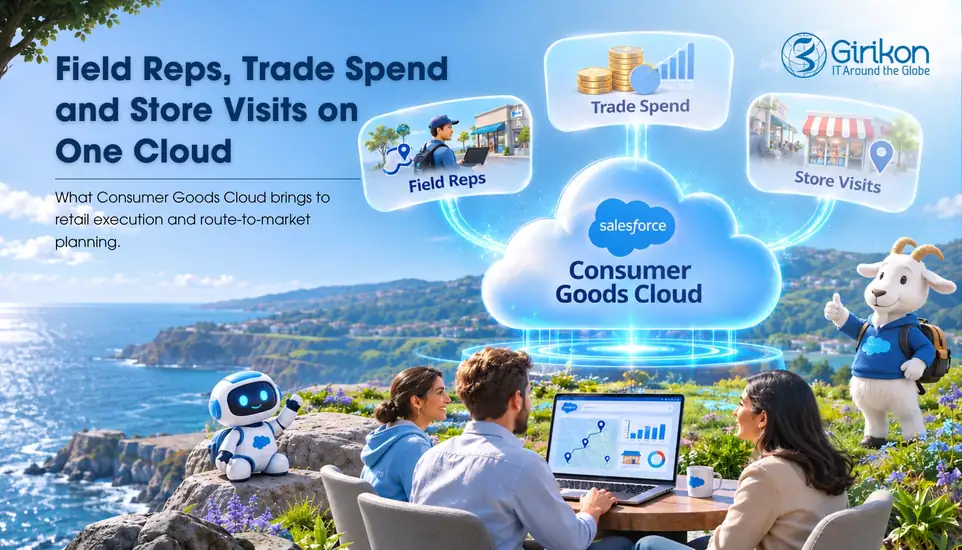
For the teams dealing with sales and trade marketing, the task is not just limited to achieving their sales targets but includes coordinating the distributors, arranging for store visits, checking on the availability of products, ensuring the implementation of promotions, and monitoring the performance of each individual channel. When these processes take place through isolated systems, the field data hardly ever gets to the decision-makers in time.
Salesforce Consumer Goods Cloud provides the required solution by bringing all these processes into one single integrated framework. In this blog, we will look at these capabilities, the technologies behind them, and how CPG companies can implement them.
The goal isn’t just hitting sales targets, but connecting planning, trade spend, and store-level execution into one system that reaches decision-makers in time.
What is Salesforce Consumer Goods Cloud?
Built specifically for the CPG sector, Salesforce Consumer Goods Cloud offers industry-focused capabilities to support businesses that produce and distribute everyday consumer products. It enables organizations to handle retailer relations, coordinate sales efforts, and link up commercial teams with the teams responsible for executing the plans at the retail level. The solution embeds industry workflows in Salesforce, providing a common view of the retail business for account managers, sales reps, and operations teams. The solution encompasses all stages of the sales cycle, including management of retail accounts, planning, and execution.
CPG companies sell their products through retailers or distributors, and therefore, the account would be the retailer, not the consumer. This is why a generic CRM solution fails here, which is why a CPG CRM Salesforce environment requires objects for stores, visits, promotions, and routes that are not shipped together with Sales Cloud. Salesforce Consumer Goods Cloud offers:
| Solution | What it does |
|---|---|
| Customer Planning and Forecasting | Sets volume, cost, and baseline targets per account |
| Trade Promotion Management (TPM) | Plans funds, promotions, and claims |
| Retail Execution | Plans store visits and captures in-store work |
| Consumer Goods Cloud for Sales | Aids in following up on orders, invoices, and promotions for account teams |
| Consumer Goods Cloud for Service | Handles retailer cases and requests |
Business Benefits of a Connected Consumer Goods Platform
Greater Self-Service and Enhanced Customer Trust
Retailers need rapid information on order status, availability of the products, and other requirements related to services. Connected service channels help in getting the information required without being dependent on the account manager for each piece of information. It is also useful in ensuring that all commercial information remains protected due to clear permissions at the level of accounts.
Enhanced Effectiveness of Trade Promotions
Promotion budgeting becomes simple when it is possible to compare planned activities with what happens in-store. The team is able to identify whether there are any missing displays or promotion problems that could affect the final results.
Better Leverage of Customer Investment
Investments of the customer include discounts, allowances for display, and other commercial incentives. It helps in deciding on activities that need more investment.
More Effective Field Execution
Reps can schedule their calls based on the need, value of the account, and actions that have to be taken. It becomes easier for managers to see what visits have been done and to resolve any execution issues faster.
Better Sales Opportunities
Observations at the store level can identify distribution issues, competitors, and possibilities to add new products. The link between these observations and the account information helps provide intelligence that can be utilized later by the sales team.
Core Features That Connect Planning with Execution
1. Trade Promotion Management (TPM)
Trade promotion requires budgets, retailer contracts, promotional tactics, product selection, and claims. Using different spreadsheets to manage such processes does not allow tracking commitments and understanding where the money was spent.
Salesforce trade promotion management manages promotion plans for customers and products. An account manager is able to create promotion plans, allocate budgets, set up promotional tactics, and claims. The data model behind such a process links promotion plans to budget and execution of these plans.
As an example, let us consider a summer promotion by a company producing beverages, which will take place via a nationwide retailer. The manager is able to specify the list of products, the duration of the promotion, and the budget allocated for it.
2. Retail Execution
Retail execution provides field reps with a methodical way to prepare for a store visit, complete their activities, and document what goes on at the store.
One may have to check product availability, shelf arrangement, auditing, conducting a survey, or verifying promotional setups. All of this can be done using mobile workflows, as managers track store visits and store performance.
Salesforce allows one to schedule visits, make templates for them, and optimize routes. Salesforce Maps allows one to plan store visits geographically, and account priorities and frequency of visits dictate whose stores need visiting. The properly set up retail execution Salesforce solution links all those processes to account plans and promotions.
3. Consumer Goods Data Model
It is crucial to select the right data model, as it may affect the way Salesforce handles retail account management, product management, territory management, visit management, order management, promotions, and other processes.
Different data models for Consumer Goods in Salesforce include, for example, the Enhanced Platform Data Model for Retail Execution and traditional managed package data models. It is essential to assess the existing Salesforce solution before selecting the approach to implement it, especially if the organization already implements some elements from Consumer Goods Cloud.
System ownership should be addressed as well. The ERP system may be the system of record for inventories, pricing, invoices, and deliveries, while Salesforce maintains relations with customers and activities of salespeople. The two systems may be integrated using an API or middleware in order to synchronize only the necessary information.
4. Omnichannel Service Capabilities
Retailer relationships extend beyond sales visits. Retailers might require assistance due to order delays, pricing issues, return processing, stock-outs, or false promotions.
Service capabilities within Salesforce allow teams to handle such issues by opening a case against the respective account and transaction. The service representative who is handling the issue regarding delayed delivery will be able to review the account and get details of the order from ERP by integrating with that system.
Agentforce capability can come in handy by assisting the user in retrieving the required information, summarizing the interaction, and performing any action that is authorized.
Conclusion
The effectiveness of the route-to-market strategy of a consumer goods company relies solely on how well it is implemented within the retailers, distributors, and stores. Salesforce Consumer Goods Cloud provides a way for a business to integrate its commercial planning with field activities, marketing spend, orders, and partner services.
When a business is considering using the platform, the first step would be mapping out the existing route-to-market process before choosing any features or building any integration. Girikon is a solution that allows consumer goods companies to evaluate Salesforce architecture and build industry workflows.
About Author

Akanksha is a technical content writer with 3+ years of experience creating content for IT services, software development, and Salesforce consulting companies. She specializes in SEO-focused content, technical storytelling, and marketing assets that drive visibility, engagement, and business growth.
Share this post on: