
 +1-480-241-8198
 +44-7428758945
 +61-1300-332-888
 +91 9811400594
Salesforce was intended to minimize unnecessary costs, excessive discounts and breaches of policies. However, at times, the transition of approvers to different job positions, strict enforcement of approval policies, or approval via outdated channels causes Salesforce to lose its original purpose.
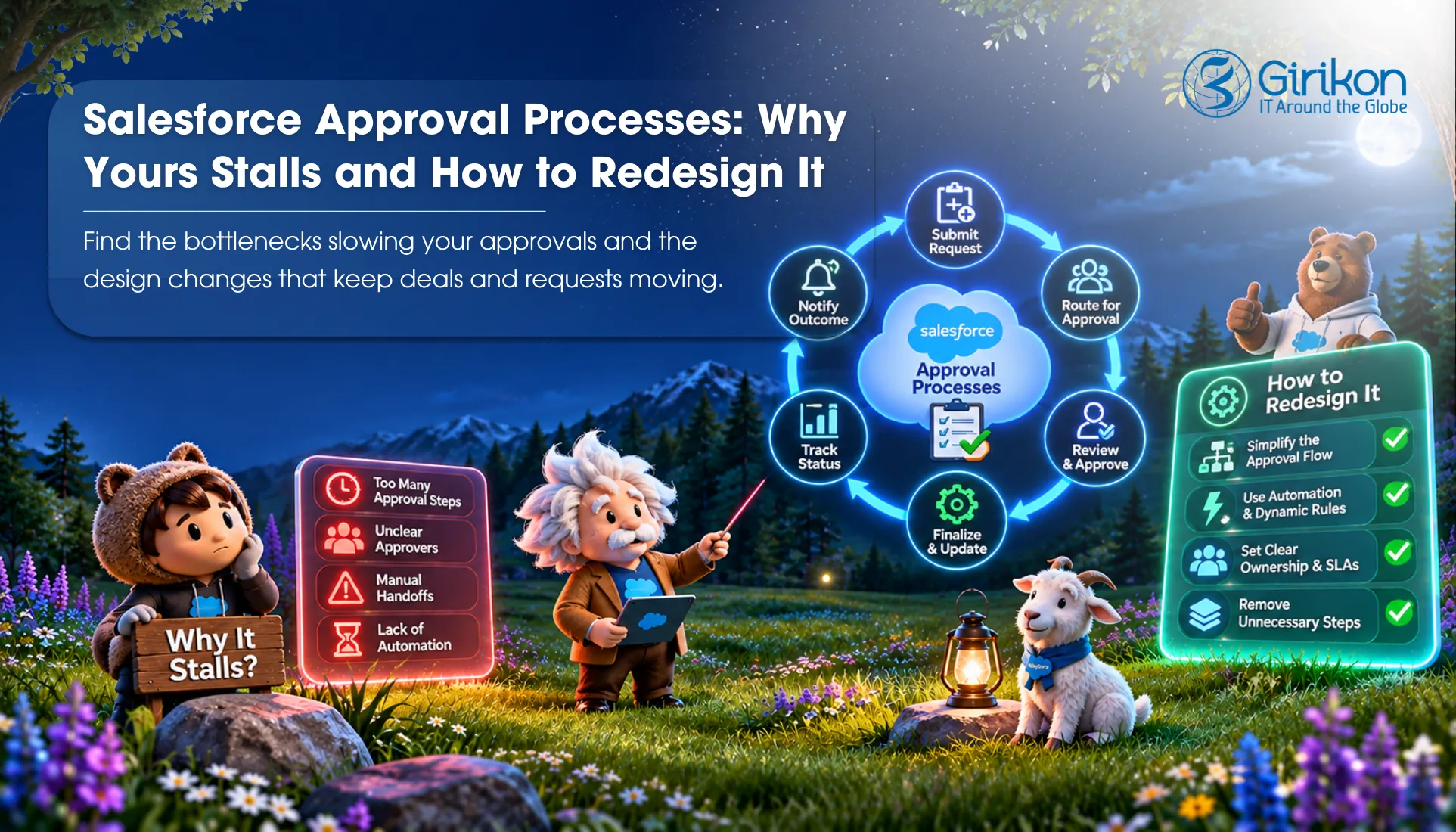
It is important to realize that the number of approvals is not what matters most, but how the requests are processed by the individual, how decisions are made, and what is being done if the situation gets out of control. This is when one should consider using the Salesforce approval process and making sure it is compliant with flexibility without impairing accountability.
Salesforce Approval Process Explored and Why Organizations Use It
Salesforce eliminates the need to email people or fill in spreadsheets while ensuring smooth process of forwarding records for approval. Organizations are now able to set rules for requesting approval, give suggestions on circumstances for the request for approval and take follow-up actions.
To illustrate, suppose a representative of sales applies to receive a discount of 15% on an opportunity. A system can be designed with a function that sends the request immediately to a sales manager. In the case that the amount of the discount surpasses a certain limit, a request is moved to the financial division or the regional director.
The approval process Salesforce can include the following components:
- A set of conditions that define the compliance of the record for approval.
- A list of users in charge of requests.
- The stages of approvals that a record undergoes during the approval process.
- Modifications done to tasks or alerts after the document was approved, rejected, recalled, or submitted.
For this reason, the approval workflow is helpful for any department but particularly useful for a sales department. Besides its use within sales, the approval workflow can also support a number of processes in the sphere of finance, procurement, operations, and Human resources. The approval workflow can be viewed as a monitor for commitments in a company.
Typical Problems with Your Salesforce Approval Process
The following are just a few examples of design issues that will gradually transform your straightforward approval process into a tangled web of dependencies:
Too many approval steps one after the other
No matter what the value, the risk and the impact on the business, certain companies approve everything through the same approval hierarchy. Requesting approval for a $500 expenditure would go through the exact same approval process that all $50,000 or greater purchases do, potentially slowing the business down and burdening senior reviewers.
Inflexible approval criteria
Business requirements change as companies evolve. For instance, a business may have changed its expense approval policies or discount thresholds. But legacy approval systems are rule-based. They might require administrators to modify approval rules whenever a business policy changes.
Restricted clarity on open requests
Without proper approval history tracking, administration and management can find it hard to tell who owns a request at the moment, where the request is “stuck,” and how long the request has been waiting.
How Much is the Real Cost of the Salesforce Approval Process Delay
A delay in approval doesn’t just impact one individual. It can disrupt a number of aligned business processes. Take a sales team who has submitted a customer discount for approval. There are a number of things the representative is unable to do until the request is approved, sharing the deal proposal, closing the deal, setting the price. The effects can ripple across organizations and cause:
- Reduced employee productivity when employees and managers spend time chasing approvals.
- Compliance concerns due to inconsistent approval practices that make it difficult to demonstrate that the right people authorized important transactions.
- Lost revenue opportunities with delayed pricing approvals give competitors an opportunity to close the deal first.
- Operational backlogs caused by accumulated service requests, expense claims, and pending purchase orders.
- Dissatisfied customers receive a longer waiting time for refunds, quotes, decisions related to service or alterations to their contracts.
Early Indicators of Backlogged Approvals
Approval bottlenecks tend to form a series of small inefficiencies that become more prominent as volumes ramp up. Keep an eye out for these red flags:
- Admins commonly resolve routing issues, re-route a request, or take over for an approver.
- Sales Teams keep their own tracking spreadsheets, which makes it difficult for employees to read the approval status in Salesforce.
- Easy approvals are often bogged down in multilayered chains, and low value transactions often get the same scrutiny as high value or high-risk decisions.
- Having to make large manual adjustments for each shift in reporting or spending policy makes the design very rigid.
- Managers are unable to discern who turned down or granted the request, the time the response was provided.
- When specific managers regularly build high approval backlogs, the routing structure might be allowing too many approvals to be made by a small group of individuals.
The reasons why Classic Approval Designs do not Evolve
Salesforce Classic Approval processes allow you to approve records as they pass through approval steps, automate actions, assign entry criteria and a group of assigned approvers. However, with more dynamic business requirements, such designs don’t tend to scale well.
For instance, a company creates an ease of approval sequence.
Sales Representative – Sales Manager – Regional Director
- Organizations slowly adopt new standards.
- International transactions need a regional compliance review.
- Finance approval is required for any request over $10,000.
- Any discounts over 25% will require Executive approval.
Adding more such criteria to a multi-step approval Salesforce setup may further increase the configuration workload. That is the place where Flow Approval Processes are available in a position to be thought about. Flow Approval Processes, in contrast to the traditional approval processes, utilize steps, levels, selections, and associated flows to allow extra versatile approval of coordination.
Salesforce Approval Process Bottleneck Troubleshooting
Assess Past Approval Routes
Look to find out what user jobs are simply no longer appropriate, exactly what approvals are repeated, what models of link there are, and exactly what types of entrance standards have become impeded.
Set Dynamic Approval Assignment
Just imagine applying the idea of a hierarchy of managers, teams, or flow-based routing to automatically assign requests. Use dynamic approval assignments, so that requests are assigned to the appropriate approvers based on changes to your organization’s structure.
Approvals Driven by Conditions
You can automate approvals in your organization based on conditions, such as discount given, amount of transaction, and risk.
How Should You Design Salesforce Approval Process for Volume Growth
To allow growth in your business with a scalable approval process in Salesforce consider:
Approvals driven by Rule
Do not hard code employee names within approval processes. Instead, ensure that your approvals are driven by the right people using org roles, queues, hierarchy and assignment rules. Even if employees change team/role, this process will continue as expected.
Use Approval Flows
If your approval process has conditions, complex automation in the background, different departments involved, or multiple parallel evaluations, using an approval flow will provide more flexibility. Approval flows allow you to break down processes into steps, decision points (to choose actions from multiple options), and related processes/flows.
Consider Realistic Scenarios
Before making changes to your approval process, it is important to think about some realistic scenarios in which your approval process may occur. Consider:
- No approval owner set.
- Request qualifies for multiple approval conditions.
- This record is re-submitted and rejected.
- Approval requirements have been turned on/off at different points in the process.
Transparency and Accountability
Within your design, you should be careful to track important information, such as who has approved, when records were submitted, why they were rejected, or are still pending. This will allow you to identify issues causing delays and assign busy approvers appropriately.
Avoiding Automation in Approval Procedures
Not all tasks require a human touch. For approval routing automation purposes, processes like sending out notifications, updating a record status, and triggering other processes should be automated. However, only those tasks that require a person to perform them should require approval at the same time.
Summary
With a well-designed Salesforce implementation, you can avoid delays in approvals and implement smooth processes to allow your business to scale. At Girikon we can support you in designing scalable automation processes to optimize your Salesforce processes and meet ever changing goals. Contact our Salesforce automation experts today!
About Author

Shivani is a Technical Content Specialist at Girikon with deep expertise in turning intricate technologies into engaging narratives. Her renowned experience and keen interest in technologies allows her to draft compelling and digestable insights for tech-savvy leaders. She helps businesses navigate the labyrinth of innovation, leveraging her proficient skills and visionary attitude.
Share this post on: