 +1-480-241-8198
 +44-7428758945
 +61-1300-332-888
 +91 9811400594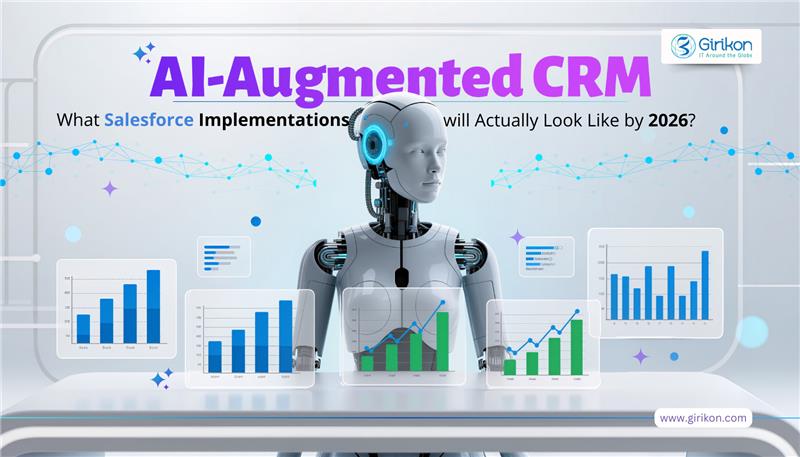
With the CRM market having reached a revenue of $98.84 billion in 2025, the embracing of AI and big data is expected to rise by 97% by 2030. This will drive intelligent insights and automation. Salesforce – a robust cloud-based CRM system has positioned itself as “the AI-powered CRM” through Data Cloud, Einstein GPT and a suite of agentic features that are accelerating that shift.
Let’s explore the trends in AI-augmented CRM, and how it will impact the customer relationship management landscape.
What is AI-enabled CRM?
AI-enabled or an autonomous CRM is a CRM that has raised its bar from being a recording tool to a CRM that can act. Besides detecting opportunities, managing cases, drafting tailor-made interactions and generating approvals, an AI-powered CRM can create multi-system workflows with no to very little human intervention. This self-sufficiency is powered primarily by generative AI for language, unified customer data, and arrangement layers that systematize actions across systems.
How AI-enabled CRM Functions?
AI-augmented CRM gathers humongous amount of data, which generates smart insights on being analyzed. These insights can help organizations sort customers, anticipate their behavior, and personalize experiences, enabling organizations to augment efficiency, boost productivity while ensuring long-term growth.
Listed below are some shifts that will become obvious in Salesforce implementations by 2026:
From Advice to Action: CRM systems that were earlier designed to perform simple automation tasks, and predictive lead scoring have now been transformed into robust agentic systems that can handle complex workflows. With a clear momentum around Einstein 1, GPT and Agentforce, Salesforce indicates a future that will introduce agents that can manage multiple tasks, i.e. from basic to complex ones. Rather than operating in silos, these agents will be intensely connected to Customer 360 cloud and transactional systems, ensuring actions are data-driven, as well as completely assessable. Entrepreneurs can train agent playbooks, which set restrictions on what agents can perform and where human consent is required. However, in-built tools are required to train such agents using unique prompts and integrate them into existing workflows.
Single Source of Truth for AI: The data that powers Generative AI plays an extremely crucial role in how effective it is. With Salesforce’s strong focus on integrating data cloud with AI ensures increased ingestion of data, resolution of identity and deliberated schema design. In truth, data management is indeed a time-consuming part of a CRM project and involves connecting backend systems, refining identity matches and providing administered set features to models to ensure precise and reliable output. This will enable architects to spend more time and effort creating data connectors and stores rather than configuring page layouts.
Building Low-code Tools: Low code tools such as App builders are expected to offer competences such as generative AI prompts, agent behaviors and more. By leveraging Einstein 1 and builder tooling, Salesforce is empowering admins to associate prebuilt AI skills with business data. This enables the creation of personalized email creators, service responses drafted by default, and dynamic product suggestions without the need for deep expertise in data science. This will empower teams to model AI-enabled workflows in just few weeks although deployments will continue to rely on operations, thorough testing and regular tracking.
Trust Can’t be Negotiated: With Salesforce strengthening support trust across Einstein GPT, implementations will include built-in interpretability whenever agents produce output that impacts customers. All-inclusive assessment trails specifying prompt versions, data inputs, and resulting activities will become compulsory, especially in regulated sectors where disputes and compliance checks may arise. This ensures a change management process that addresses how agents cater to users with compliance and support teams offering support from the outset.
Governed Personalization: True hyper-personalization becomes possible when Generative AI is paired with integrated customer profiles. However, organizations won’t allow unrestrained personalization. Rather, personalization will be driven by policy. Adequate usage of data will be programmed into the data model and imposed through the trust layer of Salesforce’s AI. This ensures that sensitive characteristics are excluded by default from some prompts. This approach capitalizes on commercial effect while protecting privacy and compliance. This will enable sales and marketing teams to gain rich content while compliance teams will have to adhere to stringent templates, compliance gates and more.
Focus on Agent Value: Measuring CRM performance is no longer limited to standard KPIs such as pipeline value or record volume. Organizations will now be able to track AI-powered metrics such as acceptance of generated content by customers, time saved by agents, and how often humans dominate AI suggestions. Dashboards amalgamating Tableau and real-time AI monitoring will turn these insights achievable. This shift is enabled by Salesforce’s AI and analytics approach. The parameter of success will now be determined by quicker resolutions rather than just feature releases.
Multi-model by Design: Organizations would no longer stake everything on a single model. Rather, Salesforce CRM implementation with AI will merge multiple models. For instance, proprietary models for sensitive data, third-party ones for generative ingenuity, and vertical models for unique domain tasks. A unified trust layer will direct requests to the right model. With Salesforce already offering multiple model providers under a shared framework, this approach is expected to become mainstream by the coming year 2026. With this, teams have to assess the cost, risk associated and performance of every model. Operation teams will also require guidelines for routing and emergency suggestions.
Privacy & Security are Non-negotiable: In 2026, teams will have to treat security and privacy as the primary aspects of core architecture due to mounting regulatory pressure. Implementations will mandate data minimization, filter what goes in a model, and policies for retention. With regulations and emerging AI laws, organizations will have to provide impact and risk assessment, and data lineage for all AI workflows. Such a roadmap forestalls these demands. This will ensure why teams prioritize privacy constraints while designing their object model.
Final Words
In 2026 and beyond, Salesforce will evolve from being just a tool for keeping track of customer interactions to a decision-making engine. From integrating AI models and data to enabling teams to create actions that drive value. With Data Cloud, Einstein GPT, Einstein 1, governance layers etc., creating the foundation, enterprises are gradually moving from pilots to large-scale deployments. In fact, AI should be central to any Salesforce program. To unlock meaningful outcomes, make sure to design your data strategy, operating processes and governance around agent-enabled decisions. To avail Salesforce CRM implementation in USA, make sure to partner with a reputed Salesforce partner like Girikon.
About Author

Jaya is a content marketing professional with more than 10 years of experience into technical writing, creative content writing and digital content development. Her decade long experience lends her the ability to create content for multiple channels and across different technology verticals.
Share this post on: