
 +1-480-241-8198
 +44-7428758945
 +61-1300-332-888
 +91 9811400594
A buyer requires 80 tons of steel before the next production process; the quote is three days old, and the delivery window is uncertain, while the account manager is dealing with two other high-priority cases right now. The buyer does not want to know about the discrepancy between the system used by the inventory department, the system used by the salespeople, and the recent conversation in the CRM activity stream.
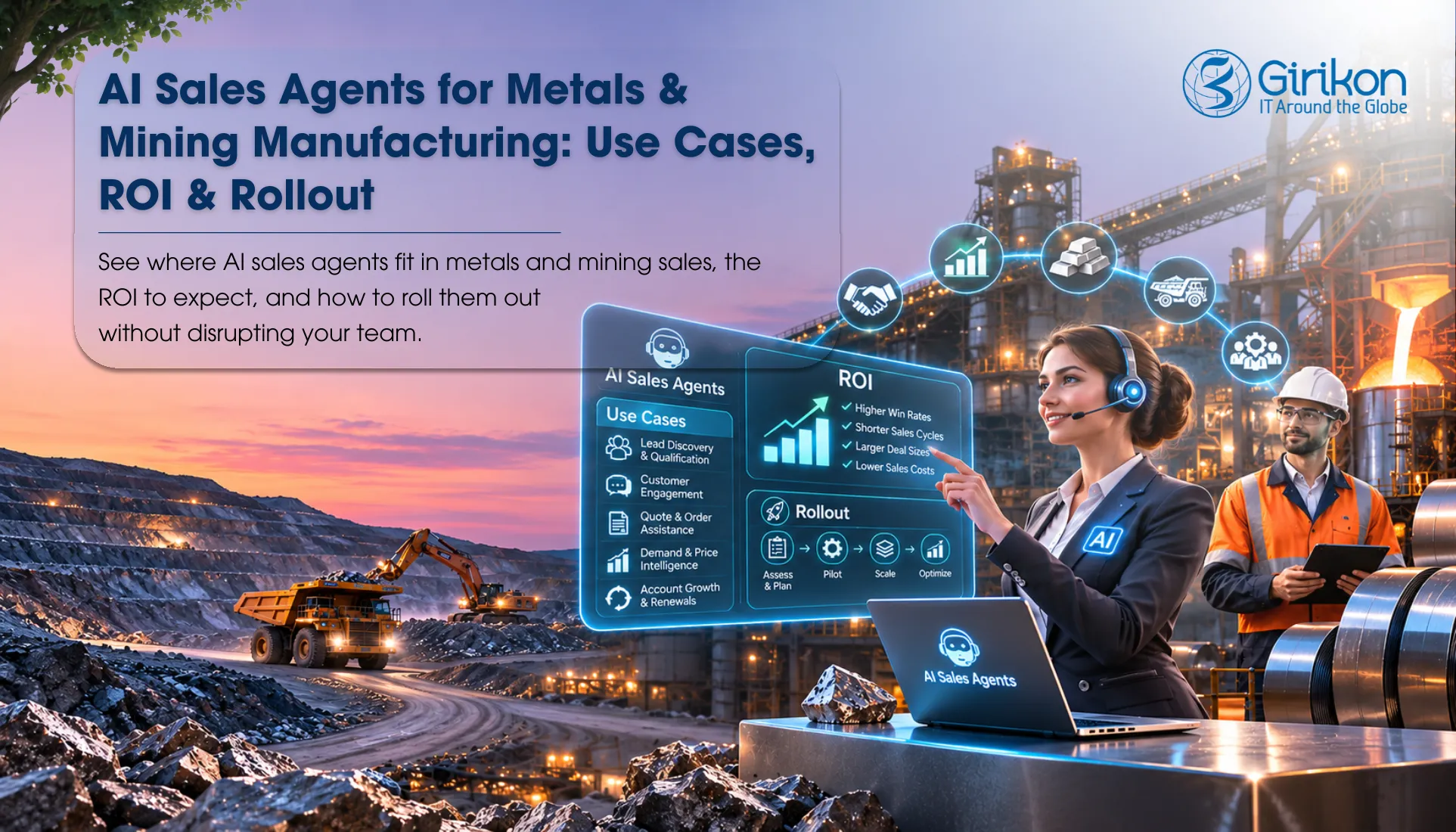
In metal and mining manufacturing, that time lag from customer inquiry to response could be costly. AI agents for manufacturing sales can provide an answer with their capability to retrieve approved information, deal with mundane inquiries, and move the task along in the workflow. Their usefulness, however, goes beyond just communication skills. They need to function within the systems that determine pricing, inventory, orders, and customers’ obligations. This is where the implementation choice begins to matter.
The Importance of Context in Metal and Mining Sales
An individual requesting steel coils, copper cathodes, or drilling equipment replacements may not necessarily just want that. The product requested may be subject to various criteria like grade, volume, pricing, delivery locations, inventory, or even sales contracts. A conversational and knowledgeable agent that lacks this context may give a quick response that will result in significant problems.
That is why there should be an AI in metal and mining sales based on business processes. It should have the capability to collect data regarding customer requirements, access information about available products, and find missing links. It should not provide non-existent items, discounts, or deadlines without reason.
Use Cases That Move Sales Forward
1. Filter Potential Customers Even Before Salespeople Get in Touch
A purchase request for bulk steel, industrial equipment or mining machines might have been initiated by either a buyer who wants to make a purchase or just somebody looking for quotations. It is essential that the salespeople realize which one of these cases they are dealing with since it is necessary that they don’t spend their time in vain. AI agents for manufacturing sales can provide information about quantity needed, requirements, delivery location, purchase timing, and budget of the inquiry and compare it with qualification standards. The AI agent will be able to route the qualified inquiries to the appropriate salesperson and alert them about those that require more work.
2. Check Quotes That Have Become Stalled
Quotations might get delayed due to the need of the client for approvals or comparing suppliers as well as in case of any changes in demand. This may result in losing the deal. AI in metals and mining sales workflows helps identify quotations that have been put on hold and then determine their status in the CRM and proceed further depending on particular conditions. It may be decided that the representative should send an email, verify the specifications and quantities or notify the account owner about making personal contact.
3. Maintain Repeat Order and Contract Requirements
Manufacturing organizations have the tendency to sell via repeat orders, pricing agreements, or other contract conditions based on volume or timing requirements. Any new order must first be compared to existing agreements before confirming the order specifics. Using Salesforce Manufacturing Cloud with order or ERP system data can help agents assist in reviewing account history, contract terms, past quantity sold, and order details. Approval of any sort or next actions for the representative could be generated through this procedure. Nevertheless, price and delivery terms should comply with company policies anyway.
4. Convert Service Discussions into Meaningful Sales Opportunities
The individual who contacts the company about getting another part, a piece of equipment problem, or maintenance services may actually have a need for a purchase. This could be easily overlooked in case the service and sales transactions operate independently from each other. As part of our exploration of how AI impacts the manufacturing sales process, we could analyze how AI automates this process. The first step involves an intelligent system identifying the product or part that is the subject of the discussion, as well as the client’s account history. Once the system detects the potential for a sale, it then creates a CRM entry for that particular sales lead, and then transfers it to the sales team member responsible for managing that client. As part of sales automation, the use of AI also helps the sales team manage and optimize their CRM, leading to better sales tracking, customer relationship management, lead qualification, and a higher level of sales team productivity.
ROI: Value More Than Quick Responses
How valuable the results will be depends on what happens in the sales process after the introduction of AI technology. Less time spent answering questions can be used to take care of more important customers only if the freed time is used effectively. More orders, fewer mistakes in follow-up, and a cleaner CRM database could also serve as evidence of success.
The performance of the team before implementing AI needs to be estimated first. The number of minutes it takes to process an inquiry, the percentage of inquiries that become qualified leads, the percentage of quotes that result in orders, and customer response time need to be measured. This way, the company will have a point of comparison when evaluating the results.
Rollout: Start Small, Prove the Workflow
It is difficult to find out what works and where mistakes happen with an extensive deployment. It would help to have a more limited pilot project for the team to understand better how to assess the value of the agent as well as the surrounding controls. The Agentforce for manufacturing will facilitate configuring agent processes within Salesforce based on the available licensing and implementation. The possible first use case will be qualifying incoming leads or following up on outstanding quotes.
Firstly, it should be decided what kind of decision is being made and what information is needed for this purpose. Salesforce will store account ownership, lead data, sales stage, opportunities and sales activity. ERP will know current prices, stock levels and order status. The integration middleware and API tools can ensure the integration of those systems, while Salesforce Flow can facilitate the orchestration of the process and approvals.
Test for bad input data, stale information, inconsistencies and bad integrations. Smooth workflows rely on efficient salesforce integrations and accurate information flow across systems. The pilot tests should be for a specific team or product. Success metrics will include a performance comparison, a review of escalations and poor decisions, and collection of user feedback. Further testing should occur once the results show the processes achieve the intended results.
Where Does Salesforce Consulting Come In?
B2B manufacturing sales AI agents can recognize opportunities for sales and increase the speed of routine tasks, but they have a business potential that depends on their compatibility with the current Salesforce platform of the organization. The manufacturers require an implementation strategy that integrates AI into their sales processes seamlessly. A Salesforce consultant can evaluate your current business environment and understand how ERP and telephony systems can be integrated with Salesforce. As a certified Salesforce implementation partner, Girikon helps businesses enhance Salesforce functionality through customized implementation, seamless integrations, AI adoption, and ongoing technical support.
Conclusion
In metals and mining, for instance, a fast response is good if the information on which the response is based is reliable. Artificial Intelligence (AI) solutions can take some of the burden of the administrative aspects of selling in the mining and manufacturing sectors off sales representatives and give them the opportunity to focus on sales. It is necessary for companies to collaborate with trained Salesforce consultants for proper data access control, the definition of permissions, and for secure AI agents. As businesses begin the process of making AI more accessible, they should carefully review and evaluate the results and only then extend access.
About Author

Akanksha is a technical content writer with 3+ years of experience creating content for IT services, software development, and Salesforce consulting companies. She specializes in SEO-focused content, technical storytelling, and marketing assets that drive visibility, engagement, and business growth.
Share this post on: