 +1-480-241-8198
 +44-7428758945
 +61-1300-332-888
 +91 9811400594
Imagine it’s six months after your Salesforce go-live — yet your sales team is still exporting spreadsheets, pipeline data is incomplete, and the “Salesforce partner” who promised a seamless rollout has stopped returning calls. The platform that was meant to accelerate growth has become another expensive system your teams avoid — this is the risk of choosing a vendor for a convincing pitch rather than proven implementation capability.
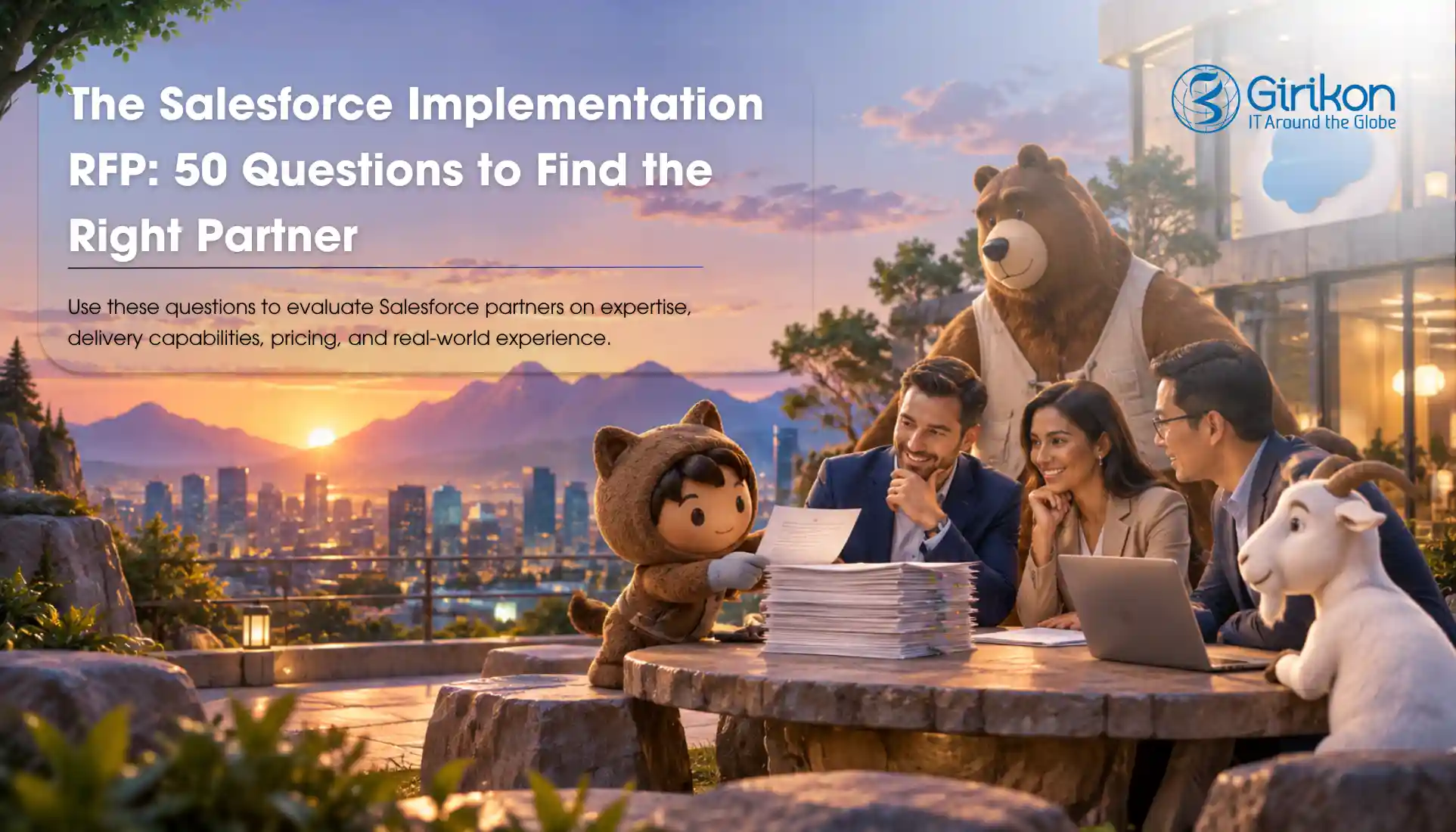
A Forrester Consulting study commissioned by Salesforce found that 60% of surveyed decision-makers said their organizations were not getting the expected or full value from their existing Salesforce deployments.
So, the question comes in: how to choose an appropriate Salesforce implementation partner that will assure its deliverables?
A well-structured Salesforce RFP template helps you look beyond promises. In this guide, we’ll cover 40 questions to help you assess a partner’s delivery expertise, integration capabilities, project governance, and post-go-live accountability—so you can distinguish capable implementation partners from resellers.
What You Must Include in a Salesforce RFP Template
The template for a Salesforce RFP should contain enough information regarding your company, existing systems, and project needs so that the partners can make the right proposal that would allow for generating equivalent bids.
There are six key sections that need to be included in the Salesforce implementation RFP template:
Company/Project Overview:
Provide details about your business, its industry, existing CRM system — and the issue that needs to be resolved using Salesforce.
Objective/Requirements:
Specify your objectives, Salesforce features required — and the changes in the process to be implemented.
Technical Environment:
List the products of Salesforce used by — your company, as well as your software/data integration requirements.
Budget/Timeline:
Indicate budget — time frame for starting the operations, and costs involved.
Vendor Qualification:
Request the vendor’s past project experience, references, delivery team for the solution and any case studies similar to yours.
Proposal Evaluation:
State what you expect from each partner with regard to proposal submission period, pricing, evaluation of proposal and presentation of approach and limitations.
Tips for Practice: Send the RFP to all the partners you are considering and ask them to reply similarly. This will make it easier to evaluate their proposals, delivery capabilities, schedules, and prices without the need for sales pitches.
Now that the RFP structure is defined, you can use the following 40 questions to test each vendor’s ability to fulfill your needs and implement the solution effectively.
What to Look for in a Business Partner before You Issue an RFP
An RFP allows you to compare various vendors — but selecting the right business partner involves more than that. See what to consider when evaluating a Salesforce partner before making your decision.
Why Choose Us!40 Questions to Ask a Salesforce Consultant Before Choosing an Implementation Partner
Integrate the following set of questions into the Salesforce implementation RFP — which will enable you to judge beyond the certifications and the sales pitch. These responses will aid you in comparing experience in implementation, technical skills, delivery of the project, pricing, and support.
Company Overview and Partner Experience
- How much experience do you have in implementing Salesforce projects?
- How many Salesforce-certified personnel (consultants, architects, and developers) do you have — working for your company?
- What is your current partner status with Salesforce — and what is your specialization?
- Do you have any case studies on similar Salesforce implementation projects — that you can share with us?
- How would you ensure — project continuity in the event of any member of the project team leaving the project?
- Do you have any subcontractors or offshore personnel — within your team?
- Are there any references from similar projects performed by you for your clients?
- Who will manage our project — and how much experience does he/she have in this field?
Project Scope and Functional Requirements
- Which Salesforce products do you recommend for our requirements — and why?
- How will you map our business processes to standard Salesforce features — before recommending customizations?
- How will you configure workflows, page layouts, and user experiences — for different teams?
- How will you address our specific sales, service, or customer management processes — and align them with our business needs?
- How will you design reports and dashboards — and use them to measure our business goals?
- How will you ensure Salesforce works effectively for desktop and mobile users —and across different work environments?
- How will you support user training and adoption — before and after go-live?
- What system configuration and technical documentation will you provide — and how will these support future maintenance?
- What deliverables will we receive at each project stage — and how will they be documented?
- How will you confirm that the solution meets our requirements — and validate it before launching?
Technical Architecture and Integration
- How will you integrate Salesforce with our ERP, marketing automation, billing, and other business applications — and other business applications?
- Which integration tools or APIs would you recommend — and why?
- What is your data migration strategy?
- How will you manage development environments — testing, and production deployments?
- Which tools will you use for version control and release management?
- How will you assess the impact of Salesforce releases on our customizations and integrations?
Security, Compliance, and Governance
- How will you configure user permissions and record access to protect sensitive data?
- How will you address the security and compliance requirements relevant to our business?
- How will you — protect data during migration, integration, and everyday use?
- How will you document and review access permissions and security-related changes?
- Which security responsibilities will your team handle — and which will remain with us?
Implementation Methodology and Timeline
- Which implementation methodology will you follow — and why is it suitable for our project?
- What are the major project phases, milestones, and estimated timelines?
- How will you manage scope changes — and their impact on costs and deadlines?
- What time commitment and resources will you need from our internal team?
- How will you communicate project progress, risks, delays, and pending decisions?
- How will you conduct user acceptance testing and confirm readiness for launch?
- What is your backup plan for go-live issues — and what immediate post-launch assistance will you offer?
Pricing, Licensing, and Ongoing Support
- Which Salesforce licenses, third-party tools — and recurring fees will we need to pay separately?
- How will you price change requests and additional requirements?
- What post-launch support do you offer — including issues of severity levels and response time commitments?
- What is the estimated three-year total cost of ownership — including implementation, licenses, support, and maintenance?
How to Evaluate Responses with a Salesforce Partner Evaluation Scorecard
A Salesforce partner evaluation scorecard enables you to evaluate proposals according to similar criteria — rather than select partners on the basis of cost or presentation alone. Adjust the weights below to fit your project needs.
| Evaluation criteria | Recommended weighting | What to evaluate |
|---|---|---|
| Salesforce expertise and experience | 15% | Credentials, partner certification, and previous experience |
| Technical expertise | 25% | Solution design and knowledge of your business needs |
| Delivered delivery team | 20% | Experience of the assigned consultants |
| Methodology and project management | 15% | Milestones, testing, and risk management process |
| Data migration and integration | 10% | Data migration plan and integration process |
| Support after launch and total cost | 15% | Support terms and costs |
| Total | 100% |
Swipe to see the full table →
Score each proposal
Criterion ratings should be done based on the given information on a scale of 1 to 5 — then multiply it by its weight using the formula (Rating / 5) x Weight.
Before you make a decision — make sure that the qualifications of your partner are okay, get in touch with your client’s references and also see to it that the recommended team will handle your project.
Red Flags to Watch for in Salesforce Implementation Proposals
A thoroughly professional proposal might still miss vital risk factors —that you must watch out for prior to choosing your Salesforce provider:
The scope of the project is vague:
No deliverables, exceptions — or responsibilities have been stated.
The project schedule is unrealistic:
There is insufficient time provided for — testing, migration, and training.
The price is unclear:
There is no information on pricing related to — customization, integration, licensing, and support.
Unproved experience:
The partner cannot establish experience with Salesforce by providing references.
Unidentified delivery team:
The proposal does not specify who will be responsible for the project delivery.
Lack of post-go-live support:
There are no details on support terms, SLAs, or maintenance responsibility.
Compare those risks with the results of your Salesforce partner evaluation scorecard and RFP responses to make your final decision — you can also refer to our guide that talks about the process of Salesforce Implementation Partner Selection.
The Ending Note
Finding the best Salesforce Implementation Partner begins with — asking the right questions and comparing every proposal with your business needs. You could assess any potential Salesforce implementation partner with an efficient Salesforce RFP, a thorough scoring system, and a proper assessment of the project’s scope, cost, and support.
You could use this Salesforce RFP sample when looking for a suitable Salesforce Implementation Partner.
About Author

Sakshi specializes in creating high-quality, SEO-driven content focused on Salesforce, CRM, and business automation. She writes blogs, landing pages, solution pages, case studies, and thought leadership content that simplifies complex Salesforce concepts, highlights business value, and helps organizations make informed CRM decisions.
Share this post on: