 +1-480-241-8198
 +44-7428758945
 +61-1300-332-888
 +91 9811400594
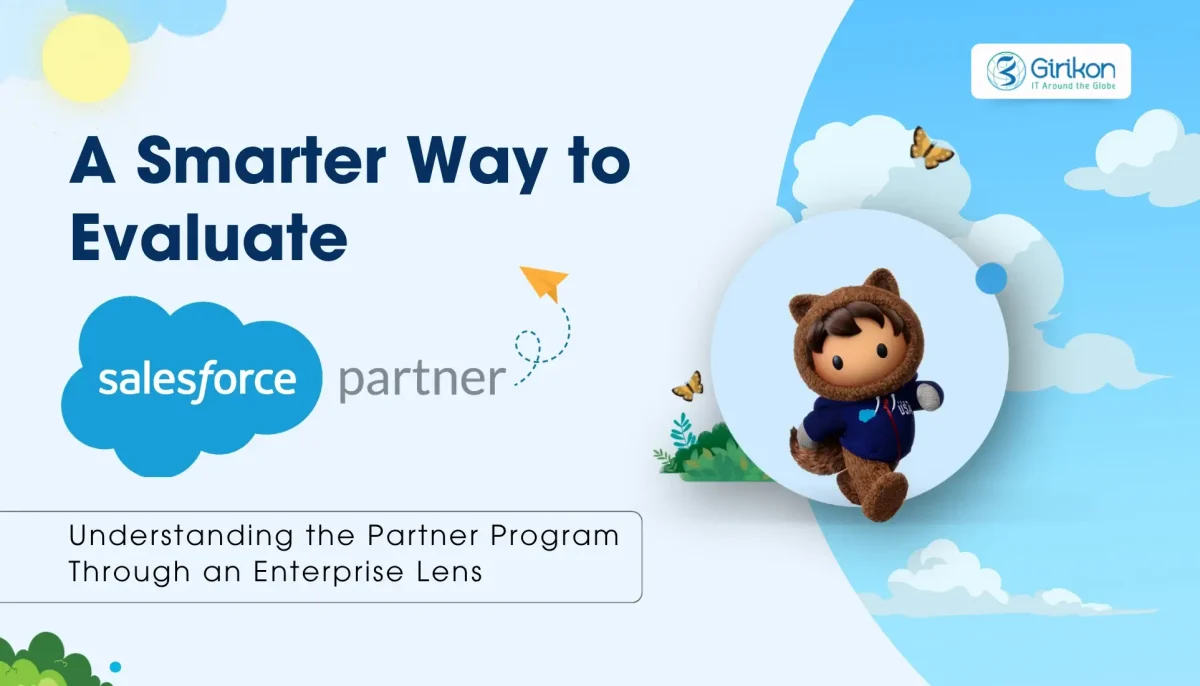
Businesses today are operating in a dynamic digital ecosystem. Modern enterprises that have invested in robust CRM systems like Salesforce rely largely on reliable Salesforce Partners to draw the most out of their CRM investment. This is where the Salesforce Partner Program comes to the rescue of enterprise businesses looking for certified experts skilled at designing, implementing and optimizing Salesforce solutions at scale. However, not every partner offers the same level of service.
This article throws light on how the Salesforce Partner Program works and what all is essential for enterprises looking to make informed decisions.
What the Salesforce Partner Program Really Means for Enterprises
It is a global ecosystem of system integrators, consulting firms and independent software vendors (ISVs). They team up with Salesforce to offer tailored solutions across multiple industries. Partners are judged on various factors, including certifications and specializations, their customer success record measured by CSAT scores. Their drive innovation through product development and their level of engagement reflects in their ongoing relationship with Salesforce. Based on this detailed evaluation, partners are assigned tier rankings, which determine their acknowledgement within the ecosystem, as well as their access to exclusive benefits.
Salesforce Partner Tiers Explained (Beyond the Labels)
Base Tier – When Cost Matters More Than Scale
This forms the entry level, and consists of companies that have become a part of the partner network yet are in a process of building their Salesforce practice. These partners have limited abilities with few certifications, a small collection of accomplished projects, and expertise across Salesforce solutions. They are usually best suited for small-scale implementations, less complex projects where budget is a priority.
Ridge Tier – The Scaling Sweet Spot
It represents partners who have showcased expertise and a steady track record of client success within the Salesforce ecosystem. These partners have a moderate number of trained professionals, a history of successful project delivery, and gradually expanding experience across industries. They are suitable for mid-sized executions and for businesses that are in the process of scaling their CRM usage.
Crest Tier – Enterprise Execution Layer
This tier includes highly capable Salesforce certified partners within the Salesforce ecosystem. These partners display deep technical acumen and outstanding delivery. With a huge pool of expert professionals and strong customer success scores, these partners are suitable for enterprise-wide implementations, intricate integrations, and multi-cloud deployments.
Summit Tier – Strategic Transformation Partners
This represents the top tier of the Salesforce partnership level. It is reserved for businesses that demonstrate extraordinary capability, strategic alignment and scale. These partners possess extensive certifications across various Salesforce clouds. They also consistently achieve extraordinary customer success scores, and maintain close arrangement with the product roadmap of Salesforce and possess global-scale delivery capabilities. They are suitable for mission-critical transitions, large-scale transformation initiatives, and more.
Enterprise Framework: How to Evaluate a Salesforce Partner
Selecting the right partner is a strategic decision, not just an obtaining task. By following a structured approach, enterprise can ensure the partner aligns with business goals, as well as project complexity.
1. Match Partner Tier with Project Complexity
Most organizations fail to make the right estimation w.r.t the partner level they need. For comparatively simple implementations, a Ridge-tier partner might suffice. However, for complex implementations, associating with a higher-tier partner makes sense. Failing to make the right match might result in delays, budget constraints, and low outcomes.
2. Evaluate Technical Depth (Beyond Certifications)
Analyzing the technical ability of a partner is essential for successful delivery. Some of the indicators include skilled architects, their expertise with multi-cloud implementation and complex integrations including third-party apps, data lakes and more. Enterprises should seek real-world case studies to comprehend how the partner approaches execution in actuality.
3. Assess Delivery Maturity & Governance Models
An experienced partner must showcase a structured delivery methodology. This might include hybrid delivery models, well-outlined governance frameworks, and risk extenuation strategies. Enterprises should also evaluate how the partner drives user adoption, approaches change management, and delivers training, as these factors are essential to successful implementation.
4. Validate Real Customer Outcomes (Not Just Case Studies)
Actual success is one of the major signals of a partner’s efficiency. Organizations must ask for case studies, client references, and proof of outcomes such as operational efficiency gains. It’s equally important to assess the longevity of customer relationships, as partnerships often indicate dependable performance and trust, rather than secluded project success.
5. Measure Innovation Readiness (AI, Data, Customization)
Choosing a partner within the Salesforce ecosystem in today’s AI era requires looking beyond non-specific implementation skills. Enterprises should evaluate whether the partner can initiate innovation through AI integration capabilities, strong data strategy expertise, and tailored application development. Partners with an innovative approach well-positioned to make your Salesforce investment future-proof, and ensure long-term business value.
6. Analyze Commercial & Engagement Models
When assessing partners within the CRM ecosystem, it’s crucial to comprehend their pricing models. Some approaches involve fixed-price ventures, billing for resources, and contributions for managed services. Rather than focusing on cost, enterprises should rank distribution capability along with overall value. A partner offering low-cost might appear to be appealing initially, but poor execution can lead to delays, long-term expenses and compromised outcomes.
Common Mistakes Enterprises Make While Choosing Salesforce Partners
Selecting a Salesforce partner is not just about finding out the business’s capability on paper. A lot of enterprises, despite having clear business goals, make avoidable mistakes while evaluating the partners. Such instances often lead to delayed implementations, too many change requests, budget overruns, and underutilized CRM systems. We have the ability to flag these common pitfalls and help organizations make more informed and strategic decisions.
Overvaluing Certifications Over Delivery
Salesforce Certifications are an important indicator of a partner’s technical knowledge. However, it do not tell you the real-world execution capabilities. A lot of enterprises prioritize hiring a certified professionals without evaluating how effectively those certifications/ skills co-relate to goal achievement or successful project delivery. It goes without saying that any partner with fewer certifications but stronger implementation experience, proven case studies, and consistent delivery outcomes is better fit than one with a larger certified workforce but limited execution depth.
Ignoring Change Management Capability
Successful Salesforce implementation goes beyond technical deployment. One of the most overlooked aspects is change management, which includes user adoption, training, and process alignment. Enterprises that fail to evaluate a partner’s ability to manage organizational change often face resistance from internal teams, leading to low adoption rates and reduced ROI. A capable partner should demonstrate a structured approach to onboarding, training, and ensuring that users are able to leverage the platform effectively.
Choosing Based on Cost Instead of Value
Cost is always a consideration, but making it the primary deciding factor can lead to long-term challenges. Lower-cost partners may lack the depth required for complex implementations, resulting in rework, delays, and additional expenses over time. Enterprises should focus on the overall value delivered, including quality of implementation, scalability, and long-term support. A higher upfront investment with the right partner often leads to better outcomes and reduced total cost of ownership.
Misalignment Between Partner Tier and Use Case
Not all projects require top-tier partners, and not all partners are suited for enterprise-scale transformations. A common mistake is either overestimating or underestimating the level of expertise required. Engaging a lower-tier partner for a highly complex, multi-cloud implementation can lead to execution challenges, while choosing a top-tier partner for a relatively simple project may result in unnecessary costs. Enterprises should align partner selection with the scope, complexity, and strategic importance of the project to ensure optimal results.
How the Salesforce Partner Ecosystem Is Evolving (2026 Shift)
The Salesforce partner ecosystem is continuously evolving to align with changing enterprise needs and technological advancements. As organizations demand more measurable outcomes and innovation-driven solutions, the criteria for evaluating partners is also shifting. Understanding these changes is essential for enterprises looking to make future-ready decisions.
Move Toward Outcome-Based Evaluation
Enterprises are increasingly focusing on outcomes rather than inputs. Instead of evaluating partners solely on certifications, team size, or hourly rates, there is a growing emphasis on business impact. Metrics such as improved operational efficiency, faster time-to-market, and measurable ROI are becoming key indicators of success. This shift encourages partners to align more closely with business objectives and deliver tangible value rather than just technical implementation.
Shift to Fewer, More Defined Tiers
The traditional multi-tier structure is gradually evolving into a more streamlined model. Salesforce has been moving toward simplifying partner classifications, with greater emphasis on performance, specialization, and customer success. This shift helps enterprises better understand partner capabilities without navigating overly complex tier distinctions, making the evaluation process more transparent and effective.
Focus on AI-Driven Delivery
With the growing influence of AI across the Salesforce ecosystem, partners are expected to go beyond standard implementation services. Enterprises now look for partners who can integrate AI capabilities, build intelligent workflows, and leverage data for predictive insights. This includes expertise in areas such as automation, analytics, and AI-powered customer engagement. Partners who can incorporate these elements into their delivery approach are better positioned to support long-term digital transformation.
Final Verdict: How to Choose the Right Salesforce Partner
The Salesforce Affiliate Program is crucial to ensure businesses get access to high-end implementation and innovation support. However, steering through this ecosystem needs a clear comprehension of Salesforce partner tiers, proficiencies, and more. Opting for the right partner can pace up digital transformation, reduce implementation risks, generate tangible ROI for enterprise clients. Alternatively, choosing a partner who isn’t the right fit can lead to delays, budgetary constraints, and under-exploited systems.
Finally, the key is to assess partners by striking the right balance between different tiers, technical understanding, industry knowledge, and social fit for ensuring long-term success.
FAQs
What is the Salesforce Partner Program?
The Salesforce Partner Program is a global ecosystem of consulting firms, system integrators, and ISVs that are certified to implement, customize, and optimize Salesforce solutions for businesses.
How do Salesforce partner tiers impact enterprise projects?
Salesforce partner tiers - Base, Ridge, Crest, and Summit. They reflect a partner’s expertise, certifications, and delivery capability. Higher-tier partners are typically better suited for complex, enterprise-scale implementations.
How should enterprises choose the right Salesforce partner?
Enterprises should evaluate partners based on technical expertise, project complexity alignment, delivery methodology, innovation capabilities, and proven customer success to ensure long-term ROI and successful implementation.
About Author

Jaya is a content marketing professional with more than 10 years of experience into technical writing, creative content writing and digital content development. Her decade long experience lends her the ability to create content for multiple channels and across different technology verticals.
Share this post on: