+1-480-241-8198
 +44-7428758945
 +61-1300-332-888
 +91 9811400594
Your organization may be employing Salesforce already for tracking its business data, including customers, operations, and suppliers. The question here is whether it can serve the purposes of data collection needed for climate reporting. Thus, what is the significance of CSRD and SEC climate reporting regulations for your CRM?
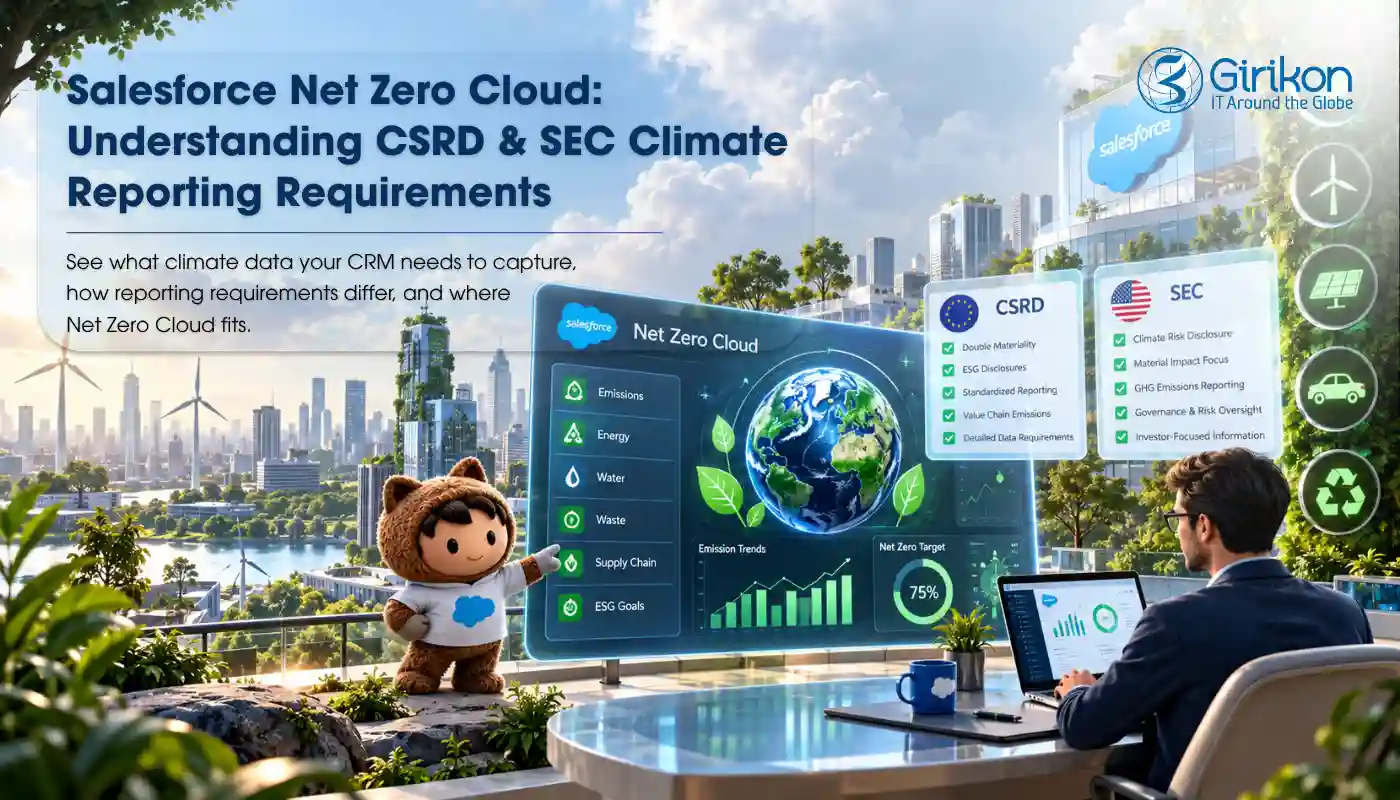
The principles demand the organizations to do more than report emissions via Salesforce. They require companies to collect reliable climate-related data, maintain a clear record of where it comes from, and use it to support the information included in their disclosures. This is where Salesforce Net Zero Cloud becomes important– by bringing related sustainability and emissions data into a climate disclosure CRM environment where it can be tracked, reported, and managed.
For organizations, preparing for more structured climate reporting, this can also provide a foundation for a climate disclosure CRM approach.
What Do CSRD and SEC Climate Reporting Require?
Climate reporting does not merely consist of putting one number of carbon emissions in the annual report. According to the CSRD, companies falling under its purview need to provide sustainability information in compliance with the ESRS.
ESRS E1 takes into account the company’s strategy on climate change, CO2 emissions, energy consumption, climate risks and opportunities, measures taken to reduce CO2 emissions, etc. as well as the Scope 1, Scope 2 and pertinent Scope 3 emissions.
So, companies should not only focus on results but also on the form of data. A company should be aware of what is being measured, how emissions were determined, where data comes from, and what obligations stem from the company’s climate strategy.
In the USA, the situation is different. The SEC introduced the climate-related disclosure rules in 2024, but they have been postponed for further consideration and are now being considered for withdrawal. Thus, the SEC rules of 2024 cannot be treated as the current reporting requirements. At the same time, if climate data is reliable and excellently organized, it can help companies with their future reporting.
Reasons Why Climate Reporting Is Hard and Requires Improved Data
Climate reporting becomes challenging when the information necessary for reporting is scattered throughout different systems.
Travel information may come from a travel management platform. Energy consumption may sit with the facilities team. Fuel data may be maintained by operations. Emissions calculations could be made using spreadsheet software while supplier information could be located within the procurement software.
This will mean that the climate reporting procedure becomes a cumbersome task since someone will need to collect the information, check if all the information is collected, put it into the appropriate form, use the proper emissions factor, make the calculation and report the numbers. There is more to it than just that. The team may need to understand the sources of reports that get updated to keep track of any change.
Even though CRM is not a panacea in every situation, it can significantly help manage reporting if you are ready to implement sustainability measures across different aspects of business in one solution.
What Role Does Salesforce Have in Climate Reporting?
Salesforce is already used to manage large amounts of business information, and the same platform can also support ESG reporting Salesforce by bringing sustainability related information into a more structured environment.
It allows organizations to merge relevant environmental data with business information that can already be processed in the Salesforce system. Nevertheless, Salesforce is not an easy way to comply with regulations. This platform does not determine whether your disclosure meets all obligations under the CSRD or any other framework. The quality of the report will rely on the calculations, procedures, data, systems, and decisions made regarding the report.
How Salesforce Net Zero Cloud Helps Manage Emissions Data
Net Zero Cloud has the ability to gather, arrange, analyze, and disseminate environmental data. The information available in the source indicates that carbon accounting capabilities can be utilized with energy consumption statistics which are provided by such sources as electricity, corporate travel, direct fuel consumption, and logistics from outside suppliers.
The benefit is not simply having another dashboard that helps team:
- Categorize environmental information
- Create reports from centralized sustainability data
- Obtain emission and energy consumption data from various sources
- Monitor the goals and progress on sustainability
- Calculate and monitor carbon emissions
- Review emissions within corporate activities
The primary benefit in this case is the organized structure for managing data required for sustainability reports.
What Climate Data Should You Track in Net Zero Cloud?
The climate-related information can cover different areas of an organization’s operation and value chain, with these main Scopes being important starting points.
Scope 1 refers to direct emissions from the company’s operations. These emissions arise from fuel burnt in furnaces, equipment, motor vehicles, etc. Tracking these emissions allows a business to know what emissions it generates in its own operations.
Scope 2 is the emissions resulting from the use of energy purchased by the company to heat and cool buildings. This data may require tracking not only the amount of energy consumed but also the places where it was consumed and emissions resulting from its consumption.
Scope 3 involves other indirect emissions of an organization’s entire value chain that come from activities related to business travel, the purchase of goods and services, transport, various listed and unlisted upstream and downstream activities. Since the source of this data is often the partner organizations, suppliers, and other external origins, obtaining and organizing it may become complicated.
In addition to this, organizations have to keep information on emission factors, energy consumption, reporting periods, activity data, suppliers, calculation methods, and data sources.
It may become necessary for businesses to consistently monitor climate goals. For example, the present level of emissions can then be compared to a baseline in order to track the success of a reduction strategy.
What Should You Know About Net Zero Cloud Pricing?
The cost of using Salesforce Net Zero Cloud can vary depending on an organization’s data volumes, requirements, integrations, users, and the Salesforce environment it already has in place.
An organization with a larger volume of emission data and multiple data sources may have different implementation requirements than a smaller organization with a simpler setup.
Besides, the organization may also need to consider data integration, reporting requirements, configuration, implementation, and ongoing management because bringing information from other business systems into Salesforce may require additional work and affect the overall implementation cost of a carbon accounting CRM.
Conclusion
Organizations familiar with Salesforce Sustainability Cloud can also see how Salesforce’s sustainability capabilities have evolved to support broader reporting and data needs. Nevertheless, mere utilization of the platform is not an assurance of compliance with CSRD or other relevant standards.
The achievement of success in terms of climate reports will ultimately depend on the information and calculation processes, as well as specific regulatory procedures. With ample experience worldwide in implementing Salesforce technology and eco-efficiencies, Girikon experts will be able to analyze the needs of the organization, join the required information for climate reporting, and set up the Salesforce ecosystem.
About Author

Shivani is a Technical Content Specialist at Girikon with deep expertise in turning intricate technologies into engaging narratives. Her renowned experience and keen interest in technologies allows her to draft compelling and digestable insights for tech-savvy leaders. She helps businesses navigate the labyrinth of innovation, leveraging her proficient skills and visionary attitude.
Share this post on: