+1-480-241-8198
 +44-7428758945
 +61-1300-332-888
 +91 9811400594
Salesforce releases are getting faster. But are they getting easier?
With multiple developers, sandboxes, admins, metadata dependencies, and testing workflows in the mix, a single deployment can quickly become a release-management headache.
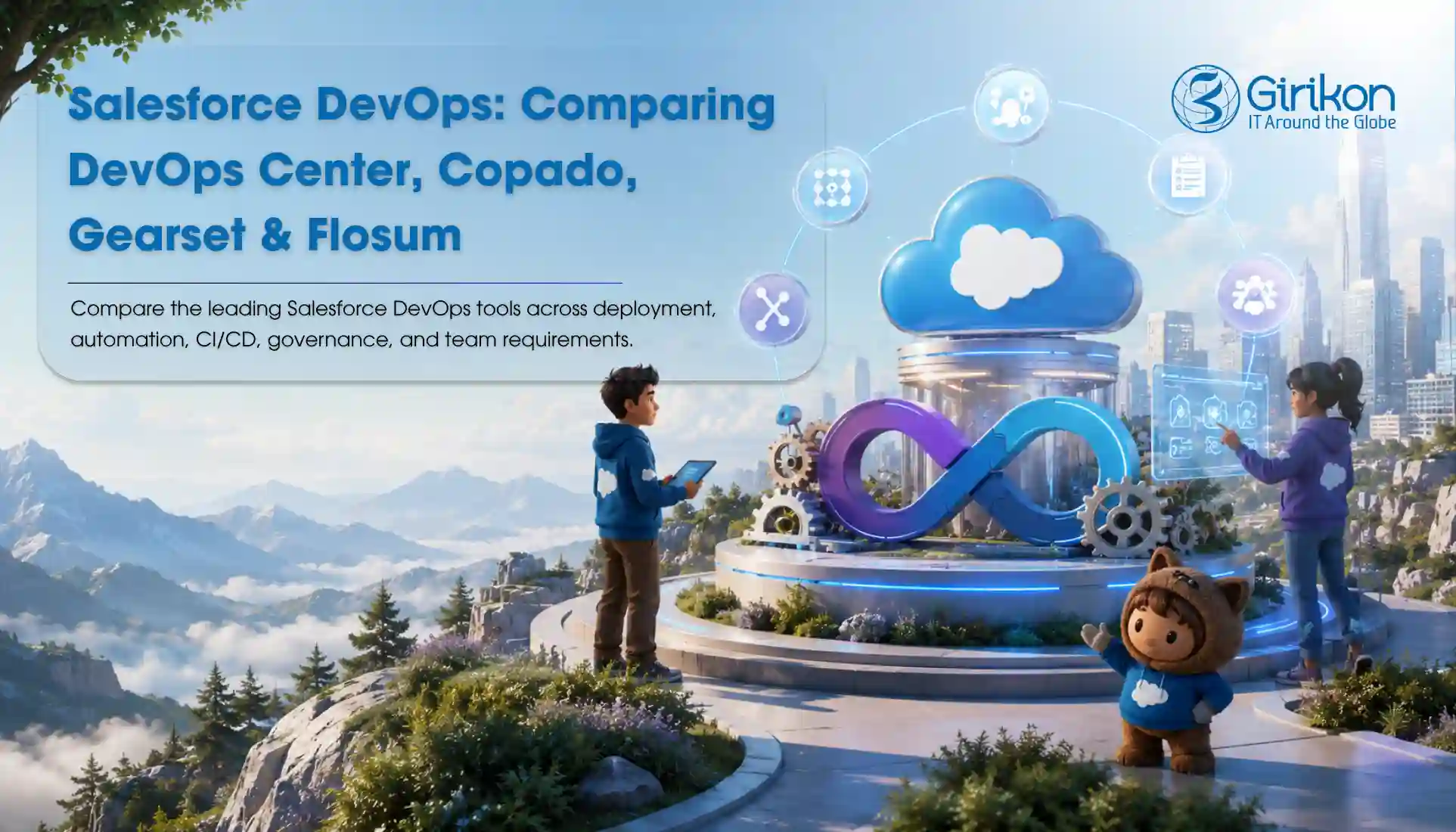
That’s where Salesforce DevOps tools come in.
But in 2026, the choice goes beyond replacing change sets. It becomes essential to pay attention to source control, CI/CD automation, metadata management, governance, scalability, security, and rollback.
There are four names that are usually mentioned: Salesforce DevOps Center, Flosum, Gearset, and Copado. Each takes a different approach to Salesforce release management and can serve as valuable Salesforce tools for implementation, depending on your deployment needs. Let’s do a Salesforce DevOps tools comparison and find out which one fits your Salesforce DevOps strategy best.
What is Salesforce DevOps?
Salesforce DevOps is the process of applying development and operations principles to Salesforce application development and release management.
Instead of manually moving changes between sandboxes and production, teams use a controlled process to:
- Track development work
- Automate testing
- Manage Salesforce metadata and source code
- Deploy changes through defined pipelines
- Recover from failed deployments
- Validate changes
- Align releases across multiple teams and orgs
This is especially essential if you are an enterprise managing several Salesforce organizations, hundreds of developers, and sometimes innumerable releases along with high compliance standards.
What to Look for When Selecting a Salesforce DevOps Tool
01
Source Control
Source control gives development teams a history of changes and a structured way to collaborate — tracking what was changed in metadata, who made changes, and when. Without it, teams encounter difficulties in choosing what version to apply.
02
Metadata Management
Metadata — fields, objects, Apex, Flows, validation rules, Lightning components, permission sets, layouts — can rely on each other. A good DevOps platform helps teams identify, compare, track, and deploy related metadata correctly without breaking dependencies.
03
CI/CD Automation
CI/CD automates the repetitive activities of development and deployment — validating changes, running tests, discovering problems, and moving approved changes into other environments. A typical pipeline runs: Commit → Validate → Test → Approve → Deploy.
04
Rollback and Recovery
Rollback capabilities help teams restore a previous working state or reverse problematic changes after deployment — instead of manually reconstructing the previous configuration from scratch.
05
Integrations
Salesforce DevOps doesn’t operate alone. Development teams typically use Jira, GitHub, Azure DevOps, GitLab, Slack, ServiceNow, automated testing tools, and Salesforce integration services together as part of a unified release pipeline.
06
Testing
Automated testing verifies any changes before going to production. As part of effective Salesforce quality engineering and testing, the CI/CD pipeline first validates changes and runs required tests instead of deploying code directly—helping prevent faulty code from reaching customers.
07
Governance and Auditability
As Salesforce environments grow, governance and Salesforce security introduce controls over who can make, approve, deploy, and test changes. A Salesforce governance framework helps enterprises and regulated industries track what changed, when it was deployed, and who approved it.
The Four Tools: A Quick Overview
DevOps Center
by Salesforce
Salesforce’s own native solution for managing development and release workflows. A click-based interface that helps developers and admins track and promote changes — positioned as an alternative to traditional change sets.
Good fit for teams that:
- Want a Salesforce-native experience
- Are moving away from manual change sets
- Need centralized release visibility
- Don’t want a large third-party platform
Copado
Enterprise DevOps
An advanced platform designed to automate development, deployment, testing, and governance in Salesforce at scale. Built for organizations managing multiple Salesforce projects across various environments and teams.
Good fit for teams that need:
- Multi-team development workflows
- Enterprise-scale release management
- Sophisticated CI/CD pipelines
- Release governance and automated testing
Gearset
Deployment-Focused
Specializes in deployment, CI/CD, metadata comparison, backup, testing, and release management. Enables quick comparisons and clean transfers to production — strong on deployment comparison capabilities.
Good fit for teams that:
- Have developer-led Salesforce teams
- Want automated CI/CD pipelines
- Need strong deployment comparison
- Are comfortable with Git
Flosum
Compliance-Focused
Built exclusively for Salesforce with a focus on version control, release management, governance, backup, and rollback. Metadata-aware with flexible deployments — a strong fit where compliance and strict governance are major concerns.
Good fit for teams that need:
- Multi-org DevOps
- Compliance-focused workflows
- Detailed audit trails
- Metadata-aware version control
Head-to-Head: DevOps Center vs Copado vs Gearset vs Flosum
Which Tool Offers the Best Source Control?
| Tool | Source Control Approach |
|---|---|
| DevOps Center | Salesforce-native way to manage development work and connect with source control |
| Gearset | Works well with Git; helps teams deploy and manage Salesforce changes |
| Copado | Leverages Git heavily to track, manage, and move development work through environments |
| Flosum | Salesforce-focused version control with Git support when teams need it |
Takeaway
For a Salesforce-focused experience, Flosum and DevOps Center may be easier to work with. If your team already uses Git extensively, Copado and Gearset may feel more familiar.
Which Tool Handles Release Management Best?
| Tool | Release Management Approach |
|---|---|
| DevOps Center | Structured way to organize and move Salesforce work between environments |
| Gearset | Manages releases through testing, deployment, automation, and comparison |
| Copado | Built for complex releases involving multiple environments, teams, and approvals |
| Flosum | Covers release planning, testing, deployment, governance, and recovery |
Takeaway
For straightforward release processes, DevOps Center can work well. For organizations handling complex Salesforce releases, Copado, Gearset, and Flosum are better suited.
Which is the Best Salesforce CI/CD Tool?
| Tool | CI/CD Capabilities |
|---|---|
| DevOps Center | Native Salesforce pipelines for transferring changes between environments |
| Gearset | Automation for validating, deploying, and testing |
| Copado | Automation across approvals, deployments, and testing in Salesforce |
| Flosum | Combines automated deployments with governance, testing, and release management |
Takeaway
Copado, Flosum, and Gearset bring more capabilities when it comes to complex and highly automated release processes.
Which Tool Makes Rollback and Recovery Easier?
| Tool | Rollback & Recovery |
|---|---|
| DevOps Center | Primarily focused on managing and promoting work — not a dedicated backup/recovery solution |
| Gearset | Offers backup and recovery capabilities alongside its deployment tools |
| Copado | Salesforce support enables approvals, enhanced control, and tracking for enterprise releases. |
| Flosum | Helps teams return Salesforce to a previous working state |
Takeaway
If recovering from failed deployments is a major concern, evaluate the backup and rollback capabilities of Gearset, Copado, and Flosum carefully.
Which Tool is Best for Governance and Compliance?
| Tool | Governance Approach |
|---|---|
| DevOps Center | Brings deployment workflows and structured Salesforce development |
| Gearset | Helps teams maintain visibility and manage governance across deployments |
| Copado | Enables approvals, enhanced control, and tracking for enterprise releases |
| Flosum | Concentrates on governance, audit logs, approvals, and compliance workflows |
Takeaway
Copado and Flosum have proven to be the strongest regarding compliance, tracking, and approval workflows.
The Final Verdict
Picking a Salesforce DevOps tool is not just chasing the biggest feature list. You should look at how often you ship, how your team builds, what rules you must follow, and where you plan to go next. If you work with a seasoned Salesforce consulting partner, you can also compare options and shape a deployment approach that can grow with your org.
DevOps Center
Deserves a closer look if you’re replacing manual change sets and want a Salesforce-native experience without third-party complexity.
Copado
May be the right fit if you need enterprise-wide release orchestration across multiple orgs, teams, and complex approval chains.
Gearset
A strong fit for powerful deployment comparison, CI/CD workflows, and teams that want fast, reliable release automation.
Flosum
Worth evaluating for metadata-aware DevOps, complex Salesforce environments, and organizations where compliance and audit trails are non-negotiable.
Girikon can assess your Salesforce DevOps requirements and recommend the most appropriate platform — concentrating on speeding up and managing Salesforce releases in the most effective way. Schedule a consultation and discover how the right Salesforce DevOps tool can boost your Salesforce environment.
About Author

Shivani is a Technical Content Specialist at Girikon with deep expertise in turning intricate technologies into engaging narratives. Her renowned experience and keen interest in technologies allows her to draft compelling and digestable insights for tech-savvy leaders. She helps businesses navigate the labyrinth of innovation, leveraging her proficient skills and visionary attitude.
Share this post on: