 +1-480-241-8198
 +44-7428758945
 +61-1300-332-888
 +91 9811400594
Businesses have plenty of data, and most of it is not even required. Customer details are scattered here and there; records keep piling up, and finding a clear answer on time gets a little challenging. Here, the problem isn’t that businesses don’t have enough data, but accessing it at the right time is the actual obstacle.
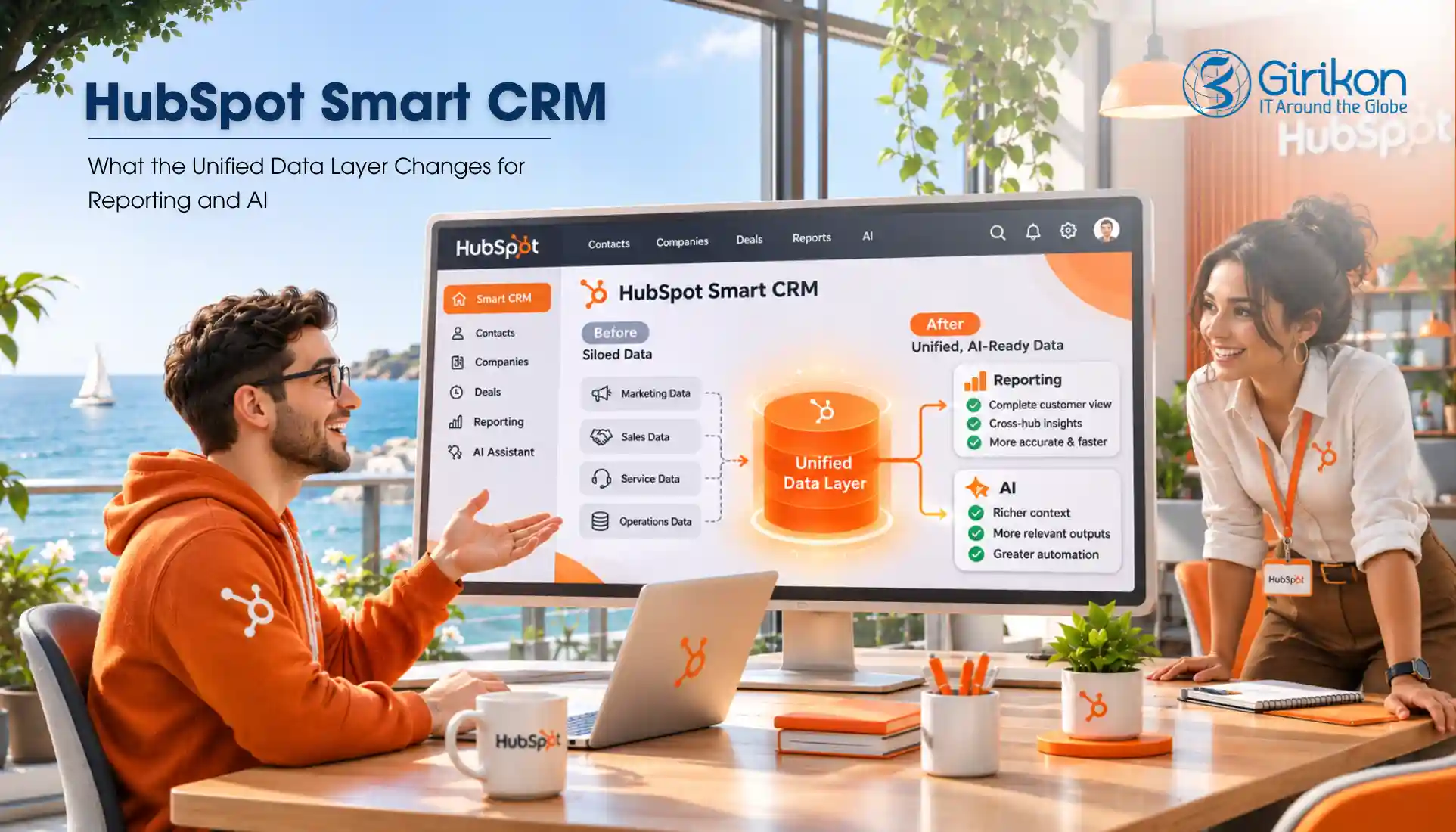
To overcome this problem, HubSpot Smart CRM is the best solution – it helps bring customer details, conversations, and routine business workflows together. This platform helps teams see the bigger picture instead of collecting every single piece of data from different tabs.
But keeping the data organized alone won’t be enough. When the information is stored in one place, reporting becomes more meaningful, and AI is likely to have a clearer picture of the business’s overall workflow. In this blog, we’ll have a clearer look at how this changes the way businesses analyze their performance and make better decisions.
Basic Overview of HubSpot Smart CRM
Through a shared data layer, HubSpot Smart CRM—an AI-powered CRM system—connects customer data, business activities, and HubSpot products. It assists in relationship management, activity tracking, and decision-making by providing a consolidated view of customer interactions to the marketing, sales, and service teams.
When compared to more conventional customer relationship management systems, HubSpot Smart CRM unifies all the customers’ records and interactions. Customization, automation, AI-powered insights, and data enrichment are also supported.
The HubSpot unified CRM’s value approach lies in the fact that teams can collaborate on pertinent customer data rather than handling separate records. More meaningful reporting and decisions driven by AI will become possible because of this shared foundation as companies expand.
Implications for Reporting from HubSpot’s New Unified Data Layer
Just picture yourself generating a company report without ever having to download spreadsheets, manually combine data, or wait for your IT department to make a connection with the figures. That is the reporting benefit that HubSpot hopes to achieve with its unified data approach.
Companies can integrate customer relationship management records with data from other sources and create more insightful reports with the help of HubSpot Data Hub (previously Operations Hub) and HubSpot Smart CRM. This is what shifts:
Integrate Information from Various Sources
You can integrate external data sources with your CRM information using HubSpot Data Hub’s Data Studio. For instance, instead of depending on monthly spreadsheet reconciliation, companies can integrate deal revenue, SaaS usage metrics, and advertising spend to obtain a more comprehensive picture of company performance.
Perform Record-Level Metric Calculation
Before data is aggregated, formula fields allow for row-level calculations. For instance, companies can track the duration between lead generation and initial sales contact or determine the profit margins for specific deals. This allows for more customizable reporting, though subscriptions determine which features are available.
Keeping Business Data Accurate and Consistent
Businesses can find inconsistent records and keep CRM information cleaner with the help of data quality tools, data formatting, and duplicate management software. There will be less chance of teams dealing with property values that are at odds with one another or with duplicate customer records.
Extract Data from Natural Language Using Breeze
Users can now describe the report they need in everyday language with the integration of Breeze Assistant into the custom report builder. Users have the option to review and modify HubSpot’s suggested report configuration, which includes metrics, dimensions, and chart types.
Understanding the Role of Data in AI
Better integration of customer relationship management (CRM) records or customer interactions provides AI with more relevant context. Automated insights and well-informed business decisions can be made with this.
Reporting becomes more focused on understanding company performance and less dependent on scattered information with a HubSpot unified CRM approach.
What Companies Need to Know About HubSpot Reporting Limitations
At first, HubSpot may look like a great reporting tool. But as soon as the business starts to expand, getting all the insights into one place won’t be a piece of cake.
Below are the issues that businesses can face:
Data silos:
Data from external sources will need additional integration to be used in the CRM reports.
Inconsistent HubSpot CRM data:
Date format inconsistencies, country code conflicts, property values, and duplicate entries may affect data accuracy and consistency in reporting.
Limited access to advanced tools:
Certain HubSpot plans offer advanced reporting, data manipulation and management options, which are not available for others.
Delayed data refresh:
Changes will not be updated immediately in integrated data sets and reports.
It all starts with understanding the requirements for reporting, making sure your CRM properties are consistent, and selecting the right integration and reporting setup. Consistent data brings great value but requires careful management.
Why is HubSpot CRM Data Important for AI Data Readiness?
AI can write reports, find patterns, and suggest the next best step. But what if the knowledge behind those recommendations is incomplete or inconsistent?
That’s why HubSpot AI data readiness is important. For organizations to gain full benefits from AI, they must have customer information, which is accurate, linked, and accessible.
HubSpot Smart CRM creates this foundation by keeping all customer records and interactions in one location. When combined with HubSpot Data Hub, companies can integrate external data and optimize how they use data across their business.
This creates opportunities for more effective AI adoption via:
Better customer insights:
AI can work with more connected customer information to provide relevant context.
Smarter automation:
More consistent CRM data supports better-informed workflows and actions.
Improved decision-making:
Connected information helps businesses identify trends and understand customer behavior.
More relevant AI assistance:
Tools such as Breeze can use available CRM context to support business activities.
However, AI readiness isn’t achieved simply by adopting an AI tool. Data quality, access permissions, integration, and ongoing governance all play an important role.
The bottom line? Companies investing in better connected data today are better positioned to make practical use of AI tomorrow.
Is HubSpot Smart CRM a suitable CRM for Your Business?
If your teams are struggling with disconnected customer information, inconsistent reports or limited visibility into business performance, then HubSpot Smart CRM is worth a look for businesses that:
- Manage customer information across multiple platforms.
- Need consistent reporting across marketing and sales.
- Want to connect external data with CRM records.
- Are preparing their data infrastructure for AI adoption.
- Need better control over data quality and reporting processes.
However, the right setup depends on your business requirements, existing technology, and HubSpot subscription. Simply adopting a CRM isn’t enough; the real value comes from implementing it around your business processes.
With the right strategy and integration support, businesses can turn disconnected information into a more useful foundation for reporting, customer management, and AI.
Final Thoughts
Informed decision-making begins with more connected data. HubSpot Smart CRM helps take customer information, reporting, and AI to a more connected level of data ecosystem that businesses need to rise above their fragmented records and disconnected insights.
However, making the best of this ecosystem is not just about using the right software. Rather, the process also calls for the use of the right data strategy and integration.
So, maximize the potential of your CRM data by connecting with our expert team. Contact us now!
About Author

Sakshi specializes in creating high-quality, SEO-driven content focused on Salesforce, CRM, and business automation. She writes blogs, landing pages, solution pages, case studies, and thought leadership content that simplifies complex Salesforce concepts, highlights business value, and helps organizations make informed CRM decisions.
Share this post on: