
 +1-480-241-8198
 +44-7428758945
 +61-1300-332-888
 +91 9811400594
You might have been eyeing a beautiful dress for quite some time yet refraining from buying it because of its high price. On a fine day, as you scroll through your phone, you come across the same product, which is now available at an amazing discount. What will you do? Certainly… make an instant payment, with the product reaching your doorstep in a day or two.
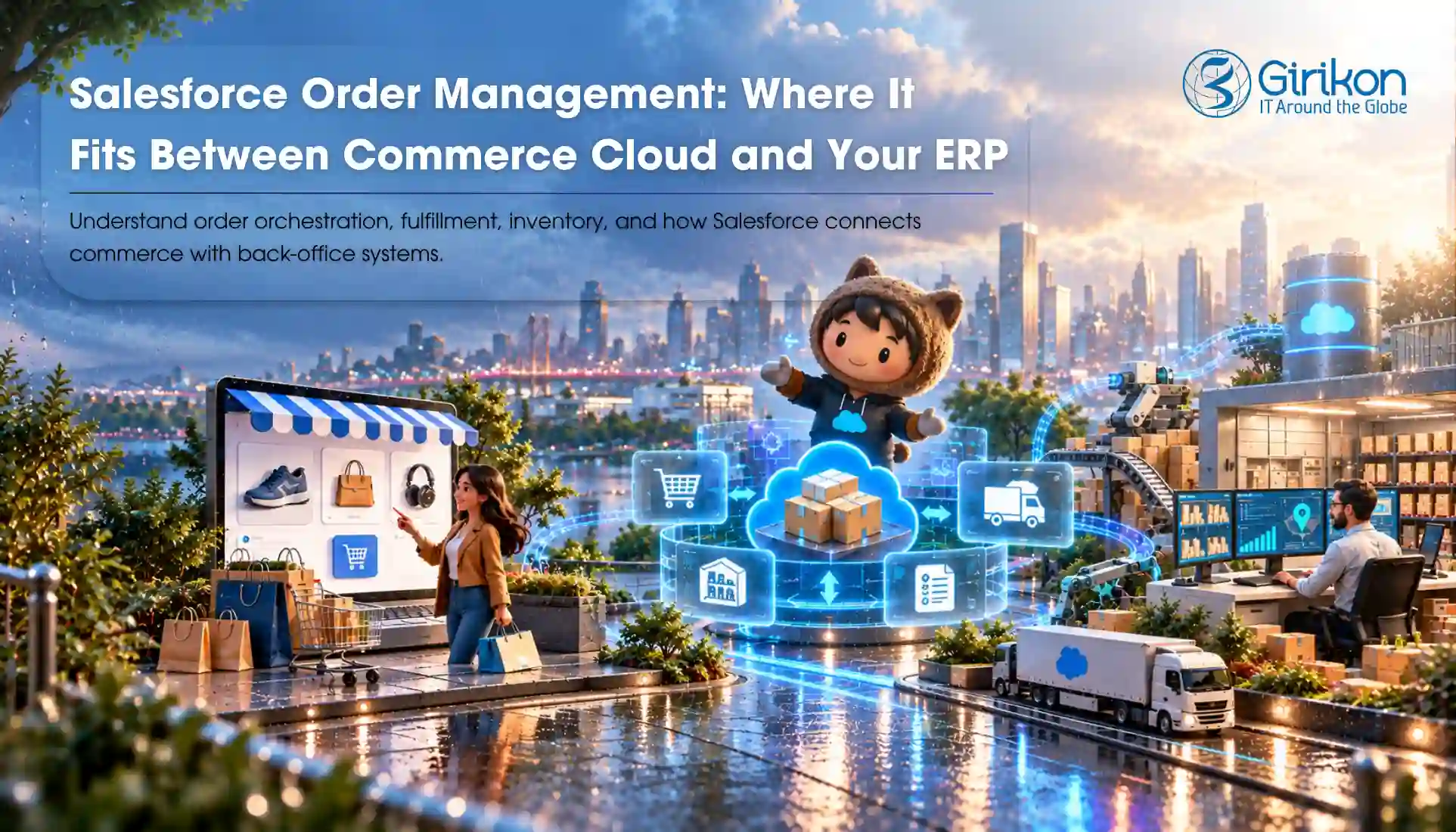
However, you aren’t satisfied with the fit and wish to place a return. You chat with a bot and place a return request following which a different order for a different dress is generated. The merchant website offers the same deal with a new dress in a better size. You are finally happy as you get a new dress as a replacement for the old one.
An Order Management tool makes the entire process right from order placement to delivery seamless.
What Is Salesforce Order Management?
Salesforce Order Management system is a tool that assists organizations to handle tasks such as accepting online payments, order processing, tracking orders, and processing returns. This helps meet the rising client expectations of an eCommerce business. However, Salesforce OMS not only helps process orders effectively but also integrates client-facing systems such as sales, CRM, commerce, and service to ensure that clients have an explicit post-purchase experience.
Since modern businesses usually use multiple platforms to manage their orders, they might have to toggle between systems to manage their workflow. For instance, a customer may browse their product on Salesforce Commerce Cloud, make a payment via third-party system, and have the order accomplished by an ERP system.
However, businesses have to deal with scattered order information, inaccurate inventory data, paused deliveries, and inadequate visibility into returns when these systems aren’t connected properly.
This is where Salesforce Order Management comes to the rescue.
Order Management System Salesforce provides a central way to handle the order process after a customer places an order. It can link commerce platforms with tools that manage order fulfillment, inventory, expenditure, customer service, and other operations.
Where Does Salesforce OMS Fit?
A simple way to understand the role of every platform is to know what it is primarily responsible for.
| Platform | Primary Responsibility |
|---|---|
| Salesforce Commerce Cloud | Provides online shopping experience and captures customer orders. It answers how a customer browses, works and places an order. |
| Salesforce Order Management | Manages the order lifecycle and structures what occurs once an order is placed. |
| ERP | Handles supply chain, procurement, inventory, finance and other core business operations. It answers how the financial and operational side of the order can be managed. |
The setup might differ from one business to another, but the basic idea remains the same.
Commerce Cloud vs. Salesforce Order Management
Salesforce OMS and Commerce Cloud complement each other. Designed around the digital commerce experience, Commerce Cloud supports client-facing business functions such as product discovery, carts, checkout, and others.
Once the customer places an order, many processes begin.
The business may need to establish:
- The location where the order needs to be fulfilled
- Product availability
- Whether the client can change the delivery address
- Should the order be split across several locations?
- What will happen in case of item unavailability?
- What will be the return process?
- How should the clients receive updates?
- How must refunds be coordinated?
This is where order management capability shines.
For instance:
- Customer
- Commerce Cloud
- Salesforce OMS
- Fulfillment/ERP
- Customer
The OMS layer offers the coordination needed to move the order through its lifecycle while ensuring visibility for client-facing teams.
Salesforce Order Management vs. ERP: What Is the Difference?
Salesforce Order Management vs. ERP isn’t all about deciding which system should “own” the order. The two platforms serve different purposes within a company’s technology landscape.
While an ERP is designed to focus on core enterprise operations, including financial management, procurement, supply chain, manufacturing, inventory, and business reporting, Salesforce Order Management System (OMS) focuses on handling and arranging the order lifecycle across different sales channels and fulfillment procedures. This helps businesses provide a connected and consistent experience from order capture through fulfillment, order delivery, returns, and service.
Let’s understand this with an example: A retailer operates an ecommerce website, runs physical stores and multiple warehouses, and works with logistics providers, Salesforce Service Cloud, an ERP, and multiple payment providers. While ERP may continue to serve as the system of record for financial transactions and supply chain processes, the OMS matches the customer-facing order lifecycle across these associated systems. This approach can help shield digital commerce and client service teams from the complexity of ERP processes while providing a more simplified order management experience.
Why Do Businesses Require an Order Management Layer?
Omnichannel commerce has taken precedence over the years. This has made order management extremely complex. Customers may buy online, pick up products in stores, get deliveries from stockrooms, return items to physical locations, exchange products via a different channel, or contact customer service via Salesforce.
Without centralizing order visibility, each system may gather only part of the customer journey. An OMS offers a steadier operational view by merging order status, fulfillment, returns, and refunds. This allows customer service teams to access appropriate information more easily, gives customers a better post-purchase experience, and helps operations teams manage sales channels and fulfillment processes.
What Are the Common Salesforce Order Management Implementation Mistakes?
Common Salesforce OMS implementation mistakes include:
- Treating OMS as a replacement for the ERP.
- Creating overlapping responsibilities.
- Failing to establish a clear system of record.
- Not clearly defining which platform serves as the system of record for inventory, payment, and service-delivery data.
- Designing only for standard order flows while not accounting for exceptions such as inventory shortages, payment failures, cancellations, returns, etc.
Final Words
Salesforce Order Management bridges the gap between digital commerce and back-office processes. While Commerce Cloud manages customer orders, ERP manages financial and back-office processes. Salesforce OMS connects these systems by coordinating fulfillment, cancellations, returns, and order visibility. For businesses evaluating OMS Salesforce architecture, the focus must be defining clear platform responsibilities instead of replacing the ERP. A successful Salesforce Order Management implementation needs clear ownership of inventory, orders, fulfillment, integration, and customer-service processes to support capable omnichannel operations.
About Author

Jaya is a technical content specialist with 14 + years of experience - especially in the B2B space. Her forte lies in changing complex technologies into compelling narratives that educate, engage and drive business growth. Over the years, she has honed her skills of creating all types of marketing copies including white papers, landing pages, thought leadership articles and website copies that support lead generation, brand positioning, and client engagement. She is also passionate about creating content strategies that outline the future of customer engagement. She is currently associated with Girikon as a Content Manager where she heads the Content function.
Share this post on: