 +1-480-241-8198
 +44-7428758945
 +61-1300-332-888
 +91 9811400594
Enterprise AI has moved from being in the experiment stage to production at scale. Inside most Salesforce orgs, it’s already running support queues, scoring leads, and shaping decisions that impact revenue directly. But many businesses weren’t ready for it, which is why the ROI formula they’ve used for decades is starting to prove insufficient to decode what AI actually does.
Earlier return on investment models followed the simple logic: spend the money, get the return, close the file. AI value builds gradually through efficiency, expanded capacity, and stronger data foundations. That’s why ROAI is becoming the most accurate measure for Salesforce teams.
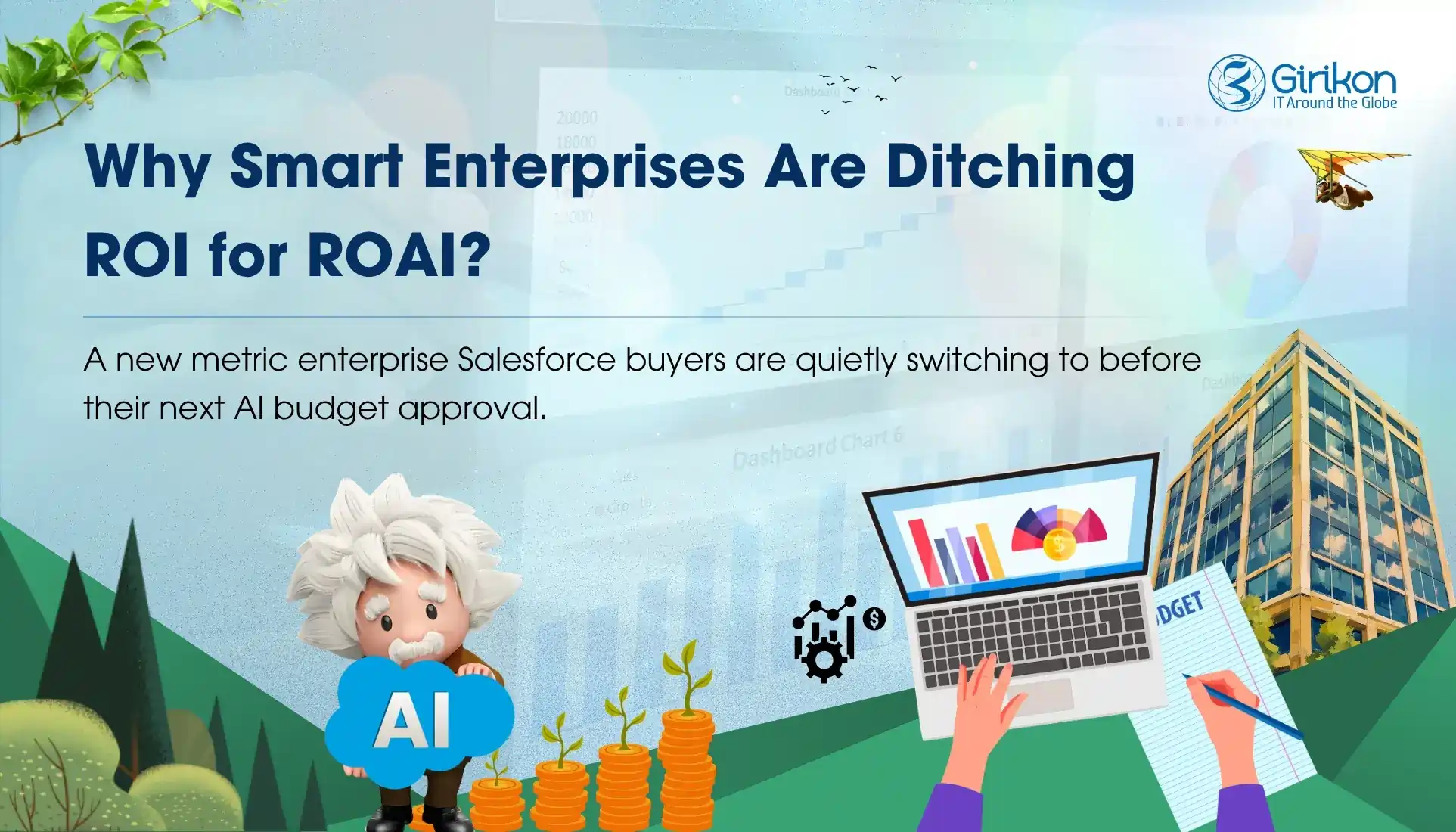
But businesses must understand what ROAI is to fully replace traditional return on investment in Salesforce projects. In this blog, we’ll explore 5 Salesforce Agentforce impact tracking metrics that show how to track impact more effectively. We’ll also talk about how to build a strategy to help you transit from traditional AI investment metrics enterprise to return on AI investment Salesforce.
Why Enterprises are Rethinking AI Investment Impact in Salesforce
Businesses assume stability once they have invested in the AI project. But it doesn’t work well with AI because it keeps evolving. When teams apply legacy formulas, they face issues like:
Fixed-input thinking breaks down fast — AI systems keep improving without any extra spending behind them.
Watching single transactions in isolation misses how one gain tends to spread quietly into other workflows.
Capacity gains from handling more work without new headcount are rarely included in ROI.
Data quality improvements from AI rollouts don’t appear in financial reporting, even though they create measurable returns.
What is ROAI?
ROAI offers a wider lens for evaluating what Salesforce AI projects actually produce. It calculates token consumption and model usage costs alongside efficiency, scalability, and data quality improvements. Thus, providing a more precise view than traditional ROI for Agentforce and enterprise AI investments.
ROAI Formula
ROAI = Economic Return / (Cost of Human Intelligence + Cost of Tokens)
ROAI vs ROI AI Projects: What is the Difference?
If traditional ROI focuses on knowing whether a project paid for itself, then ROAI asks something more useful — what can the business do now that it couldn’t manage before? That question only gets more important as agentic tools take on a bigger role. Salesforce Agentforce ROI metrics, for instance, need to reflect the independent judgment calls an agent makes on its own, not just how many tickets got closed by end of day.
| Factor | Traditional ROI | ROAI |
|---|---|---|
| Core Metric Basis | Net financial gain versus investment cost | Business value from AI adoption across efficiency, revenue, and data quality |
| Formula Basis | ROI = (Gain – Cost) / Cost | No fixed formula — mixes cost savings, productivity, new revenue, and risk reduction |
| Focus Area | Purely financial outcomes: profits, margins, payback | Broader enterprise outcomes: automation, decision speed, customer experience |
| Time Horizon | Short-to-medium term, tied to a project’s lifecycle | Medium-to-long term, tracking AI maturity and scaling impact |
| How it Measures | Straightforward, drawn from accounting data | More complex, requiring tracking of intangible benefits like agility and competitive edge |
Common Salesforce Agentforce ROI Metrics
Case Resolution Speed
Track the reduction in average time taken to close customer cases.
Agent Productivity
Calculates the boost in cases handled per agent without adding staff.
Customer Satisfaction
Focuses on any improvement in CSAT or NPS scores tied to faster resolutions.
Cost Efficiency
Measures savings from reduced escalations and lower support expenses.
Scalability
Assesses the ability to manage higher case volumes during peak demand without disruption.
5 Steps to Begin Transitioning to an ROAI Framework
Step 01
Audit What You’re Already Tracking
Review every metric tied to current technology projects and separate those that only measure speed or efficiency. This exposes gaps in reporting and sets the stage for a broader framework that captures value beyond operational quick wins.
Step 02
Map Capability Gains Directly
Document where teams manage greater demands or more complex tasks without adding staff. These gains often go unnoticed, but they show expanded organizational capacity. Capturing them provides a clearer view of how investments reshape what the business can realistically handle.
Step 03
Score Your Data Health Gains
Check and improve the quality of data, including the introduction of a more restrictive approach to data quality improvement — through better records and fields and proper use of data and information governance. By applying these changes you can enhance reporting accuracy, ensure compliance, and boost system performance. Unlike tool-specific benefits, these upgrades remain valuable long after individual solutions are replaced.
Step 04
Build a Three-Tier Dashboard
You need a reporting dashboard that integrates velocity, scalability, and data foundation metrics into one structured view. With this layered approach, you can see the value of the project across different systems. Leadership gets a clearer insight into a system’s performance and can spot the gaps, if any.
Step 05
Review Performance Quarterly
Annual checkpoints miss rapid shifts in technology. Conduct structured evaluation every three months to identify compounding benefits and detect early warning signs. This method lets you make timely iterations before escalation and stay updated to ever-evolving advancement in artificial technology and its subsets.
Key Considerations Before Measuring ROAI
01
Scaling Benefits Take Time
Not every AI initiative shows scaling benefits right away, and that’s expected. Some projects exist mainly to build the data foundation that other tools will depend on later.
02
Leadership Commitment Required
Capability gains surface slower than efficiency wins. Therefore, leadership must sustain commitment, as early metrics may underreport long-term enterprise transformation.
03
Cross-Team Impact Counts
Don’t ignore cross-departmental inputs. Data architecture improvements frequently benefit teams outside the one that requested the AI tool — narrow reporting may understate the real impact.
04
Baseline Data Essential
Solid baseline data matters most of all. Without accurate pre-AI benchmarks, proving full enterprise impact becomes difficult to highlight later.
Wrapping It Up: What is ROAI
The real question behind ROAI vs ROI isn’t which formula is more precise — it’s which one to focus on initially. Because ROI tells you whether a project broke even, and ROAI tells you what the organization can now do, and how much sturdier its foundation has become.
So, to capture return on AI investment Salesforce fully, organizations need expert guidance. Partner with a Salesforce AI consulting provider — the certified Salesforce experts will help you accelerate adoption, strengthen data foundations, and enable you to realize enterprise-wide transformation.
ROI tells you whether a project broke even. ROAI tells you what the organization can now do — and how much sturdier its foundation has become. That’s the metric shift enterprise AI demands.
About Author

Anjali is a technical content writer and strategist with 9 years of experience, bringing expertise in creation and strategy for IT services, software development, and Salesforce consulting companies. She excels at developing SEO-driven storytelling and technical narratives, and in crafting marketing assets that boost visibility, accelerate sales, and deliver measurable business growth.
Share this post on: