 +1-480-241-8198
 +44-7428758945
 +61-1300-332-888
 +91 9811400594
For businesses, data is the most important asset, serving as the foundation for making informed strategies. However, managing large volumes of data can be challenging as organizations grow. This is where salesforce marketing cloud partners can help businesses streamline data management, optimize customer insights, and improve marketing efficiency while ensuring data is organized and actionable
Nearly 60% of business data remains untapped just because of poor data management practices. Inefficient business processes become unavoidable. This jeopardizes the business’s long-term investment.
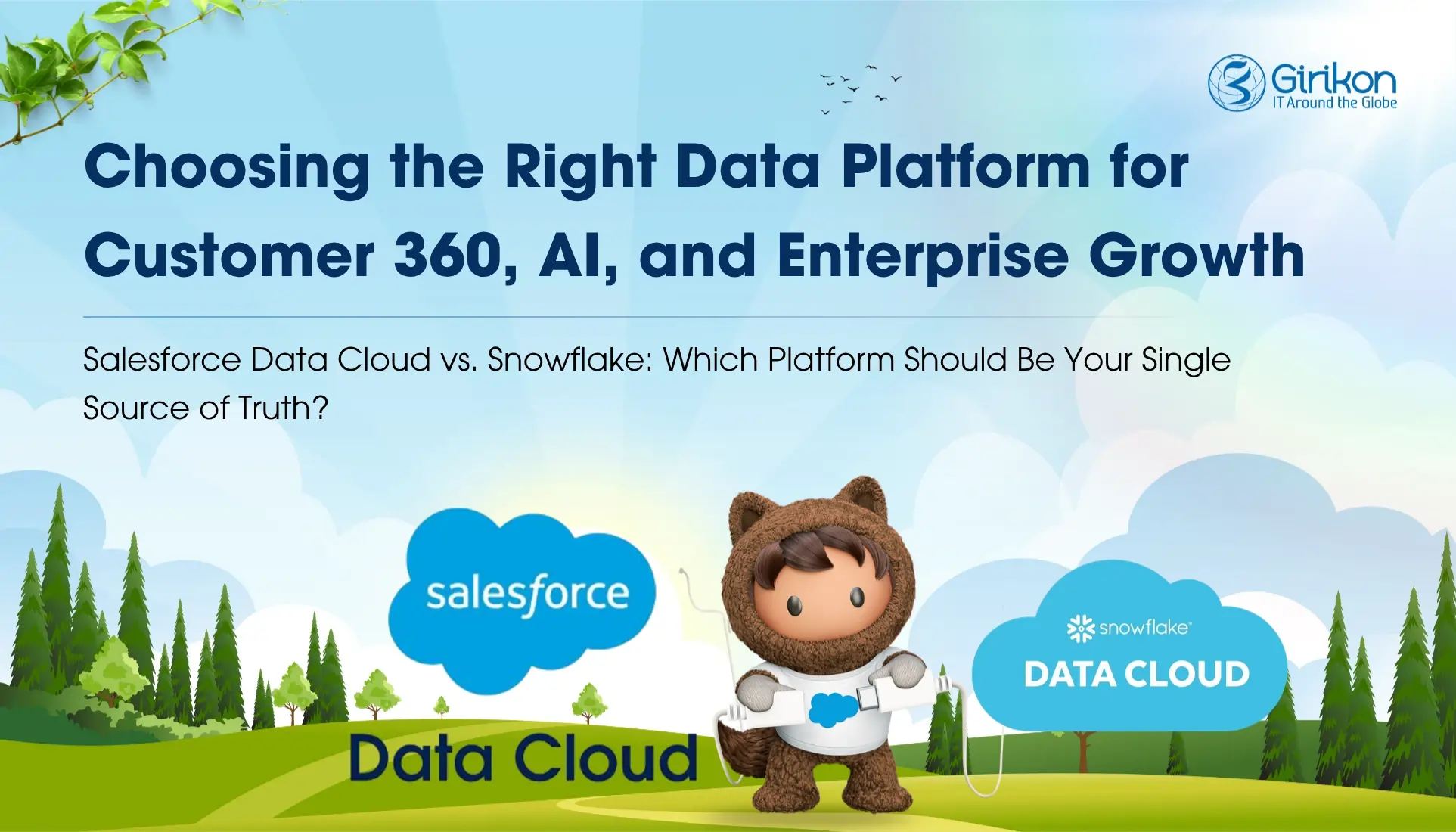
Selecting a database to save, secure, monitor, and perform analysis would seem like a smart decision for your business needs. So, what would you pick if you had to choose the one from these two giants: Salesforce Data Cloud vs Snowflake?
While Snowflake gives complete control over data transformation and analytics, let’s find out the right pick for your business.
Why Single Source of Truth Matters More Than Ever
No business can afford to have data fragmentation because it results in duplicacy, poor customer experience, delay in taking any decision, and so on. In today’s time, the challenge is no longer in collecting data (or information) but making sure that all the teams have access to a unified platform.
What if your company has been running disconnected systems for a long time? Like the sales team depends on the CRM for data, analytics use completely different datasets. Marketing sees the entire customer lifecycle within the unified view.
What happens at the time of such differences? Inconsistency takes over that affects the entire reporting system. Unable to decide, etc.
And that’s where the Data Cloud vs. Snowflake single source of truth concept comes into play. The focus is entirely on where a business can build a strong foundation to make insightful decisions, understand customer expectations, and drive long-term growth. Exploring the various use cases Salesforce Data Cloud implementation supports can further help organizations determine which platform best aligns with their business objectives and data strategy.
Now, comes another question! The source of truth should revolve around customer activation and unified profiles, or simply centralized data storage along with analytics?
What Is Salesforce Data Cloud?
Formerly, Salesforce Data Cloud was known as the “Customer Data Platform.” The purpose of designing this platform is to store data from multiple sources in one unified place. The information can be from anywhere: be it CRM systems, marketing platforms, service channels, websites, any external source and more.
One of the core competencies is data cloud identity resolution. It helps in connecting the records across various systems and building a single customer profile. In simple terms, the only focus of the Salesforce data cloud is to make the customer data accessible on operations, like sales, marketing, or service.
Read More: Top Salesforce Data Cloud Implementation Use Cases
What Is Snowflake?
Snowflake is a cloud-based data platform that was created specifically for storing, maintaining, and processing numerous datasets of business data that come from different sources. Its intention is to help organizations create a complete view of their customers and unify all types of data across their business to turn it into actionable insights.
The reason many businesses use Snowflake is that they want operational, customer, and analytical data in a unified environment so that teams don’t have to switch between platforms for reporting, forecasting, and decision-making. One of the key advantages of Snowflake is the flexibility it provides for data transformation, advanced analytics, and long-term data management. When combined with salesforce data cloud implementation for business success, organizations can unify customer data across systems, generate deeper insights, and make faster, more informed business decisions.
A Detailed Comparison Between Salesforce Data Cloud vs Snowflake
Both platforms have one goal: helping businesses manage their data. The only thing is they have their own definition of a single source of truth.
Salesforce Data Cloud enables a single view of the customer profile, making the data accessible to all business functions. Connecting customer data from disparate sources of engagement to enable teams to provide a cohesive and personalized experience to customers.
Snowflake offers a comprehensive, fully managed solution. Since data exists on one platform, businesses can effectively manage and store vast quantities of data. This helps the team to create reports and analyze them to make future ready decisions.
Here is a simplified comparison:
| Features | Salesforce Data Cloud | Snowflake |
|---|---|---|
| Primary Focus | Customer data unification | Enterprise data management |
| Core Use Case | Customer engagement & activation | Storage, analytics, and transformation |
| Best Suited for | Sales, marketing, and sales team | Data and analytics team |
| Data Approach | Unified customer profiles | Centralized business datasets |
| Strength | Real-time customer understanding | Scalable analytics & flexibility |
Can Salesforce Data Cloud and Snowflake Work Together?
Picking between Salesforce Data Cloud and Snowflake is not always about choosing one and not considering the other at all. There are organizations that are adopting a Salesforce Data Cloud Snowflake integration approach for a more connected data strategy.
In this type of model, Snowflake acts as a unified database while Salesforce Data Cloud consumes that data and builds a personalized customer experience that drives business actions.
This has been enabled by features such as Snowflake zero ETL Salesforce, designed to remove unnecessary data movement and enable data consumption across connected environments.
Snowflake
Centralized data storage, transformation & analytics layer
Zero ETL
Salesforce Data Cloud
Customer profile activation, personalization & CRM actions
As the discussion regarding Salesforce Data 360 vs Snowflake in 2026 evolves, the conversation has shifted away from determining which platform will be responsible for all data to focusing on how both platforms can work together to establish a more reliable and scalable “single source of truth.”
Wrapping Up
There’s no single definitive choice to pick between Salesforce Data Cloud vs Snowflake because every business has a different notion of a single source of truth.
For companies centered around delivering personalized customer experiences and unifying customer profiles, Salesforce Data Cloud might offer a more operational approach to realizing a unified customer view. However, businesses looking at data from an integrated standpoint for analytics and future scalability might prefer Snowflake.
This becomes a tricky decision, as data integration tools’ capabilities continue to evolve, shifting away from traditional single, siloed integration solutions toward integrated data solutions for modern enterprises, including robust Salesforce integration capabilities
Discussions around picking up the suitable platform seem to be about achieving reliable, actionable, and accessible data across teams, rather than choosing the best piece of technology available. At the end of the day, it isn’t about the platform that really matters — it is about the business decisions and the business outcomes that the data drives.
About Author

Sakshi specializes in creating high-quality, SEO-driven content focused on Salesforce, CRM, and business automation. She writes blogs, landing pages, solution pages, case studies, and thought leadership content that simplifies complex Salesforce concepts, highlights business value, and helps organizations make informed CRM decisions.
Share this post on: