 +1-480-241-8198
 +44-7428758945
 +61-1300-332-888
 +91 9811400594
Appointments adjust themselves based on availability. Referral requests are automatically sent to the correct specialists. At the same time, high-risk patients get flagged immediately for follow-up, like it’s just handled. All without the staff manually checking, making calls, and forwarding documents. This is no longer just a vision for the future — it is becoming a reality through Salesforce Health Cloud hospital automation.
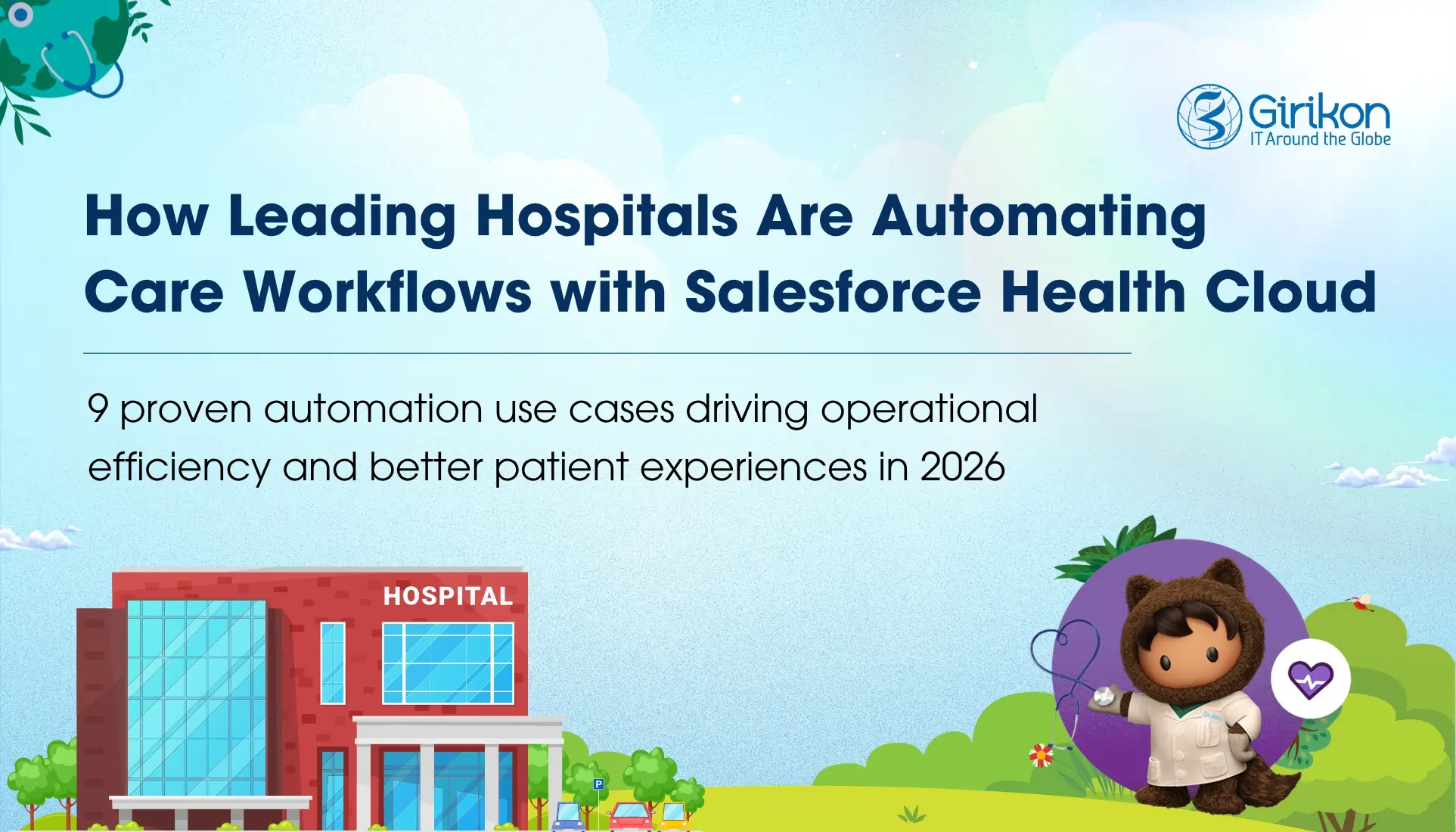
While automating workflow, the tool simplifies operations, connects teams, and improves care coordination. It appears as a game changer for hospital teams who find themselves trapped in repetitive manual tasks and disconnected workflows.
Moreover, with its latest Health Cloud workflow automations, hospitals are kind of rethinking how care teams collaborate, communicate ,and deliver patient-centric services throughout 2026. Backed by seasoned Salesforce healthcare partners, healthcare organizations are streamlining things, tightening care coordination and—somehow—making patient outcomes better. Read through the blog ,to get a sense of the hospital workflow automations that are being built with Salesforce Health Cloud in 2026.
9 Salesforce Health Cloud Hospital Automations
01
Automated Patient Intake and Registration
The first real touchpoint between hospitals and patients is basically patient intake. But it comes with repetitive paperwork, manual data entry, and long lines, all while depending on old school onboarding routines. This not just brings delays but also frustrates patients and increases the chances of inaccurate information.
The best part? Salesforce data cloud implementation allows hospitals to streamline the overall intake workflow. In other words, patients can fill out the forms online without coming to the hospital, meanwhile the platform generates the consent documents itself, stores demographic details, and checks insurance eligibility in real time too.
Also, Salesforce Health Cloud hospital automation reroutes patient cases toward the right departments based on their medical needs, which reduces needless waiting and speeds up registration — what most hospitals want in the first place.
02
Smart Appointment Scheduling and Reminder Automation
Scheduling conflicts are everywhere because staff availability, appointments, and medical resources overlap and fail to align properly. Staff needs to manage calendars manually, make repeated phone calls, and coordinate rescheduling requests in a manual reminder setup. This is where those operational hiccups begin to emerge in the hospital.
However, when you add workflow automation, Salesforce for hospitals 2026 creates automatic email confirmations, patient SMS reminders, and more without requiring staff to touch any of them. To reduce no-show rates, Salesforce Health Cloud hospital automation allows teams to engage with patients proactively before the scheduled visit.
03
Referral Management and Triage Automation
Routing referrals to the appropriate specialists is one of the most time-consuming processes in healthcare operations. And delays in such processes can affect treatment outcomes and patient care timelines. Salesforce Health Cloud use cases for hospitals ensure referrals are automatically triaged based on urgency levels, patient conditions, and availability.
It also verifies all required and submitted documents before processing the referral. This makes it easier for team members to monitor referral progress, improve operational transparency, and eliminate communication gaps between the process. Moreover, automated referral triage and coordination reduce admin workflow, ensuring timely specialist care and better treatment outcomes.
04
Care Coordination & Case Routing
Scattered patient data creates inconsistencies with how hospitals provide coordinated care. This can be resolved with Salesforce Health Cloud that automatically assigns care coordinators for patients, creates follow-up tasks, and alerts teams about high-risk situations. For example, if a patient missed his/her medication on time, the automated workflows would advise the appropriate teams regarding these missed medications and allow timely interventions.
Also, doctors, care coordinators, and specialists can view their patient’s entire medical history in one steady display which helps in making more accurate decisions and easier collaboration. In the end, delays caused by disconnected workflows mostly disappear.
05
Prior Authorization and Approval Workflows
One of the biggest challenges in hospitals is none other than prior authorization requests and insurance approvals — because it involves payer verification delays and repetitive paperwork. Long approval cycles also add to administrative challenges. Luckily, Salesforce Health Cloud use cases for hospitals streamline authorization workflow.
The tool automatically collects required documents, validates payer requirements, and routes requests to the correct teams for approval. It also simplifies authorization status updates, thus helping both staff and patients stay informed throughout the process.
06
AI-Powered Patient Follow-Up System
That window right after discharge really decides long-term outcomes and readmission risk. However, it also involves a great deal of paperwork. But not anymore with care coordination automation Salesforce. Hospitals can send medication reminders, discharge summaries, wellness check-ins, and follow-up appointment notifications by analyzing patients’ info.
Moreover, hospitals can quickly identify those who are likely to be readmitted or will develop additional conditions. This helps care teams to make a quick response to these patients. All these workflows support continuity of care while reducing avoidable readmissions.
07
Capacity Management in Real Time
It requires constant coordination between staff, resources, and departments to manage hospital operations efficiently, especially during high patient volumes. That’s where Salesforce Health Cloud hospital automation really shows up — it improves operational visibility through connected workflows, not only reports.
It helps hospitals automatically keep an eye on bed availability, refine staffing allocation, and coordinate patient transfers. If bed occupancy starts hitting critical levels, the system can automatically suggest operational tweaks and notify administrators right away. Further, emergency departments coordinate patient movement more seamlessly during emergencies, ensuring faster and more organized patient care.
08
Remote Patient Monitoring Automation
By integrating with wearable devices and remote monitoring systems, Salesforce Health Cloud implementation automates patient monitoring workflows. It can easily monitor important patient health data — oxygen saturation levels, blood pressure, blood sugar levels, heart rate, etc. — in real time so that if any of these values are abnormal, it can automatically send an alert to the care team and initiate contact with the patient immediately.
And it does that without requiring manual data entry, the system can even update patient records on its own. This ensures that hospitals can extend care beyond just physical facilities, thus enabling faster invention for patients who are in need of immediate medical attention.
09
Clinical Documentation and Administrative Workflow Automation
Dealing with documentation, claims handling, compliance reporting and approvals, plus that whole admin overload in the health sector, is pretty significant. But with Salesforce Health Cloud hospital automation, things can get less chaotic, you know, because it can automate documentation routing, audit tracking, record updates , case summaries, and even claims prep. When organizations dig into how many companies use Salesforce, and why it still stays a top CRM platform, its ability to reduce friction in healthcare operations tends to stand out as a big advantage.
Leveraging its AI-assisted workflows, clinicians access centralized information easily instead of manually navigating multiple systems, thus simplifying compliance processes. Moreover, the less reliance on manual workflow helps hospitals improve operational productivity while allowing healthcare professionals to spend more time delivering quality patient care.
Conclusion
With all these Salesforce Health Cloud use cases for hospitals, you can learn how the platform is making a measurable impact. From referral management to patient intake, and post-discharge engagement, automation is the ultimate source that helps hospitals build more efficient and patient-focused operations.
If you want to streamline care delivery, respond faster, and improve collaboration while reducing repetitive administrative work, it’s time to switch to Salesforce Health Cloud hospital automation. By combining intelligent workflow automation with generative ai consulting services, healthcare organizations can enhance operational efficiency, automate routine processes, and deliver more personalized, coordinated care at scale.
From referral management to patient intake and post-discharge engagement, automation helps hospitals build more efficient and patient-focused operations — providing more coordinated care at scale.
About Author

Shivani is a Technical Content Specialist at Girikon with deep expertise in turning intricate technologies into engaging narratives. Her renowned experience and keen interest in technologies allows her to draft compelling and digestable insights for tech-savvy leaders. She helps businesses navigate the labyrinth of innovation, leveraging her proficient skills and visionary attitude.
Share this post on: