 +1-480-241-8198
 +44-7428758945
 +61-1300-332-888
 +91 9811400594
Salesforce can feel like a family reunion where everyone’s secretly fighting over the remote. In case of Salesforce for Sales Leaders, it’s the place where deals live or die. For RevOps, it’s the backbone of the entire revenue engine. For the CIO, it’s a massive, business-critical system that better not break, leak data, or blow up the IT roadmap. And somewhere in the middle of all that, CRM ownership conflict quietly bubbles away while everyone claims they “just want what’s best for the business.”
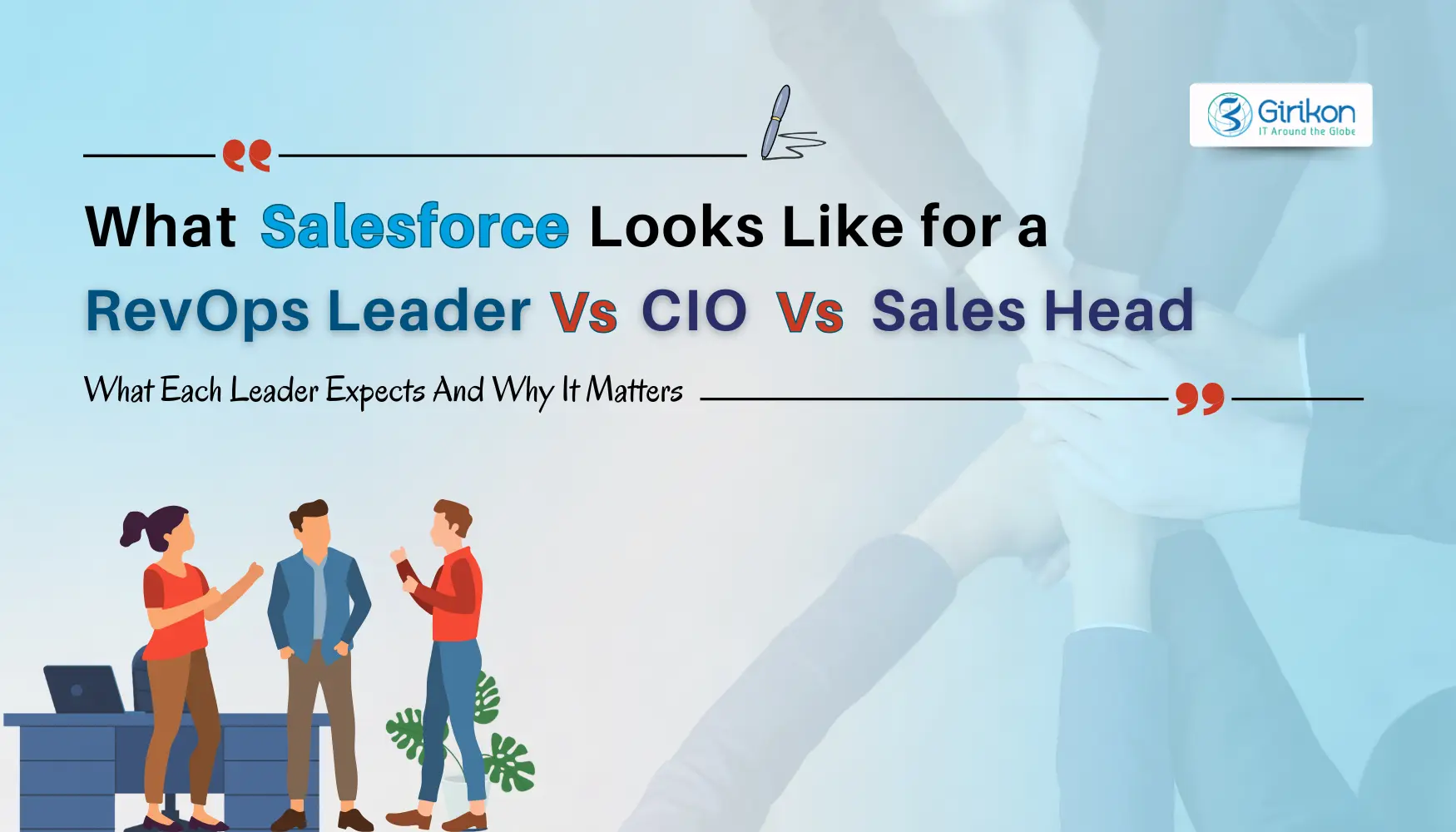
Anyway, let’s walk through how Salesforce really looks from each side of the table – and what it takes to get those perspectives working together instead of pulling in opposite directions.
Salesforce for RevOps: The Revenue Engine Control Room
When we think about Salesforce for RevOps, we’re basically talking about the control room for the entire go-to-market motion. RevOps leaders don’t just care about opportunities or tickets in isolation. They care about how leads move from Marketing, to Sales, to Customer Success, and then loop back into expansion or advocacy.
So in their world, Salesforce isn’t “the sales tool.” It’s the revenue system of record.
Typical RevOps questions inside Salesforce sound like:
- Where are we leaking pipeline?
- Which segments move fastest from lead to won?
- Are renewals and expansions tracked the same way across regions?
RevOps leaders obsess over consistency. They want standardized stages, clean picklists, and automation that makes handoffs boring in the best way possible. According to Salesforce’s own guidance on revenue operations, the goal is to align every revenue touchpoint – marketing, sales, customer success, and finance – around one shared process and one shared source of truth.
You know that feeling when every team has its own spreadsheet, its own “version” of the number? RevOps hates that. Their dream is:
- One forecast everyone trusts.
- One account view that spans marketing activity, open deals, live contracts, and support history.
- One set of definitions for “qualified,” “pipeline,” and “live customer.”
Kind of makes you think: most “misalignment” isn’t about people. It’s about data and process not lining up.
What RevOps Actually Does Inside Salesforce
If we zoom in on the day-to-day, a RevOps leader’s to-do list inside Salesforce is surprisingly tactical, even though the role is strategic.
They’re usually:
- Designing and refining process workflows (how an opportunity moves, when a renewal kicks off).
- Building and maintaining reports and dashboards for leaders.
- Testing automation: flows, validation rules, routing.
- Cleaning data – duplicates, bad picklist values, fields nobody uses.
One RevOps lead described their mindset simply: “How does this impact pipeline generation or deal closing?” That’s the lens. If a new field, rule, or integration doesn’t help create or close revenue, it’s probably noise.
A simple RevOps-friendly mini framework for Salesforce:
- Map the full revenue lifecycle inside Salesforce (lead → opportunity → contract → invoice → renewal).
- Assign clear ownership for key objects (Opportunities, Contracts, Invoices, Payments).
- Automate handoffs where possible, and define escalation rules so nothing falls through the cracks.
Done well, this turns Salesforce from “system of record” into “system of action.” And RevOps becomes the quiet hero keeping it all stitched together.
Salesforce for CIOs: Security, Scale, and Governance
Now, flip to the CIO’s chair. Salesforce for CIO doesn’t start with pipelines or win rates. It starts with questions like:
- Who has access to what?
- Are we compliant in every region we operate in?
- What happens if an auditor walks in tomorrow?
This isn’t paranoia. It’s the job.
From a CIO’s perspective, Salesforce is a giant, cloud-hosted front door to sensitive customer data: deals, contracts, pricing, even confidential notes. As security advisors often point out, the real risk isn’t that Salesforce “goes down” for an hour; it’s governance drift – where Salesforce is technically secure, but out of sync with the company’s access policies, risk frameworks, or compliance model.
So what does the CIO care about most?
- Identity and access: SSO, multiple identity providers, who gets admin privileges.
- Data classification: what’s public, internal, confidential, sensitive.
- Monitoring: event logs, unusual access patterns, privileged-user activity.
- Regular reviews: cross-functional security teams, monthly or quarterly reviews of Salesforce security posture.
To be fair, this angle can feel “slow” to business teams. But when a CIO pushes for permission set reviews or data classification, they’re not trying to block progress – they’re trying to avoid being tomorrow’s headline.
Salesforce for Sales Head: Adoption, Quotas, and Reality
For the Sales Head, Salesforce lives or dies on a simpler question: “Does this help my team sell more, or is it just extra admin?”
This is where Salesforce for sales leaders gets interesting. Adoption, not features, is the deal-breaker. If reps aren’t using Salesforce properly in their daily flow – logging activities, updating stages, entering data – then all the beautiful dashboards in the world are useless.
Sales leaders care about:
- Clean, reliable forecasts they can stand behind.
- Pipeline visibility by rep, segment, and product.
- Fast ramp for new sellers: how quickly someone can go from “new hire” to “productive.”
Studies on CRM adoption show that good enablement and embedded guidance inside Salesforce can lead to big jumps in forecast accuracy and sales productivity. But only if reps aren’t fighting the system at every step.
So, from the Sales Head’s view, Salesforce has to:
- Be easy to update on the fly (especially on mobile).
- Reflect the real sales process, not a theoretical one.
- Provide immediate value back to the rep (reminders, next-best actions, prioritized lists).
Does anybody really enjoy typing into a system that only feels like a compliance tool? Not really. If Salesforce feels like a black hole where data goes to die, adoption tanks and leadership loses trust in the numbers.
Where It Blows Up
Put these three perspectives together and tension is almost guaranteed. That’s where CRM ownership conflict tends to show up.
Common friction points:
- RevOps wants new fields, rules, and objects to support better reporting.
- Sales wants simplicity and speed, and resists anything that slows them down.
- CIO wants tight permissions, limited admin access, and careful control over integrations.
No single view is “wrong.” They’re just incomplete on their own.
One subtle problem: whoever “owns” Salesforce on paper (often RevOps or IT) might not be the one with the loudest voice. If Sales leadership pushes for shortcuts that bypass process, RevOps ends up with messy data. If CIO locks down everything without consulting users, Sales feels blocked and adoption drops. And if RevOps reconfigures objects without looping in IT, governance can drift out of alignment.
You can see how quickly “tool problems” turn into “relationship problems.”
Stakeholder Alignment: From Turf War to Shared Platform
This is where Salesforce stakeholder alignment comes in. Not as a buzzword, but as a survival strategy.
Organizations that treat Salesforce as a shared strategic platform – owned collectively by RevOps, IT, and Sales – tend to do a few things differently:
- They define joint goals: revenue performance, data quality, uptime, and adoption metrics all matter, not just one dimension.
- They create a cross-functional Salesforce or CRM council that meets regularly (monthly or quarterly).
- They use data to mediate disagreements, instead of relying on opinions.
For example:
- RevOps might show that cleaner processes in Salesforce cut the average sales cycle by a few days.
- CIO can bring in security metrics and audit readiness reports, reducing risk for the whole exec team.
- Sales can track which teams with higher Salesforce usage actually hit their quotas more consistently.
When everyone sees their priorities reflected in the roadmap, alignment stops being abstract.
A Simple Three-Lens Framework for Making Salesforce Work
If we had to boil all of this into a simple framework, it might look like this:
RevOps owns “How the revenue engine works.”
Process design, lifecycle mapping, automation, and reporting.
CIO owns “How the system behaves.”
Security, access, integrations, compliance, and long-term scalability.
Sales Head owns “How people actually use it.”
Adoption, coaching, forecasting discipline, and ensuring the process reflects reality on the ground.
When those three share the salesforce roadmap – and agree that Salesforce is a strategic asset, not just a tool – everything changes. Salesforce becomes less of a battleground and more of a shared operating system for growth.
Look, Salesforce isn’t magically going to align these roles on its own. But with the right conversations, a bit of structure, and clear ownership of who drives what, it stops being a source of constant tension and starts feeling like what it was meant to be: the place where the business actually comes together.
FAQs
How can organizations improve Salesforce adoption across leadership teams and users?
Improving adoption requires aligning Salesforce with real business workflows, minimizing unnecessary complexity, providing proper training, and ensuring the system delivers visible value to users. Executive alignment, continuous optimization, and governance frameworks help Salesforce remain relevant, trusted, and actively used across departments.
Who should own Salesforce in an organization: RevOps, IT, or Sales?
Salesforce works best when ownership is shared across RevOps, IT, and Sales with clearly defined responsibilities. RevOps typically manages process design and reporting, IT oversees security and governance, and Sales drives adoption and usage. Organizations that establish cross-functional governance structures ensure Salesforce remains aligned with both business and technical priorities.
Why is stakeholder alignment critical for Salesforce success?
Salesforce touches revenue operations, customer data, compliance, and forecasting. Without alignment, conflicting priorities can lead to poor adoption, unreliable reporting, or governance risks. Alignment ensures Salesforce functions as a trusted system of record and action, enabling accurate forecasting, secure data management, and scalable revenue operations.
About Author

Indranil is a technology enthusiast with over 25 years of experience in project management, operations, technology and business development. Indranil has led project teams in egovernance, business process re-engineering, product development and worked with Government and Corporate customers. Indranil truly believes in the power of technology to drive productivity and growth for teams and businesses.
Share this post on: