 +1-480-241-8198
 +44-7428758945
 +61-1300-332-888
 +91 9811400594
Salesforce has transformed the way businesses operate and interact with customers. With its AI capabilities, the CRM platform is now smarter, faster, and more predictive. Salesforce Einstein AI is one such innovative AI tool. It has been enhancing business processes and customer engagement with out-of-the-box features and intelligent agents. However, these benefits can only be realized if your organization follows a Salesforce AI implementation strategy. Without it, you risk low adoption and poor ROI.
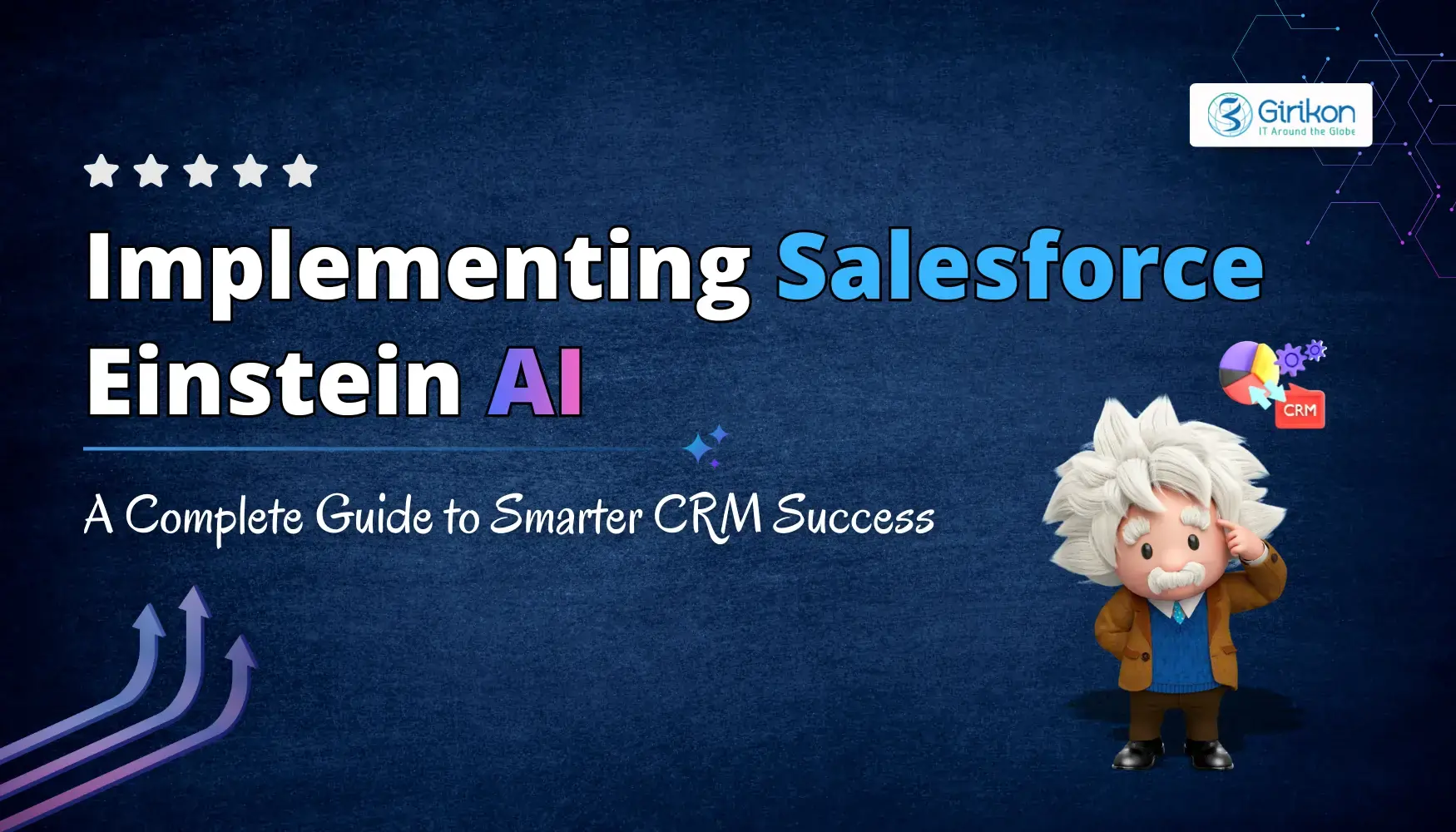
A proper guide for Einstein AI setup for Salesforce will help you align AI tools and features with business objectives, optimize resources, and ensure ethical AI usage. Therefore, in this blog, we’ll explore practical steps for Salesforce Einstein AI implementation and discuss popular Salesforce Einstein AI use cases. In addition, we’ll also share common mistakes to avoid during your Salesforce AI consulting journey.
What is Einstein AI for Salesforce?
Salesforce introduced Einstein in 2016 to help organizations work smarter and move faster. Because it’s built directly into the Salesforce platform, teams gain access to a wide range of intelligent features that simplify daily work. From boosting performance to guiding better decisions and delivering more personalized experiences, Einstein makes it easier for businesses to focus on what matters most.
Key Salesforce Einstein AI Use Cases
- Smarter Lead Qualification: Einstein Salesforce can predict lead conversion. This enables the sales team to focus on the high-value prospects and improve the Salesforce AI implementation strategy results.
- Pipeline & Revenue Forecasting: Einstein AI provides precise forecasts that include closure of deals, revenue trajectories or lead drop, and, thus, allows planning ahead.
- Customer Support Intelligence: AI-powered functions such as case classification, sentiment analysis, and automated response are used to improve the service functions to lower response time and deliver customer experience that can be better personalized.
- Personalized Marketing Journeys: Einstein AI personalizes the marketing campaign on the basis of customers’ journeys and forecast recommendations, thereby enhancing market reaction and ROI.
How to Implement Salesforce Einstein AI Successfully: 7 Best Practices
Following are practical steps for you to consider before you develop Salesforce AI implementation strategy for your organization:
Step 1: Always Align Initiatives to Outcomes
Begin by understanding areas where smart suggestions can generate viable operation or shift. This may include enhancing the conversion rates, faster response to service, enhancing renewals, or stabilizing the forecasts. In addition, identify the baseline, responsibility, and ensure a way in which progress will be evaluated in the future. When you have solid goals, it provides a sense of direction and assists the stakeholders in assessing the investment’s worthiness.
Step 2: Enforce Disciplined Data Governance
Einstein AI represents the quality of information that it gets, therefore reviewing processes, defining, and fixing structural inconsistencies that may affect the behavior of the model. You must also set up ongoing stewardship to ensure that records are not compromised by the expanding organization. So, when users notice the information is correct, they are more likely to follow and implement the output.
Step 3: Secure Cross-Functional Sponsorship
Teams must coordinate well to ensure successful adoption because they’re the ones who generate data and act on insights. There, accountability of priorities, sequencing and policy decisions should be spread out among sales, service, marketing, and IT. This visible partnership among leaders helps to minimize the friction, encourage collaboration, and secures the belief that AI is at the core of how business wants to operate.
Step 4: Mandate Transparency in Predictions
People trust outputs that they can interpret, so, present the factors, trends, or historical patterns that contributed to each result, and users understand the logic. Context enables professionals to combine their judgment with analytical support, and over time, this clarity boosts confidence and drives more consistent use across the company.
Step 5: Embed Insights into Workflows
Insights work only when they can be used when they are needed the most. Embedding recommendations directly into your CRM key areas like opportunity management, service consoles, and operational dashboards minimizes disruption. Users can respond immediately without switching tools, which increases responsiveness and makes intelligent decision-making part of normal execution.
Step 6: Enable Role-based Learning
Different audiences need different depths and framing based on their own understanding. This is why it enables personalized learning based on everyday tasks, examples of how predictions are used to determine priorities, the timing of outreach, and management control. Deliver lessons with examples based on real scenarios so employees can relate outputs to their own work and gain confidence in the system to use it fully.
Step 7: Drive Continuous Evaluation
Once you successfully complete the Salesforce implementation roadmap, you must also ensure how it’s performing and where the gaps are in delivery. Because customer expectations, market demands, and internal processes fluctuate rapidly. Periodic tests of accuracy, adoption and business impact assist you in knowing where to make changes or amendments. Sustained attention is proactive to keep the system at par with strategy and a reliable source of its guidance.
5 Tips to Avoid Common Mistakes in Salesforce AI Implementation Strategy
- Pursuing AI without a defined value alignment: If the goal is unclear, enthusiasm will be limited. Teams need to know how effort contributes to measurable improvement and why their participation matters.
- Confusing configuration with transformation: New capability does not automatically change habits; you need proper reinforcement from managers and teams alike. If not, then performance dips as people often return to familiar methods.
- Overlooking integration complexities: Many outputs rely on information that originates elsewhere; therefore, you need proper integration. When those connections are incomplete or unreliable, users quickly question what they see.
- Leaving ownership undefined after launch: Initiatives lose momentum when no one is clearly responsible for outcomes. You must name accountability and ownerships to keep enhancements moving and ensure relevancy as priorities evolve.
- Expecting immediate precision: Accuracy improves with time, volume, and feedback, and not overnight. Allowing room for growth helps maintain confidence while the system matures.
Build vs Partner: When to Work with a Salesforce AI Consultant
| Factors | Build in-house | Hire Salesforce AI Consultant |
|---|---|---|
| Expertise | Relies on internal Salesforce admins, data teams, and IT capacity. May face steep learning curves. | Gains immediate access to specialized AI + Salesforce expertise, reducing trial-and-error. |
| Speed to Value | Longer time due to data preparation, model training, and workflow integration. | Faster timelines with proven frameworks, pre-built assets, and best practices. |
| Risk Management | Increased due to poor data management practices, unrealistic expectations, and low adoption. | Consultants employ governance, change management, and adoption strategies to lower risks. |
| Cost Profile | Lower upfront spending if internal resources are available, but hidden costs are due to delays and rework. | Higher service investment, but clearer ROI through faster deployment and reduced errors. |
| Scalability | Scaling depends on internal bandwidth and skill growth. May stall at an enterprise rollout. | Consultants enable enterprise-grade scaling with integration support and ongoing optimization. |
Summing It Up Salesforce Einstein AI Implementation
So far, we’ve understood that as Salesforce’s flagship tool, Einstein AI has a horde of benefits for businesses like automating processes, enabling smarter decisions, and delivering personalization at scale. It’s fair to say that Salesforce Einstein AI implementation helps businesses turn their CRM from a customer database to an intelligent decision-making system. And companies that intend to make the most of this powerful technology must have a solid Salesforce Einstein implementation strategy.
For businesses that wish to focus on the core tasks while still using this advanced Einstein AI technology, we recommend you seek a Salesforce AI consulting services provider. They have certified Salesforce AI experts that can assist you with Einstein AI set up for Salesforce, helping you enhance productivity, boost innovation, and deliver AI-powered experiences that resonate with customers.
FAQs
What is the difference between Salesforce Einstein AI vs Agentforce?
Salesforce Einstein AI and Agentforce differ in scope and focus. Einstein AI is Salesforce’s long‑standing AI suite offering predictive analytics, automation, and personalization across CRM. Agentforce, introduced later, is built specifically for generative AI agents, enabling conversational, task‑driven automation and customer engagement.
Together, they complement each other, Einstein drives insights, while Agentforce powers intelligent, interactive experiences.
Together, they complement each other, Einstein drives insights, while Agentforce powers intelligent, interactive experiences.
Is Einstein AI Worth It?
The Salesforce Einstein AI is very beneficial to businesses with its advanced AI tools and features. Common Salesforce Einstein AI use cases include sales forecasting, service chatbots, marketing personalization, and workflow automation. You can achieve high efficiency, customization, and tangible business outcomes with a strong Salesforce AI implementation strategy.
What is the Einstein AI setup for Salesforce?
Below are the 5 steps to help you in Salesforce Einstein AI implementation:
- Define the Salesforce AI implementation strategy aligned with business goals.
- Enable Einstein AI setup for Salesforce in admin settings.
- Integrate with CRM workflows and other automation capabilities.
- Configure prompts and generative templates.
- Test, refine, and optimize with Salesforce AI consulting support.
About Author

Anjali is a technical content writer and strategist with 9 years of experience, bringing expertise in creation and strategy for IT services, software development, and Salesforce consulting companies. She excels at developing SEO-driven storytelling and technical narratives, and in crafting marketing assets that boost visibility, accelerate sales, and deliver measurable business growth.
Share this post on: