 +1-480-241-8198
 +44-7428758945
 +61-1300-332-888
 +91 9811400594
It’s an understatement that AI has changed how business operates, delivers services, and drives more revenue with intelligent decision making and data processing. However, not every AI project generates revenue, in fact, according to the MIT report, nearly 95% AI projects fail. The reason is more to do with whether the enterprises were AI-ready or not, and less on the technology itself. This becomes crucial because businesses on the CRM platform have been offering something powerful like Einstein and Agentforce. This is why Salesforce AI readiness assessment is crucial. But it goes beyond tools or technologies and starts with ensuring your people, processes, and existing technology is aligned to extract real, scalable AI values.
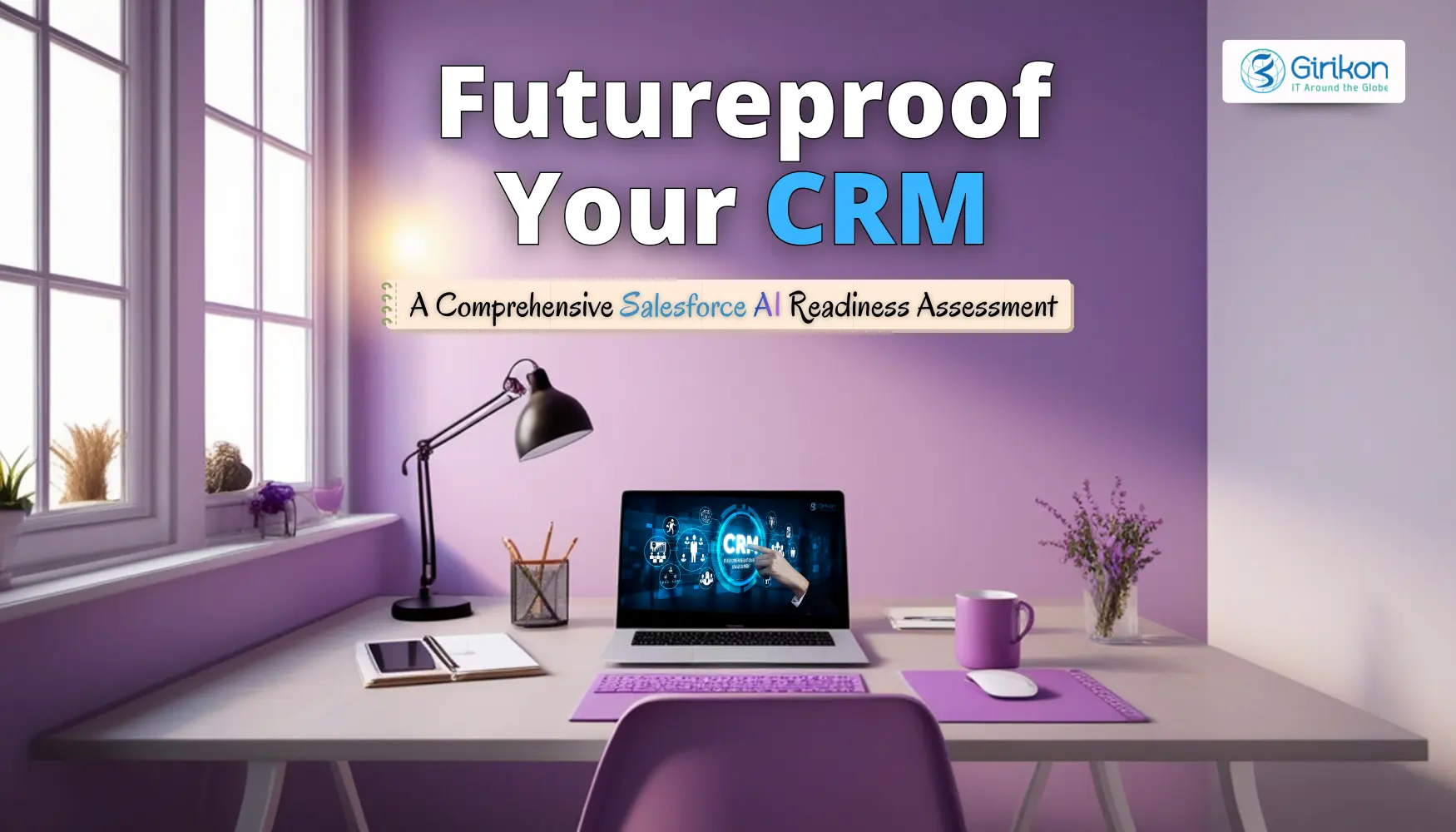
Additionally, with the help of Salesforce Einstein readiness and expert salesforce consulting services, you can take your AI investment from being some kind of high-risk experiment , into a more dependable engine for growth. A thorough AI readiness assessment basically helps make sure your AI systems run safely and effectively next to the existing business processes, not over them. If you don’t do this prep work, those AI initiatives might not bring the expected results , and then you end up with low adoption rates, outputs that are kinda off , and more operational complexity than you wanted.
When teams leverage professional salesforce consulting services, they’re able to spot readiness gaps early, craft a structured approach for AI adoption, and get the most out of the Salesforce AI capabilities. So in this blog we’ll talk about what a Salesforce AI readiness assessment actually is, why it matters, and the best practices that help your organization adopt Salesforce AI innovations faster, in a cleaner way, and with fewer surprises.
Why is Salesforce AI Readiness Important?
Salesforce AI readiness is important because it guarantees that your CRM, data, and processes are in a position to utilize Salesforce’s Einstein and other AI capabilities in their full capacity. Without this readiness, AI tools may provide inaccurate and unreliable insights or fail to integrate smoothly with your existing systems. However, with an effective Salesforce AI implementation readiness you can detect the anomalies in the quality of data, user adoption, and system alignment. This will eventually help your organizations to achieve reliable predictions, smarter automation, and get the maximum value out of your Salesforce AI ROI.
So, as you go about getting meaningful results from Einstein features, your Salesforce environment must be ready to support them. And no, it’s not about checking technical availability. You must ensure you have use case clarity, operational capability, and know best practices for Salesforce data migration, as all these factors combined will decide whether output is reliable, accurate, and trusted by users, but more importantly usable at scale.
Core Einstein AI Implementation Prerequisites
- Supported Salesforce editions: Einstein functionality is linked to specific editions and licenses. So, verify feature eligibility early to prevent misaligned planning and avoid redesigning use cases around unavailable capabilities.
- Defined business use cases: You must address a specific business requirement with Einstein. When you have a clear understanding of why you want to use the technology, critical insights remain relevant to decision-making.
- Keep your objects and fields clean: Too many custom objects, duplicate fields, or messy naming conventions can make predictions go off-tack and make it harder for teams to understand the results.
- Role-based access controls: Einstein runs on already established permission frameworks. But poorly defined access models can limit how much insight is shown, or sensitive information can get to unintended users.
- Feature Set-up and governance control: Review and configure Einstein features against internal governance, security, and compliance needs. This will stop non-compliance or security breaches and promote responsible and dependable implementation of Salesforce AI features.
What is Salesforce Data Readiness for AI: Key Evaluation Criteria
Following are key criteria to ensure you’ve AI-ready CRM Data:
- Data quality: Ensure that the data that you incorporate into the system is complete, accurate, and free of duplication. Validation rules, required fields, and regular audits will assist you in maintaining trustworthy inputs of predictive features.
- Data consistency: Fields must follow shared definitions and formats across teams and regions. This consistency allows for reliable comparisons and prevents misinterpretation during analysis.
- Historical depth: When you’ve limited or fragmented histories, it reduces trust in predictions. So, use historical data to accurately track trends, seasonality, and behavioral shifts. Limited or fragmented histories reduce confidence in predictions.
- Data ownership: Each dataset must have a clear owner with the responsibility to maintain data accuracy, update, and governance. Specified ownership will decrease negligence and accelerate issues.
From Data to Adoption: The Salesforce AI Readiness Checklist
Align with Business Priorities
When you set up business requirements early on, it keeps data preparation, feature choice, and measurement focused on outcomes that matter. Therefore, Einstein initiatives should be guided by clearly defined business problems rather than platform interest. Each use case must connect to outcomes such as forecast accuracy, service efficiency, or retention improvement. When objectives are vague, insights lack direction and rarely influence action.
Stabilize Data Model
A stable object and field structure supports consistent learning over time because frequent schema changes interrupt pattern development and weaken prediction of reliability. During salesforce data cloud implementation, ensure proper reviewing of custom objects, relationships, and field usage before activation; this helps reduce rework, preserves comparability across reporting periods, and maintains reliable, high-quality data for long-term reporting and analytics.
Integrate Systems Deeply
Salesforce Einstein depends on a unified view of customer activity through the cycle, but gaps between Salesforce and marketing, finance, or other support systems lead to partial signals. With your Salesforce AI readiness assessment, you can analyze data flow reliability, sync timing, and coverage of attributes. In addition, when you have proper integrations with your existing systems, improve context and reduce time and effort with manual intervention.
Drive User Adoption
Insights only create value when users trust and apply them; teams need clarity on how recommendations are generated and where human judgment remains essential. Role-based training, usage guidance, and expectation setting are critical. If you don’t have proper planning, even accurate outputs aren’t fully utilized or are completely ignored.
Enforce Data Compliance
AI increases the impact of existing data risks. Readiness includes reviewing access controls, consent handling, retention policies, and audit mechanisms. Einstein outputs must align with internal governance standards and external regulations. Weak controls limit usable datasets and increase exposure.
Scalability and Future-State Planning
Especially, when AI use cases rarely stay small, so your readiness assessment must anticipate higher data volumes, additional users, and broader deployment. In order not to redesign it once again, reconsider aspects such as performance limits, licensing consequences, and supporting capabilities. Long-term planning ensures that technical scalability is in sync with the changing business priorities and helps in anticipating smoother upgrades and prevents bottlenecks as adoption grows.
Refine Through Feedback & Monitoring
Even if you’ve deployed the Salesforce AI features pretty efficiently, it’s still crucial to watch how they actually perform against real outcomes. Working with the right Salesforce implementation partner can help you keep on monitoring performance, catch weak spots and chances for improvement, and keep tuning AI capabilities as the business needs slowly shift and change. Consider user feedback to implement changes or updates whenever required, while also detecting changing patterns and data inaccuracies. With a regular review process and expert guidance from the right Salesforce implementation partner, you can make timely adjustments before relevance declines or user trust drops.
Common Mistakes During AI Readiness Assessments
- Overestimating data maturity: The presence of reports often masks underlying gaps, and data issues usually surface only when models are applied. So, pilot small use cases early to reveal hidden issues and strengthen data foundations.
- Undefined accountability: When ownership is unclear, issues persist and trust in in insights weaken over time. Assign clear data stewards and AI champions to ensure accountability, faster resolution, and confidence in insights.
- Tool-first implementation: Activating Einstein without a defined problem leads to unused features and ignored outputs. So, begin with business challenges, map tools to address them to make easy adoption possible.
- Insufficient change management: When workflow changes without justification or without adequate training, the adoption will decline in even tech-ready environments. You need to incorporate communication and role-specific training and offer support to facilitate the transitions and give the user confidence in the new process.
- Ignoring long-term maintenance: AI models should be reviewed on a regular basis; otherwise, they will become less accurate and irrelevant without any warning. Therefore, regularly conduct review, retraining, and monitoring should maintain accuracy, relevancy, and long-term business value.
Final Remarks on Salesforce AI Readiness Assessment
As discussed earlier, Salesforce AI readiness assessment is crucial not only for your profit margins but across the enterprise. It’s important because it enables you to have the right capabilities, training, and processes for delivering value quickly and effectively to both your customers and clients.
In this blog, we discussed some of the best ways you can identify and assess AI readiness, avoid mistakes that could cost you both resources, efforts, and time. If the process seems too complicated, we recommend you consult a Salesforce AI consulting services partner. A team of certified Salesforce experts will assist you in deploying AI across the process, thus driving productivity, efficiency, automation in key user journeys and business-critical workflows.
About Author

Anjali is a technical content writer and strategist with 9 years of experience, bringing expertise in creation and strategy for IT services, software development, and Salesforce consulting companies. She excels at developing SEO-driven storytelling and technical narratives, and in crafting marketing assets that boost visibility, accelerate sales, and deliver measurable business growth.
Share this post on: