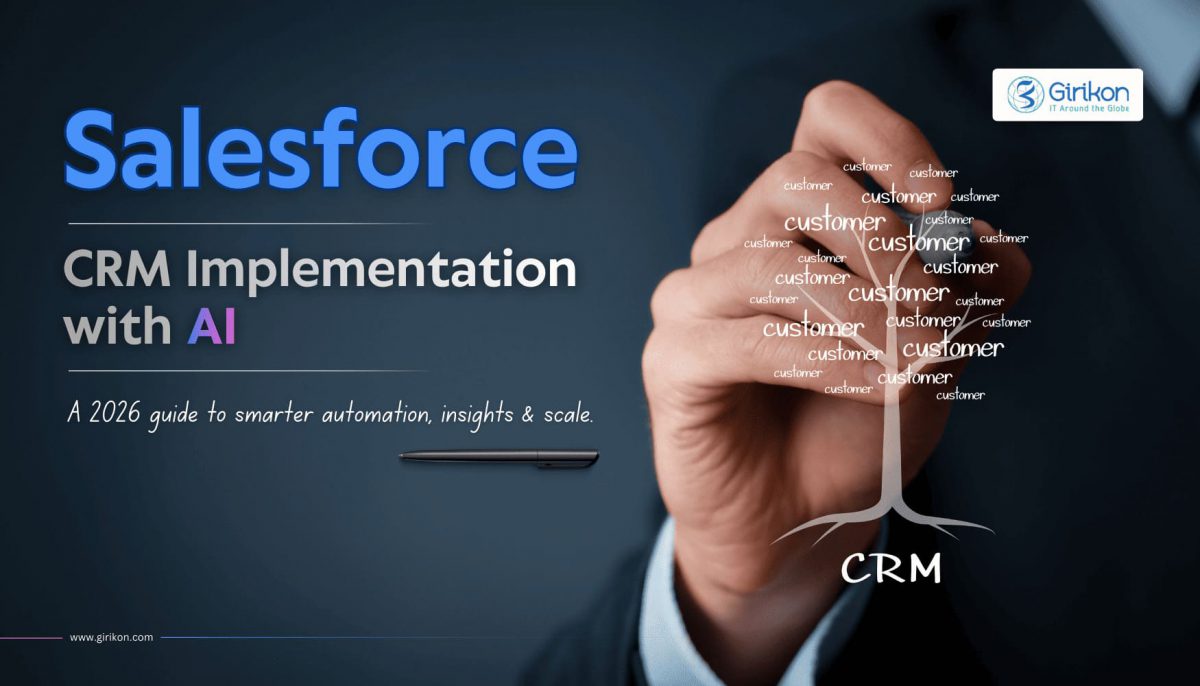
If there’s one thing 2026 is already making clear, it’s this: the companies winning on customer experience are the ones treating AI as part of their CRM backbone, not a bolt-on gadget. When we talk about Salesforce CRM implementation with AI, we’re really talking about rebuilding how sales, service, and marketing workday to day – less manual grind, more intelligent automation.
So, let’s walk through how to actually get there without burning out your team or your budget.
Why AI + Salesforce Is No Longer “Nice to Have”
Look, CRM on its own is already powerful. But without AI, it’s mostly descriptive: reports, dashboards, and maybe a few alerts if you set them up. With AI layered in, Salesforce starts doing things for us, not just showing us data.
Salesforce Einstein and the newer generative AI features help write sales emails, summarize calls, and suggest next best actions using CRM data in real time.
Businesses using AI in sales and service are seeing faster deal cycles and higher CSAT because responses are more relevant and much, much faster.
According to multiple industry studies, a large majority of consumers now prefer messaging or texting businesses instead of calling, because it’s faster and less intrusive. Does anybody really prefer long email chains anymore?
Anyway, the point is: plugging AI into Salesforce isn’t just a tech upgrade – it’s a competitive moat.
Step 1: Get Your CRM House in Order
AI will not magically fix bad data. If your Salesforce org is full of duplicates, half-filled fields, and abandoned dashboards, you’ll just get faster, more polished… wrong answers.
Here’s a simple pre-AI checklist:
Map where customer data lives: Salesforce, spreadsheets, legacy systems, marketing tools, support platforms, etc.
Clean and normalize: de-duplicate accounts/leads, standardize key fields (industry, region, lifecycle stage), and archive dead records.
Review user behavior: if reps log the bare minimum, AI won’t have much to work with.
Salesforce’s Data Cloud (Customer Data Platform) is increasingly central here, because it pulls data from multiple sources, stitches identities, and keeps a unified, real-time profile for each customer. It’s fast. Really fast.
You know how a big percentage of CRM projects fail due to poor adoption and data quality? That issue doesn’t disappear in an AI world – it just becomes more obvious.
A Practical AI Readiness Framework (5 Steps)
Before we talk tools and features, we need a sanity check. Here’s a quick 5-step framework teams are using in 2026 to see if they’re “AI ready” inside Salesforce:
Tech stack audit
Is your Salesforce org integrated with key apps (ERP, marketing automation, telephony, messaging)?
Do you have APIs exposed where needed so Einstein can actually access data?
Security and compliance review
Check policies for GDPR, CCPA, and any industry-specific rules around customer data and AI-driven decisions.
Set up field-level security and audit logs; tools like Salesforce Shield help here.
Data maturity level
Ask: Are our contact, account, and opportunity records at least 80–90% complete for core fields?
If not, invest time here first. Everything else rides on this.
People and change management
Prepare enablement sessions, not just technical training.
Be very clear that AI is here to augment, not replace. Otherwise, resistance will drag down adoption.
Pilot before scale
Pick one contained use case: lead scoring, case routing, or email drafting for one region or one team.
Measure clear metrics: time saved, conversion uplift, CSAT change, etc. Then roll out wider.
If we walk through this first, the rest of the salesforce implementation feels less like chaos and more like a controlled experiment.
What Einstein AI Actually Brings to the Table
Salesforce AI is not one single thing called “Einstein” – it’s a family of capabilities spread across Sales Cloud, Service Cloud, Marketing, Data Cloud, and now the newer Einstein Copilot.
Feature
What it actually does
Who benefits most
Einstein Copilot
Conversational AI assistant inside Salesforce
Sales, service, ops teams
Einstein GPT
Generates emails, summaries, content from CRM context
Sales reps, marketers, support
Predictive Scoring
Ranks leads/opportunities by conversion probability
Sales & marketing teams
Service AI
Suggests answers, routes cases, powers bots
Support/contact centers
Data Cloud + AI
Real-time unified profiles and segment recommendations
Larger orgs with multiple systems
According to recent overviews of Salesforce Einstein, newer releases are focusing heavily on predictive forecasting, hyper-personalized journeys, and AI-assisted search, all powered by unified data in the background. Kind of the “nervous system” for your customer ops.
To be fair, not every business needs every AI bell and whistle. But almost every business can use at least predictive scoring and content generation to start.
Messaging Integrations: SMS vs WhatsApp in a Salesforce AI World
Let’s talk about channels, because this is where AI feels the most “visible” to customers.
Look, messaging isn’t new – but how we do it keeps changing.
SMS vs WhatsApp (Inside Salesforce)
Aspect
SMS Integration in Salesforce
WhatsApp Integration in Salesforce
Reach
Works on any phone with text capability
Massive global reach, especially outside US/EU
Rich content
Mostly text, some links
Text, images, docs, buttons, templates
Engagement
Extremely high open rates and quick responses
Similar or higher engagement with richer interactions
AI use
Great for short alerts and basic AI-driven replies
Ideal for AI chatbots, guided flows, and rich support
Use cases
Alerts, OTPs, quick promos
Support, order updates, conversational commerce
Multiple business texting studies show SMS and messaging channels have open rates around 90–98% and response rates far above email, making them prime targets for AI-powered automation. You wonder why more companies don’t use WhatsApp for faster support.
In Salesforce, this is where Einstein bots, Conversation Insights, and AI-based routing start to shine – analyzing intent, sentiment, and next best steps from chat or messaging streams, often extended further using tools like Giriksms to enable richer SMS and WhatsApp-based customer interactions.
Common Pitfalls (And How to Avoid Them)
Over-automation too early – Teams sometimes automate every touchpoint before understanding which ones actually need human nuance.
Ignoring frontline feedback – If sales reps and agents feel AI is making their job harder, they’ll quietly avoid it.
Vague goals – “We want to use AI” isn’t a real objective.
Three quick, very practical tips:
Start with an MVP: one process, one team, one region.
Review logs and performance monthly.
Adjust prompts, rules, and training data.
Honestly, the biggest failure pattern isn’t tech. It’s change management.
When to Bring in Salesforce AI Consulting Partners
There’s a point where we hit the “this is getting complex” line.
Designing AI use cases tied to revenue, cost, or CX outcomes.
Setting up Data Cloud, integrations, and security baselines.
Training teams on Einstein and Copilot in daily workflows.
Measuring ROI: Does This Actually Pay Off?
A simple way to think about ROI:
ROI (%) = (Incremental Revenue or Savings – Implementation Cost) / Implementation Cost × 100
Looking Ahead: 2026 and Beyond for Salesforce AI
Deeper Copilot integration
Zero-ETL and unified data
Tighter analytics with Tableau + AI
So, yes, implementing AI inside Salesforce in 2026 takes effort. But once the pieces click together, your CRM shifts from being a static database to something that feels more like a smart teammate.








 +1-480-241-8198
 +44-7428758945
 +61-1300-332-888
 +91 9811400594