
 +1-480-241-8198
 +44-7428758945
 +61-1300-332-888
 +91 9811400594
A customer reports an equipment failure.
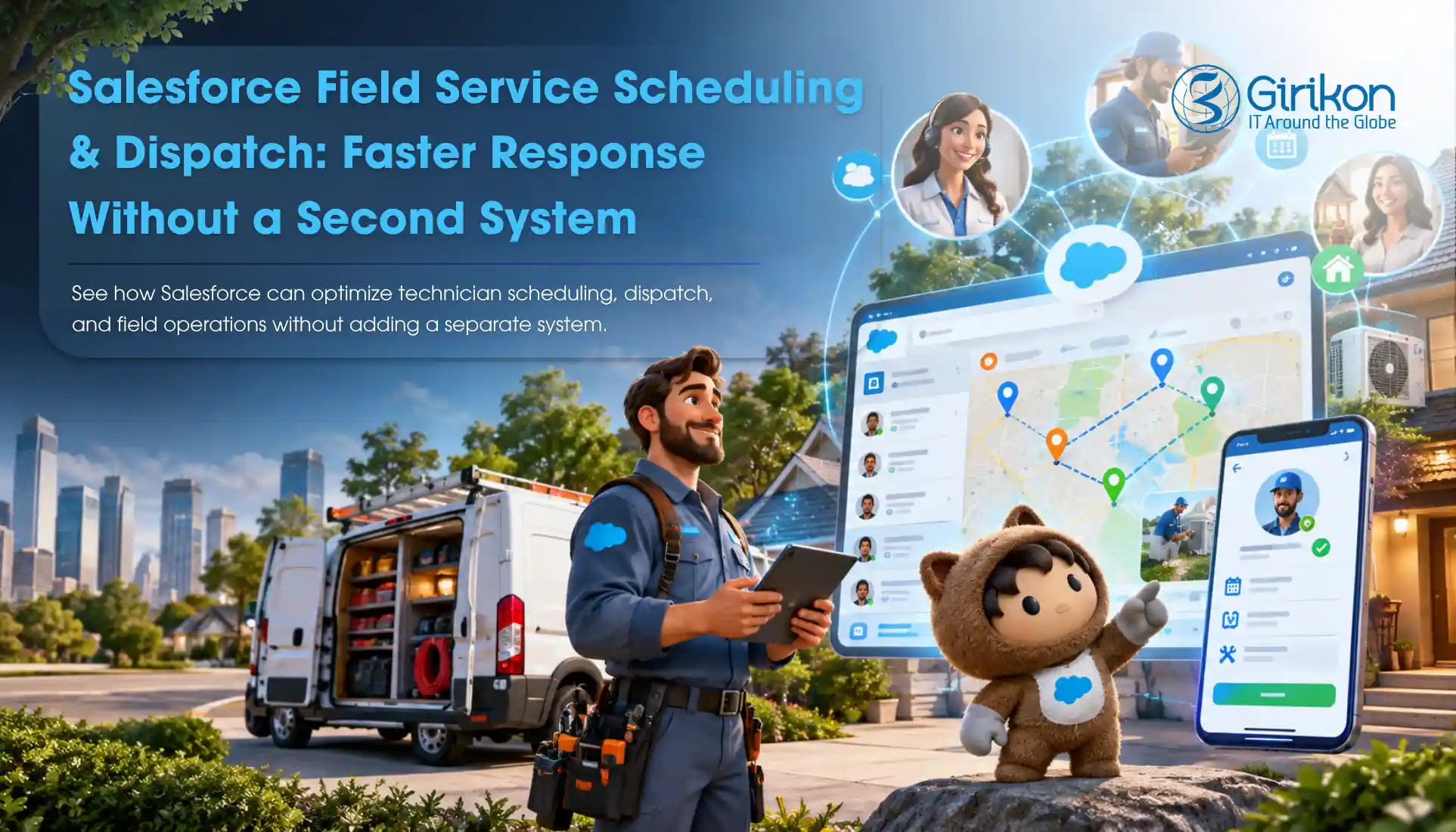
To organize the service operations, the service team has to look for technicians available for work and their qualifications and locations to send a technician to the site.
When scheduling takes place in one program while customer interactions are stored in Salesforce, and dispatchers communicate via the telephone and texting apps and spreadsheets, even an easy service request may take longer than necessary. This is where field service scheduling and dispatch can become a major operational advantage.
By bringing customer information, work orders, technician availability, territories, dispatch workflows, and skills into the same Salesforce environment, it helps businesses coordinate the entire service journey. Read on to learn how Salesforce can help streamline field service scheduling and dispatch, optimize technician operations, and reduce response times – without the need to run a separate system.
What is Salesforce Field Service Scheduling and Dispatch?
Which technician should handle a job, when it should be performed, and how it should be assigned and tracked? Salesforce field service scheduling and dispatch helps service teams make these decisions based on:
- Technician skills
- Availability
- Job priority
- Location
- Service requirements
- Required equipment or resources
- Estimated travel time
- Appointment windows
- Workload
Dispatch then turns those schedules into activity by assigning and communicating work to technicians. The key advantage is that these activities can remain connected to the customer’s Salesforce record rather than being managed across disconnected systems.
Why Field Service Scheduling and Dispatch Becomes Difficult as Operations Grow
Scheduling a handful of technicians manually may seem manageable. However, the real challenge starts when the service organization has hundreds of technicians, emergency requests, multiple territories, different skill requirements, and recurring appointments.
Moreover, to assign a technician to the job site, a dispatcher may need to answer questions like:
- Which technician has the required certification?
- Who stays closest to the customer?
- How much travel time is required between two jobs?
- Can an urgent job be added without disrupting other appointments?
- What happens if a technician calls in sick?
- Who is available during the requested appointment window?
- Which technician has the lightest workload?
When decisions on these questions are handled manually, dispatchers can spend significant time rearranging schedules instead of managing exceptions. Moreover, this may result in extra trips, long response times, missed time slots, and technician’s excessive workload. This is why it is necessary to consider field service optimization, as it helps organizations use all the benefits of technician availability and automate scheduling processes.
How Salesforce Field Service Supports Scheduling and Dispatch While Cutting Response Times
Salesforce Field Service provides tools that help organizations coordinate field operations around real-world service constraints.
Match Jobs with the Right Technician
Not every technician can manage every job or service request. Some jobs may require specific certifications, product knowledge, skills, or equipment. Salesforce Field Service allows teams to line up requests with technicians according to their proficiency, experience, and other job aspects.
As a result, it makes the scheduling of technicians much easier and minimizes the chances of sending the wrong one for a job. Leveraging technician scheduling automation, dispatchers can also spend less time examining the profiles of each technician and can devote time handling exceptions that require human attention.
Plan Technician Shifts and Availability
Scheduling starts before the day’s first service request arrives. Service managers also need to know when the technician must work, how many of them are needed, and where the coverage is needed. With Salesforce Field Service Lightning, businesses can schedule the availability of technicians by taking into account such aspects as service territories, leave plans, working hours, and service demands.
Thus, businesses will be able to provide adequate staffing at busy periods without creating excessive coverage gaps at quiet times. Also, service territories and skills of the technicians can be taken into account when scheduling their shift, ensuring that the right resources are available to handle the types of jobs expected in each area.
Schedule Based on Availability and Service Territory
Even though the technician has all the necessary skills, he or she can turn out to be not the right choice if they are unavailable or are scheduled to work in another service territory. Here comes Salesforce Field Service that takes into account service territories, technician availability, appointment windows, and working hours when creating schedules.
This helps dispatchers assign jobs without overloading technicians or creating unnecessary gaps in their day. Moreover, it supports better field service shift planning, allowing service managers to organize technician capacity around coverage requirements and expected demand.
Use AI to Optimize Technicians’ Routes
Travel time between jobs influences technician productivity. If routes are not optimized well, it could result in delays of appointments, longer travel time for each job, and less work accomplished during the entire working shift. However, with the help of AI for field service dispatch and routing, field service organizations can optimize schedules and routes.
AI takes into account factors like the customer’s location, appointment window, how much time it would take to get to the client, the level of the urgency of the assignment, the availability of technicians and others when making decisions about how the jobs should be routed or scheduled. In this way, the teams reduce dependency on manual decisions, decrease unnecessary trips, achieve a greater level of completion of appointments, and optimize the use of technician capacity while offering more efficient scheduling even if service conditions change throughout the day.
Handle Emergency Service Requests
In field service operations, schedules rarely remain unchanged throughout the day. A utility outage, equipment breakdown, or critical service request may suddenly require immediate attention. In such instances, the dispatcher must be able to locate a suitable technician without causing disruption to other appointments.
Rather than selecting the nearest available technician, Salesforce field service is useful in ensuring that the dispatcher locates the technician with the appropriate skill set who can arrive at the site within the required time. The schedule can then be adjusted as needed to respond to urgent requests while dispatchers keep the impact on the rest of the field operations under control.
Manage Dispatch from Salesforce
Dispatchers may have to switch between multiple systems to get the information they need when customer records, dispatch activities, and work orders are spread across different applications. This can make it hard to get a complete view of the job and may slow down scheduling decisions.
With Salesforce Field Service dispatch software, organizations can bring technician schedules, customer information, dispatch activities, work orders, and service history into the same Salesforce environment. Using this connected information, dispatchers can review available technicians, assign jobs, and monitor their progress without constantly moving between different platforms. This ultimately helps reduce system switching and simplify dispatch workflows.
Conclusion
The real advantage comes when all scheduling activities coordinate to ensure that the right technician is scheduled to the right client at the right time.
The use of Salesforce Field Service helps organizations utilize technician capacity, scheduling, routing, and emergency response in a single system. Furthermore, this helps businesses make faster and timely decisions without compromising customer data reliability.
Girikon, a Salesforce implementation service partner, helps businesses in implementing and optimizing Salesforce Field Service as per their specific scheduling and dispatch requirements.
About Author

Shivani is a Technical Content Specialist at Girikon with deep expertise in turning intricate technologies into engaging narratives. Her renowned experience and keen interest in technologies allows her to draft compelling and digestable insights for tech-savvy leaders. She helps businesses navigate the labyrinth of innovation, leveraging her proficient skills and visionary attitude.
Share this post on: