
 +1-480-241-8198
 +44-7428758945
 +61-1300-332-888
 +91 9811400594
AI is redefining the notion of enterprise business operations. It is not only promising speed in performance but also efficiency in execution, decision-making, and the level of automation involved. And with platforms like Salesforce Agentforce bringing AI agents into everyday business operations, the conversation is moving fast from what AI can tell us to what AI can actually do for us.
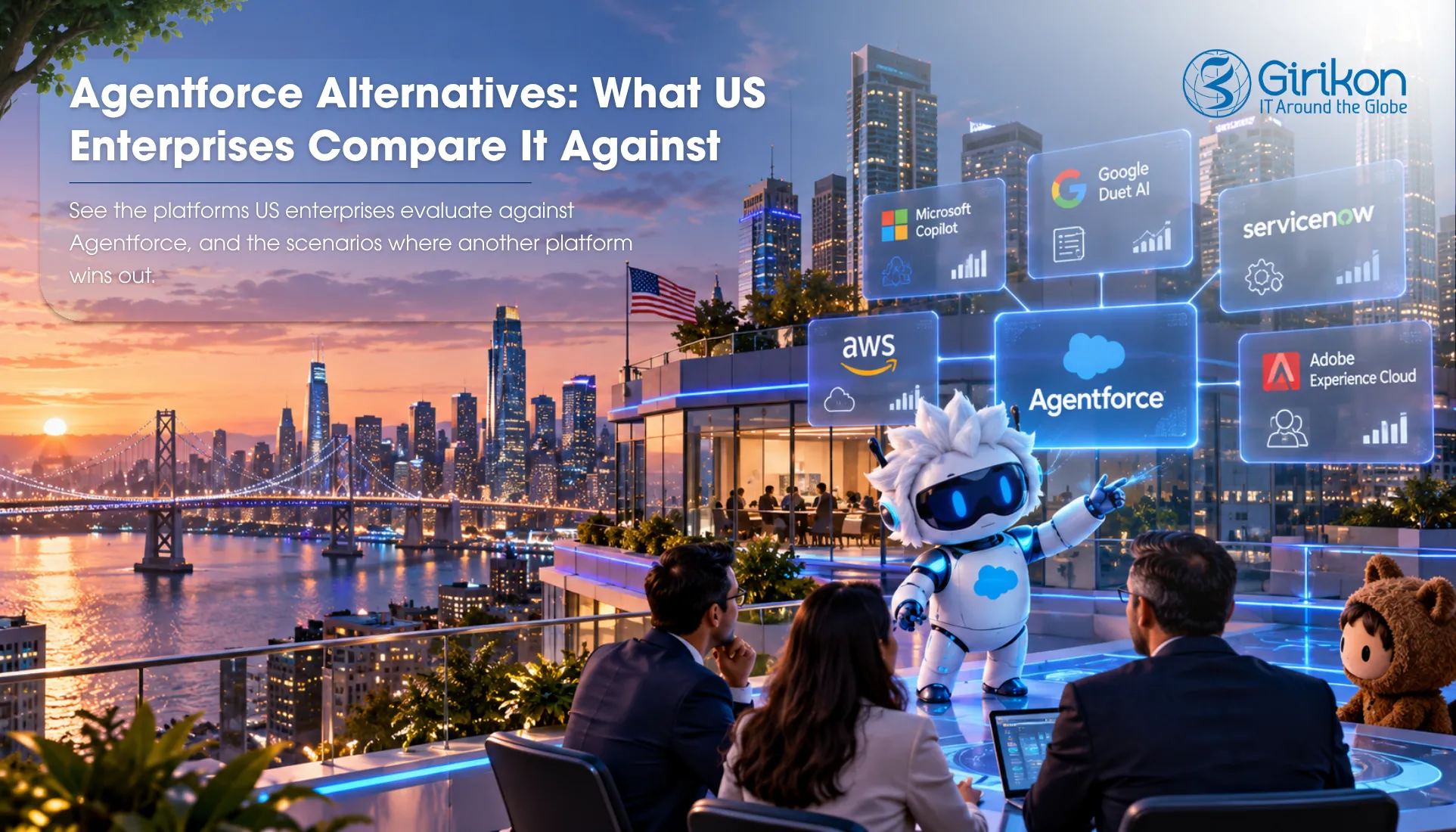
What Agentforce Actually Is — Before Comparing It to Anything
Agentforce is not a standalone AI product. It is the agent layer built on top of Salesforce’s Einstein 1 Platform — the unified data architecture that connects Sales Cloud, Service Cloud, Marketing Cloud, and Data Cloud through a shared metadata model. Agents are configured through Agent Builder using natural language Topics and Actions, where each Action is either a Salesforce Flow, an Apex class, or an API call to an external system. The reasoning layer — the part that decides which Action to invoke based on whatan user or customer said — runs through a large language model operating within Salesforce’s Trust Layer, which enforces data masking, toxicity detection, and a zero-retention policy for data sent to third-party models.The architectural implication of that design is significant for enterprise evaluation. An Agentforce agent working on a Service Cloud case has native access to the full Salesforce data model— Contact history, Entitlement records, Knowledge articles, prior Case activity — without any integration work. That native data access is the primary source of its advantage in Salesforce-heavy environments and the primary source of its limitation in environments where the data does not live in Salesforce.Agentforce vs Microsoft Copilot
Agentforce vs Microsoft Copilot is a strong point of discussion for most US enterprises. Microsoft 365 is deeply embedded across most enterprise technology stacks. Copilot Studio — the agent-building layer on top of the Microsoft platform — benefits from the same principle Agentforce does: native data access within its own trust boundary. Copilot agents working within Dynamics 365, Teams, and SharePoint access Microsoft Graph natively. The LLM reasoning layer sits on Azure OpenAI Service, and for Microsoft-first organizations, the data residency and compliance story is as clean as Agentforce’s is for Salesforce-first organizations.The comparison breaks down in cross-platform scenarios. An enterprise running Salesforce for CRM and Microsoft 365 for productivity faces a connector architecture on both sides — Copilot Studio accessing Salesforce data requires a Power Automate connector that introduces latency and a data governance boundary between the two trust environments. Agentforce accessing Microsoft 365 data faces the same challenge in reverse. Neither platform wins cleanly in a genuinely mixed environment. The decision then comes down to where the highest-value agent use cases live: in the CRM workflow or in the productivity and collaboration workflow.Copilot Studio also offers a significantly lower barrier to agent creation for non-technical users — its Power Automate integration is familiar to the enterprise citizen developer population that Microsoft has spent a decade cultivating. Agentforce’s Agent Builder is increasingly accessible but still assumes familiarity with Salesforce object model and Flow architecture. If the enterprise’s agent use cases are primarily document-centric, meeting-centric, or Microsoft 365-workflow-centric, Copilot Studio is the stronger architectural fit regardless of Agentforce’s capabilities in isolation.Agentforce vs ServiceNow and Workflow-Native Platforms
ServiceNow’s Now Assist is the Agentforce competitor that operations-heavy enterprises run second, and it is more nuanced than the Microsoft comparison because the overlap between Agentforce and ServiceNow’s agent capabilities is narrower than it appears.Now Assist agents are pre-trained on ITSM, ITOM, HRSD, and CSM workflows and access the Now Platform’s CMDB and workflow engine natively. An agent handling an IT service request in ServiceNow has access to the full configuration item history, the change management record, the asset inventory, and the approval workflow — all within the same platform, without connector architecture. For enterprises where the high-value agent use case is IT service delivery, HR service management, or enterprise workflow orchestration, Now Assist operates on a native data model advantage that Agentforce cannot match without significant custom integration work.Where Agentforce wins in this comparison is in customer-facing commercial workflows — sales process automation, service case management, field service orchestration, and revenue operations. ServiceNow’s agent capabilities are strong within the enterprise operational boundary. They are not designed for the commercial customer interaction layer that Agentforce is built around. Enterprises that need both — internal operations automation and customer-facing commercial automation — are the ones most likely to reach a genuine split architecture decision rather than a platform consolidation decision.Agentforce vs Building Your Own
The critical choice of Agentforce vs building your own within US enterprises is prominent for those who already have well-developed engineering departments, and it is the choice that is often poorly served by any vendor-based sales process because of the preference for ready-made products.A custom agent stack built on LangChain or a proprietary orchestration layer above a foundation model — GPT-4o, Claude, Gemini, or an open-source equivalent — gives the enterprise full control over the model selection, the tool-calling architecture, the safety evaluation process, and the compliance certification cycle. For enterprises in regulated industries — financial services, healthcare, defense — that control is not a preference. It is a requirement. The ability to run models in a fully air-gapped environment, to conductadversarial testing on agent behavior, and to own the complete audit trail of every agent decision is something no managed platform currently provides at the same depth a custom build can.The cost of that control is the engineering burden of maintaining it. Model evaluation is not a one-time exercise — as foundation models release new versions, the enterprise that built on a specific model version needs to re-evaluate tool-calling behavior, safety properties, and performance characteristics before upgrading. Agentforce’s Trust Layer handles that cycle within Salesforce’s own release management process. A custom build owns that cycle entirely. For enterprises with a dedicated AI platform team and a genuine requirement for model-level control, the build option remains competitive. Organizations that would rather not manage every component of an agent’s runtime and supporting services may benefit from a managed platform.The Platforms Worth Considering Beyond the Top Three
Agentforce alternatives beyond Microsoft and ServiceNow include a set of enterprise-grade platforms that address specific architectural gaps.Google Vertex AI Agent Builder gives enterprises access to Gemini-class models within Google Cloud’s trust boundary, with native connectors to BigQuery, Workspace, and the Google Cloud data ecosystem. Where Google Cloud already hosts an enterprise’s data infrastructure and machine learning workflows, Vertex AI agents may be easier to incorporate without rebuilding connections to those systems from scratch. The best AI agent platform enterprise decision for a Google Cloud-primary organization looks different than it does for an AWS or Azure-primary one.Amazon Bedrock Agents provides multi-model flexibility — agents can be built on Claude, Llama, Titan, or other models available through Bedrock — with tool-calling capabilities connecting to AWS services natively. For enterprises running core business systems on AWS, Bedrock Agents offer the same native data access principle that makes Agentforce and Copilot compelling on their respective platforms.Workday AI deserves mention specifically for HR and finance use cases — its agent capabilities are natively integrated into Workday’s data model in the same way Now Assist is integrated into ServiceNow’s. For Workday-primary enterprises with agent use cases in workforce management, financial planning, or procurement, the native integration advantage applies here as well.When Agentforce Wins, and When It Doesn’t
The AI agent platform selection decision for most US enterprises is not a general capability comparison. It is an architecture alignment question.Agentforce wins when the enterprise is Salesforce-primary and the high-value agent use cases live in the commercial customer interaction layer — sales automation, service deflection, field service, revenue operations. The native Data Cloud integration, the Trust Layer compliance architecture, and the Einstein 1 Platform data model make Agentforce the lowest-friction path to production agents in that environment. The fact that agentbehavior is configured through Flows and Apex — tools Salesforce administrators and developers already know — means time-to-production is faster than any alternative in a Salesforce-native stack.Agentforce’s native data access advantage runs in one direction. If the data is in Salesforce, the agent reaches it without integration work. If the data is not in Salesforce — in ServiceNow, in Microsoft 365, in a Workday financial model — the agent needs a connector, a custom action, or an API integration to reach it. That work is not trivial, and the platform whose data the agent actually needs probably already has native access to it. The advantage disappears the moment the use case lives outside the Salesforce data boundary.| Platform | Best suited for | Main trade-off |
|---|---|---|
| Agentforce | Salesforce-centered sales and service workflows | Salesforce ecosystem dependence |
| Microsoft Copilot Studio | Microsoft 365 and productivity workflows | Cross-platform integration requirements |
| ServiceNow Now Assist | ITSM and enterprise operations | Strongest fit within ServiceNow workflows |
| Google Vertex AI | Google Cloud and data-intensive AI workloads | Engineering and integration requirements |
| Amazon Bedrock Agents | AWS workloads and model flexibility | Application orchestration and governance effort |
| Workday AI | HR and finance processes | Dependence on Workday’s functional scope |
| Custom-built agents | Specialized control and multi-platform architectures | Engineering and ongoing maintenance costs |
Swipe to see more →
What the Decision Actually Comes Down To
Every platform in this comparison is the right answer for a specific enterprise profile. Agentforce is the right answer where Salesforce holds the data and the commercial workflow is the primary use case. Microsoft Copilot Studio is the right answer where Microsoft 365 holds the productivity and collaboration data. ServiceNow Now Assist is the right answer where the workflows live inside the Now Platform. The evaluation is not about which platform is better — it is about which one was built for the environment the enterprise is actually operating in.The enterprise that approaches Agentforce alternatives as a general AI capability comparison will make a different decision than the one that approaches it as an architecture alignment question. The second method creates a more defensible choice, one that can withstand changes to the roadmaps of both platforms, changes to the underlying foundation models of both platforms, and even changing business needs that were unforeseen when the decision was originally made.The platform that wins is the one whose native data model matches where the highest-value agent use cases actually live. Everything else — the UI, the pricing model, the ecosystem, the roadmap — is secondary to that alignment question.
About Author

Share this post on: