
 +1-480-241-8198
 +44-7428758945
 +61-1300-332-888
 +91 9811400594
For businesses most of the time, having data doesn’t automatically mean clarity. This is because each department may have the same indicators but could have various interpretations. Sales might record bookings; Finance might recognize revenue, and Operations might not consider refunds. As agents query raw tables without a shared framework and end up using these differences and deliver answers that don’t match with business reality. This has created confusion and declined trust in reporting and resulted in slower adoption of intelligent tools. If there’s no governed layer to standardize definitions, lots of organizations are unable to believe the figures they view and the insights they get.
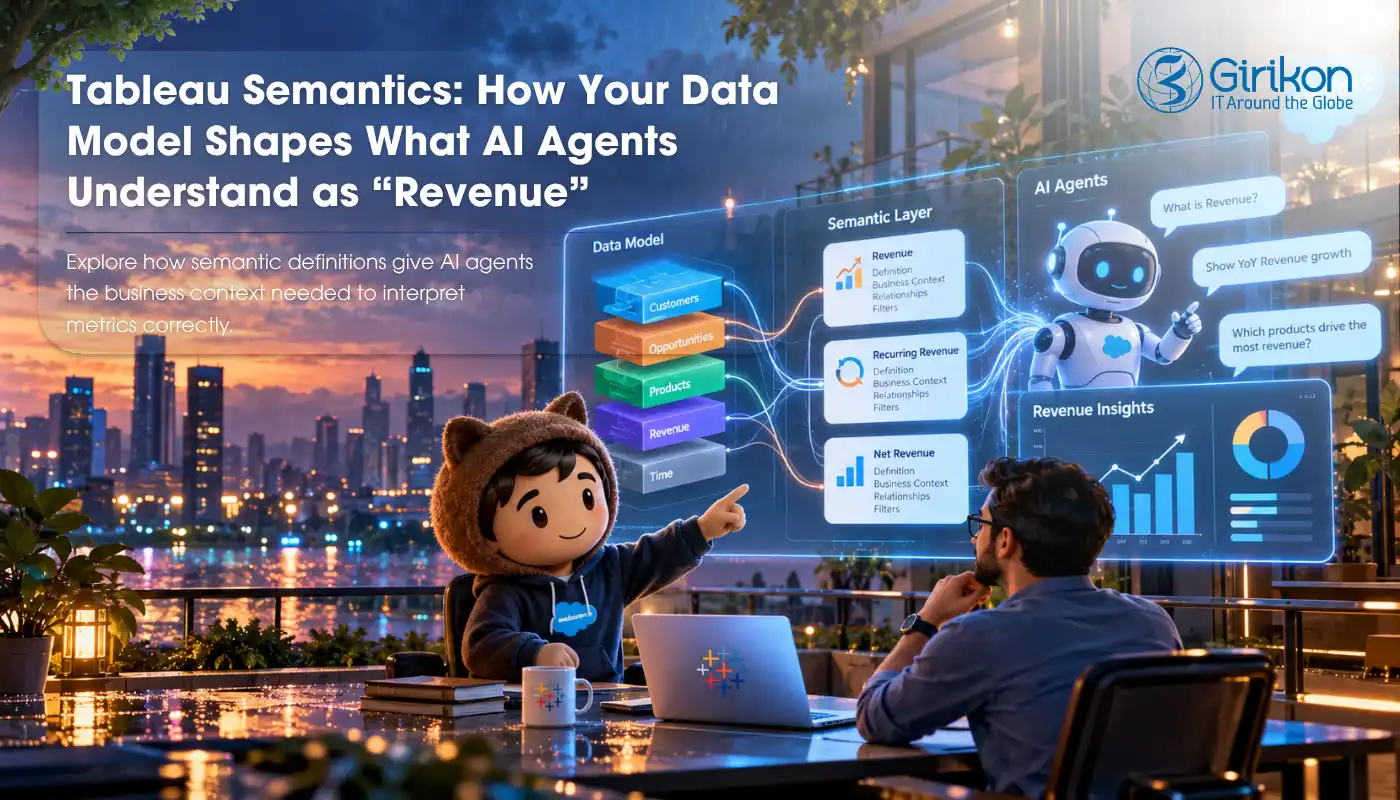
This blog examines how Tableau Semantics closes that gap. We’ll explain why AI agents require governed definitions and show how organizations can implement semantics and turn fragmented data into a reliable foundation for reporting, analysis, and agent-driven workflows.
Tableau Semantics: What Is It?
Tableau Semantics is an AI-infused semantic layer that’s embedded into Salesforce Data Cloud and Tableau Next and defines how business concepts should be understood across data and analytical applications. So, every app in the organization doesn’t have to separately understand raw fields on its own. With the help of semantic layer Salesforce, your team can define key metrics, entities, or relationships between them in a standardized manner.
For example, the semantic model can define which revenue streams are included in the ARR calculation, set the calculation and determine which business dimensions are used to analyze the ARR. With that kind of governed definition, the odds are much lower that an AI agent will misinterpret the metric.
Tableau Semantics vs. Data Cloud: Where Does Each Layer Belong?
| Factors | Data Cloud | Tableau Semantics |
|---|---|---|
| Core role | Integrates and harmonizes data from multiple systems | Applies business meaning and definitions to that data |
| Layer in stack | Technical data foundation | Semantic and logic layer above the foundation |
| Primary function | Data ingestion, unification, and activation | Standardized metrics, relationships, and analytical context |
| Use in AI | Supplies enterprise data to applications and agents | Ensures agents interpret metrics and concepts correctly |
| Outcome | A consolidated source of truth | A governed, shared business interpretation |
Swipe to compare →
Why AI Agents Need a Semantic Metrics and Governance Layer
Traditional BI systems tend to publish metrics in pre-defined dashboards, reports, and calculations. Many interpretations have already taken place without the user’s awareness of the result. AI agents transform that interaction. A user asks a subjective question, and the system must decide which data, metric, relationship, and calculation are relevant. This is why the quality of the semantic layer is even more important.
A common definition for critical metrics
Each department may have different definitions for revenue, customer lifetime value, churn, ARR and margin. A governed semantic model provides a consistent reference point for those metrics for agents.
Context around business relationships
You can see key metrics like revenue in different segments. These can be Customer, Product, Geography, Contract or Time. When it’s unified, these relationships help analytical systems make sense of these metrics and understand how business concepts are related.
Reduced code duplication
If the metrics are calculated separately by different applications, small variations may result in varying results across reporting periods. Business logic is not dependent on report, dashboard or AI outputs and applications and is kept consistent by a shared semantic layer.
Improving governance for AI
AI governance doesn’t end in model behavior and access controls. Organizations must also regulate the business definitions which agents use when answering questions and when making decisions. A semantic layer introduces that concern into the data architecture.
How to Implement Tableau Semantics in Your Enterprise Data Stack
Identify the Metrics that matter most
A semantic model doesn’t have to include all the business metrics on day one implementation. These aspects like financial reporting, executive decision-making, or customer operations using AI, are important. Carefully consider what action needs to be taken as it may impact these. The smaller size of the starting point makes the first model more accessible to manage. It also sets up governed definitions on metrics (revenue, ARR, margin, pipeline, customer count) that the business already uses extensively without a hassle.
Map the sources of those metrics
A metric can be based on many systems as opposed to only a database column. Understand where it’s getting the data, what fields are currently using it, who owns it, and where various teams are using it in varying ways. This source level audit reveals data-quality problems and business definition conflicts.
Model relationships across concepts
There are a number of business questions that require more than one measure. The item might also involve a customer, product, region, contract or time period in relation to a question about revenue. Defining those relationships will provide context of the question to the analytical systems. It also minimizes the need to go through every report or application and make those connections and comparisons by itself, especially if queries are based on multiple related entities.
Encode the Approved Business Logic
After the definition, start calculating and applying the corresponding rules in the semantic layer. Keep an eye out for filters, aggregation behavior, time periods, and exceptions. The goal is to have one set of important metrics with one interpretation, rather than each dashboard or application interpreting the metrics on their own.
Govern and maintain
After creation, it is necessary that there is one who has ownership in a semantic layer. Definitions should be reviewed in accordance with changes in business rules, and the resulting calculation should be tested against actual business questions. Model behavior can be impacted by changes to the sources, their reporting time, or the definition of the obtained metrics. Defining them regularly ensures that the definitions stay in line with the business and are easy to understand why a metric gives a certain result over time.
Conclusion
Tableau Semantics is helping businesses turn fragmented definitions into a unified vocabulary. Without a semantic layer, metrics change from team to team, clash in definitions, and teams lose trust in the results. The metrics layer for AI agents brings all in one place; departments share the same rules, business logic stays consistent, and access is controlled. As agents become part of daily decisions, the need for clear governance grows stronger.
To realize this potential, engage a Salesforce AI consulting provider. Their expertise will speed up adoption, strengthen governance, and enable measurable enterprise-wide transformation.
About Author

Anjali is a technical content writer and strategist with 9 years of experience, bringing expertise in creation and strategy for IT services, software development, and Salesforce consulting companies. She excels at developing SEO-driven storytelling and technical narratives, and in crafting marketing assets that boost visibility, accelerate sales, and deliver measurable business growth.
Share this post on: