 +1-480-241-8198
 +44-7428758945
 +61-1300-332-888
 +91 9811400594
Integrating SaaS platform with a CRM platform like Salesforce isn’t too complex. The real challenge is deciding what needs to be connected, which system owns the data, when the information should move, and what to do when integration fails.
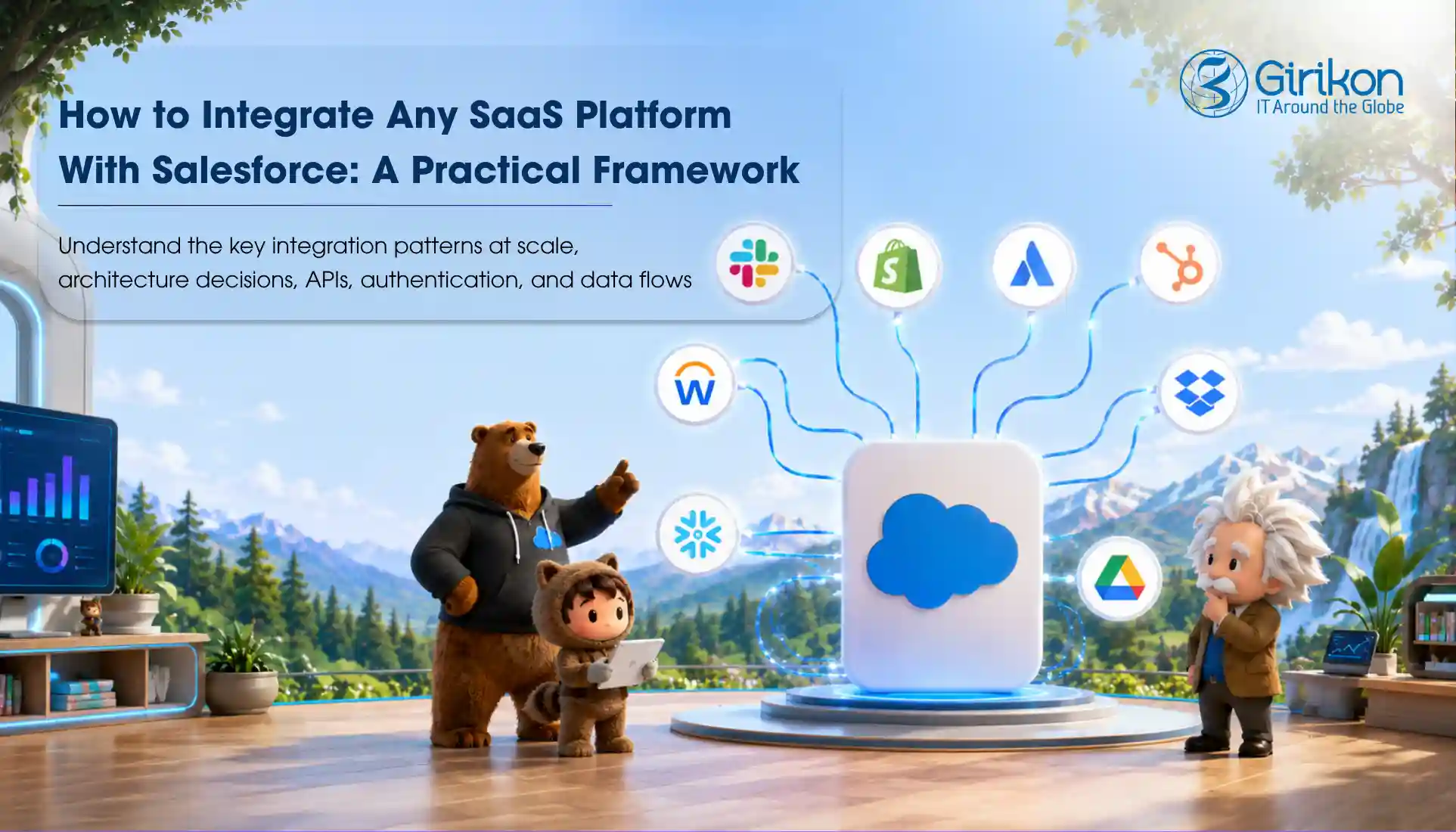
That’s where Salesforce integration projects quietly go off track. Teams start with REST APIs, middleware, or webhooks before defining the integration itself.
If you want to integrate SaaS with Salesforce, start by defining the business workflow — not the API. Then choose the technology that supports it.
This Salesforce SaaS integration framework gives you a practical way to do that.
What You Need Before Integrating a SaaS Platform with Salesforce
Before building anything, define four things:
- Business process you want to connect
- Salesforce objects and SaaS data involved
- Which system controls the data,
- Whether data exchange happens in real-time or through scheduling events,
Also make sure that both systems can facilitate necessary APIs and authentication protocols.
7 Steps to Integrate Any SaaS Platform with Salesforce
-
Define the Business Workflow
Start with what a business needs to accomplish—not with the API documentation. Whether it’s enabling a Salesforce accounting-system integration or streamlining financial workflows, define the business goals first and then determine how the API can support them.
For instance:
Customer makes a request→SaaS system works on it→Salesforce either creates or modifies an existing record→appropriate actions follow.Define every single system involved and identify what should happen at each stage.
This gives you the foundation for how to connect any app to Salesforce while applying Salesforce integration for workflow efficiency without adding unnecessary integrations or automation.
-
Decide Which Data Should Move
Next, define the exact information that needs to travel between systems.
Ask:
- Which records need to be moved?
- Which fields are required?
- Which direction should data travel?
- Should records be created, updated, or both?
- How frequently should synchronization occur?
Avoid synchronizing entire objects simply because the APIs make it possible. A smaller, clearly defined data scope is easier to maintain and govern.
-
Establish Data Ownership and Mapping
Every important data element needs a clear source of truth.
For example:
“Customer profile → Salesforce Subscription status → Billing platform Email engagement → Marketing platform”
Then map the data:
SaaS field→transformation→Salesforce fieldWhen Salesforce connects with a point solution built for a specific business function, clear data ownership and field mapping becomes essential. Without them, systems can overwrite updates, create duplicate records, or leave important information out of sync.
-
Choose the Right Integration Pattern
After defining the workflow and data, it’s time to choose the technology.
A Salesforce integration decision framework can be as simple as:
Requirement Possible approach Immediate request or response REST API Large-volume data movement Bulk API React to data changes Platform Events or webhooks Scheduled synchronization Batch integration Multiple systems or complex orchestration Middleware Scroll the table sideways on smaller screens.
There is no single best Salesforce API integration strategy. The right approach depends on data volume, timing, complexity, and direction of communication, with options such as real-time Salesforce integration with webhooks helping businesses enable faster, event-driven data exchange when immediate updates are required.
-
Decide Where the Integration Logic Should Live
The next question is where transformation, validation, and orchestration should happen.
Salesforce:Best for relatively simple logic closely tied to Salesforce workflows.
SaaS platform:Appropriate when the external application owns the business process.
Better when the integration involves multiple systems, complex transformations, routing, or orchestration, especially for Salesforce legacy-system integration with MuleSoft.
This decision can prevent integration from becoming unnecessarily dependent on custom Salesforce code.
-
Build Authentication, Error Handling, and Recovery
A successful API call is only one possible outcome, which is why following API ecosystem best practices is essential for building reliable, scalable, and resilient integrations.
Your integration also needs a plan for:
- Authentication failures
- API timeouts
- Invalid data
- Duplicate requests
- Rate limits
- Failed transactions
- Retry and recovery
Use secure authentication and appropriate Salesforce permissions. Design retries carefully so that the same transaction does not create duplicate records.
Most importantly, ensure the visibility of failures through logging, triggering alerts, and a method to replay failed transactions.
-
Test, Monitor, and Scale
The real test isn’t whether the integration works, but whether it continues to work when something goes wrong.
Send valid, invalid, duplicate, incomplete, and high-volume records through integration. Test what happens when either platform becomes unavailable; an API request fails, or unexpected data enters the workflow.
After launch, monitor:
- API consumption
- Failed transactions
- Processing time
- Synchronization accuracy
- Data duplication
- Volume growth
The Integration Failure Test: 5 Questions to Answer Before Going Live
Before you launch, ask:
- What happens if the same record arrives twice?
- What happens if Salesforce rejects the record?
- What happens if the SaaS platform becomes unavailable?
- What happens if both systems modify the same record?
- Can the team identify and reply to a failed transaction?
If these questions do not have clear answers, the integration is not ready. It simply means businesses do have an API connection, but don’t yet have a reliable integration.
That difference is important since SaaS applications rarely work in isolation. A point solution may deal with a specific problem in business; however, without proper rules of integration, it can create synchronization and data-ownership problems as the technology stack grows.
A Simple Framework for Choosing Your Salesforce Integration Approach
Use this sequence before choosing an API or integration tool:
Business workflow→Data scope→Data ownership→Timing and direction→Integration pattern→Logic location→Failure strategy→Testing and monitoring
This is the practical Salesforce SaaS integration framework behind a scalable integration architecture.
Most Salesforce integrations don’t fail because the connection itself breaks. The reason for their failure lies in the fact that important decisions were not made beforehand while the development work starts.
However, integrating SaaS with Salesforce means that API is not the only aspect that solves the integration puzzle; for successful integration, a correct integration strategy must be developed.
Connect to the systems. Define the rules. Plan for failure. Then choose the API!
Scoping a Salesforce integration and can’t answer all five failure questions yet? Girikon’s integration architects will pressure-test the design before you write the first API call.
Talk to an architectAbout Author

Sakshi specializes in creating high-quality, SEO-driven content focused on Salesforce, CRM, and business automation. She writes blogs, landing pages, solution pages, case studies, and thought leadership content that simplifies complex Salesforce concepts, highlights business value, and helps organizations make informed CRM decisions.
Share this post on: