 +1-480-241-8198
 +44-7428758945
 +61-1300-332-888
 +91 9811400594
Government technology procurement has a reputation for moving slowly, and honestly, that reputation is mostly earned. But something has been shifting over the past two or three years – agencies at every level are taking CRM adoption more seriously, partly because constituent expectations have changed and partly because the compliance and reporting burden has grown complicated enough that spreadsheets and legacy case management tools simply cannot carry it anymore. The conversation around best government CRM platforms has moved from “do we even need one” to “which one can actually survive our procurement and security requirements” – and that is a different, more useful question.
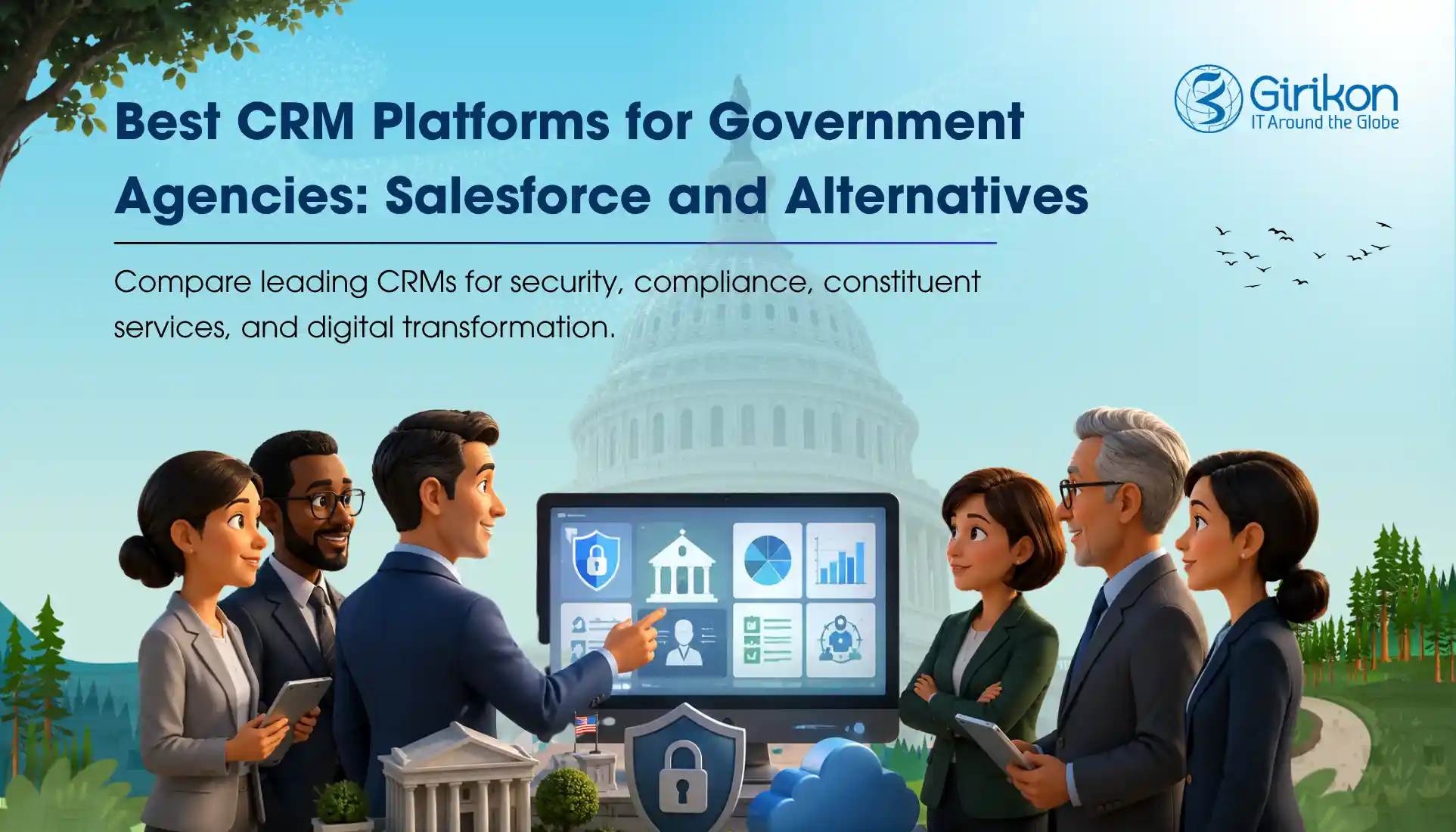
What the best CRM for government agencies offer (Which Is Not What Most Vendors Lead With)
The failure mode of most CRM evaluations in the public sector happens before a single demo is scheduled. Agencies tend to assess Salesforce solutions for government on feature lists – workflow automation, contact management, dashboards – when the real qualifying criteria is almost never about features. It is about data residency, authorization to operate frameworks (FedRAMP, StateRAMP, CJIS depending on jurisdiction), integration with legacy COTS systems that nobody has touched in eight years, and the ability to survive a change in administration without losing institutional memory.
Worth noting, though, that this does not mean all modern CRM platforms are disqualified. It means the evaluation has to start from a different direction.
A few things that tend to matter most in practice:
- Security authorization status – Whether the platform holds FedRAMP Moderate or High authorization, or StateRAMP approval, is often the gating question for federal and state agencies. Platforms that treat this as a future roadmap item rather than a current certification are effectively unavailable to many buyers regardless of how good the product actually is.
- Role-based access and audit trail depth – Government agencies are audited. The CRM has to produce clean, time-stamped records of who did what and when, at a level of specificity that most commercial deployments never need. The IT team owns this configuration, and it takes longer than vendors suggest.
- Constituent data handling across jurisdictions – For CRM for local government deployments especially, data sovereignty questions can get complicated fast when county and municipal data flows into state systems or cloud infrastructure hosted outside the region.
- Multi-department deployment without a full rearchitecture – Agencies rarely buy for one department. The platform has to be configurable enough that the permitting office and the public health department can use it without sharing data they should not be sharing.
Salesforce Government Cloud – What It Actually Does Well and Where the Complexity Lives
Salesforce Government Cloud – specifically Government Cloud Plus, which carries FedRAMP High authorization – is genuinely one of the more capable platforms available to U.S. federal agencies right now. That authorization matters enormously. Most federal civilian and defense-adjacent agencies cannot deploy on standard commercial cloud infrastructure, so the FedRAMP High designation essentially moves Salesforce into a different tier of consideration entirely.
The tradeoffs, though, are real. Government Cloud Plus runs on separate infrastructure from the commercial Salesforce stack, which means some AppExchange applications are not available, custom integrations that work fine in commercial deployments need to be rebuilt or re-evaluated for compliance, and the deployment timeline for a reasonably complex implementation tends to run longer than most agency IT teams expect. Eighteen to twenty-four months for a full enterprise rollout across multiple departments is not unusual. The license costs are also structured differently from commercial agreements – the total cost of ownership calculation is genuinely worth doing carefully before a procurement decision is made.
For state and local agencies, Salesforce Public Sector Solutions (layered over the standard commercial stack, with StateRAMP pathways available for some configurations) is a different product with a different compliance posture. Worth being explicit about that distinction, because agencies sometimes conflate the two.
The Competitive Landscape – A Practical Overview
Salesforce is not the only serious option. Far from it, actually. Any thorough public sector CRM comparison should include at minimum the platforms listed below.
| Platform | FedRAMP Status (approx. 2026) | Deployment Model | Typical Fit |
|---|---|---|---|
| Salesforce Gov Cloud Plus | FedRAMP High | Cloud (GovCloud) | Federal agencies, large state |
| Microsoft Dynamics 365 (GCC High) | FedRAMP High | Cloud (GCC High) | Agencies already on Microsoft stack |
| ServiceNow (Gov) | FedRAMP Moderate/High | Cloud | IT-heavy operations, ITSM-adjacent |
| Verint / GovCRM tools | Varies | Cloud/On-prem | Local government, small agencies |
| Oracle CX Government | FedRAMP Moderate | Cloud | ERP-integrated environments |
Scroll the table sideways on smaller screens.
The Dynamics 365 row in the table above deserves a longer observation. Agencies that have already standardized on Microsoft 365, Azure Government, and Teams tend to find that Salesforce Government Cloud vs alternatives debate resolves itself fairly quickly in favor of Dynamics – not necessarily because Dynamics is a better CRM product in the abstract, but because the integration overhead is dramatically lower when the identity management, email, and document storage infrastructure is already Microsoft-native. The incremental lift is smaller. That is not a trivial consideration when IT capacity is the actual limiting resource.
ServiceNow occupies an interesting position. It is not a traditional CRM, but agencies that already use it for ITSM and service request management sometimes extend it into constituent-facing workflows rather than deploying a second platform. Whether that is the right call depends heavily on how complex the constituent relationship management actually needs to be – ServiceNow’s CRM-adjacent capabilities are solid for case routing and resolution tracking, considerably less developed for anything involving relationship history and proactive outreach.
How to Actually Structure a Government CRM Evaluation
Honestly, most procurement processes get this backwards. They start with a market survey, move to demos, and then discover the compliance and security requirements late – at which point half the shortlisted vendors quietly fall off the list and the process restarts. A more defensible sequence looks something like this:
- Define your authorization baseline first. Before any vendor conversation, document which FedRAMP, StateRAMP, or CJIS requirements apply. This immediately segments the viable market.
- Map your integration dependencies. Legacy systems – FEMA grants management tools, state MMIS systems, county GIS platforms, whatever is actually in your environment – need to be documented before a platform can be realistically evaluated for fit.
- Run a data classification exercise. Not all constituent data carries the same sensitivity, and the classification exercise often reveals that different departments have different compliance requirements that a single platform deployment needs to accommodate.
- Engage procurement and legal before shortlisting. Contract vehicle availability (GSA Schedule 70, NASPO, state-specific vehicles) affects which vendors can actually be procured without a full RFP cycle.
- Request environment-specific references. A vendor’s federal civilian references are not necessarily relevant to a county health department deployment. The reference check has to match the compliance context.
Tip: When evaluating any vendor’s government credentials, ask specifically for their most recent FedRAMP authorization package summary and their system security plan overview. Vendors with current authorizations will provide this readily. Vendors who redirect the conversation toward their roadmap are telling you something important about where they actually stand.
Finding the Best Government CRM Platforms for Your Agency
Ranking platforms in a single ordered list flattens a set of decisions that are actually quite contextual. A mid-sized federal civilian agency with a Microsoft-heavy environment and existing Azure Government infrastructure is going to land somewhere different than a large urban county government trying to unify permitting, social services, and constituent outreach onto one platform for the first time. For agencies beginning this process, identifying the top CRM for government 2026 options requires working through the authorization and integration questions before any platform ranking will be meaningful.
What we can say with reasonable confidence – for 2026 specifically – is that the authorization landscape has matured enough that agencies no longer have to choose between compliance and platform capability in the way they did five or six years ago. Multiple vendors now hold meaningful government authorizations. The implementation complexity, the total cost of ownership over a five-year contract window, and the realistic integration burden given whatever legacy environment exists – those are the variables that tend to determine which platform a given agency should actually deploy.
Salesforce’s position in this market is genuinely strong, particularly for larger agencies with the IT capacity to manage a complex deployment and the budget to absorb Government Cloud Plus pricing. But the “best” label depends on who is asking the question and what they are actually trying to solve. The agencies that tend to get the most out of their CRM investments are the ones that spent more time on the pre-procurement definition work than on the vendor demo calendar – and that pattern, more than any platform ranking, is probably the more useful thing to carry out of any evaluation process.
About Author

Indranil is a technology enthusiast with over 25 years of experience in project management, operations, technology and business development. Indranil has led project teams in egovernance, business process re-engineering, product development and worked with Government and Corporate customers. Indranil truly believes in the power of technology to drive productivity and growth for teams and businesses.
Share this post on: