 +1-480-241-8198
 +44-7428758945
 +61-1300-332-888
 +91 9811400594
The compliance burden sitting on financial institutions right now is genuinely heavy in a way that doesn’t get talked about enough. Most of the conversation focuses on regulatory penalties—the numbers are alarming, sure—but the quieter problem is the operational drag. AML compliance CRM platforms have become one of the more interesting responses to that drag, not because they replace compliance workflows but because they stop those workflows from living in seventeen different places at once. As more organizations adopt salesforce Financial service solutions to centralize customer and compliance data, these CRM platforms become even more effective at streamlining regulatory processes and improving operational efficiency. That fragmentation is where a lot of institutions are quietly bleeding time and accuracy
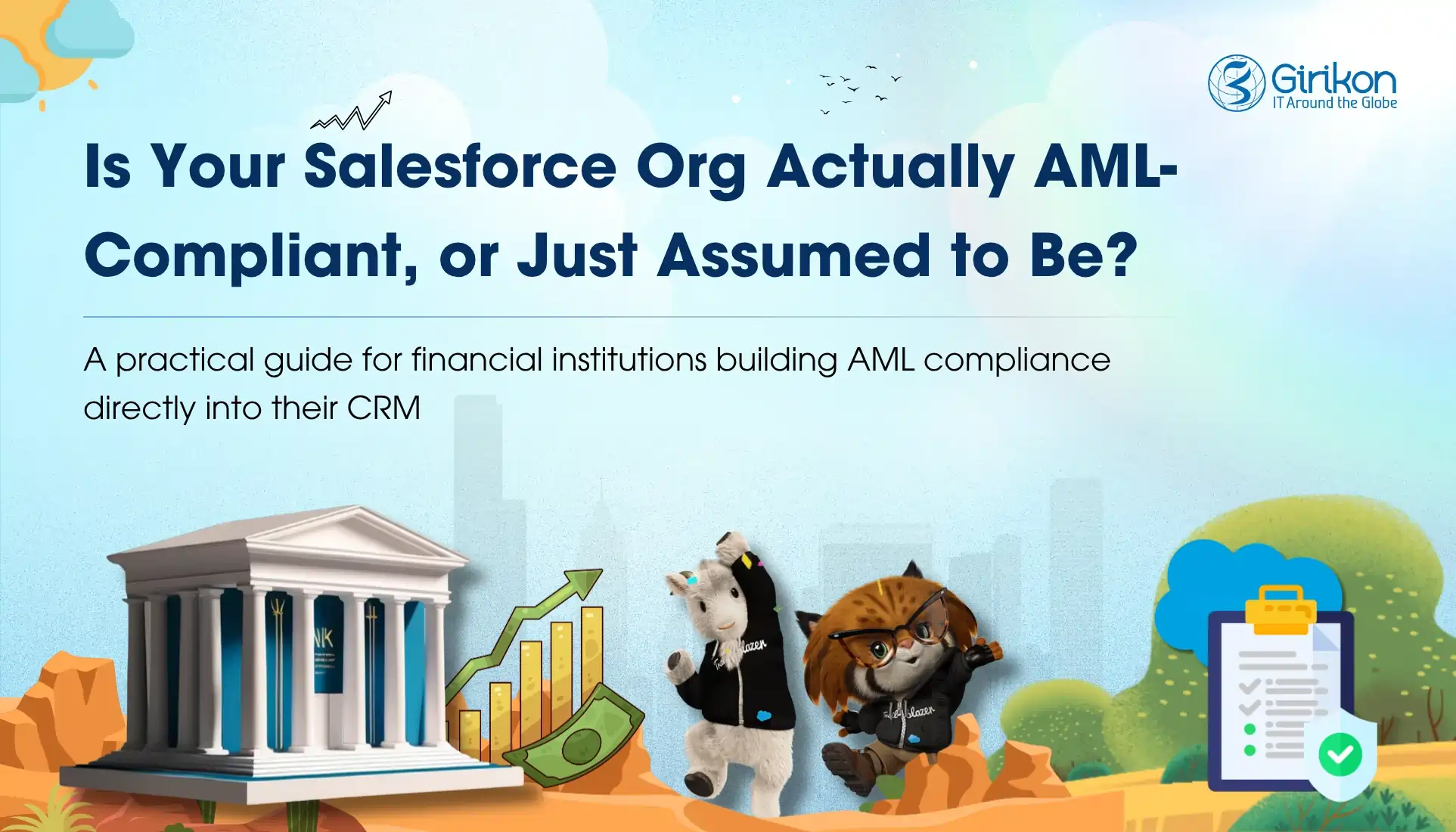
Here’s the thing. Regulators are not slowing down. The Financial Action Task Force continues to expand its recommendations, national regulators are updating their frameworks with increasing frequency, and the expectation that institutions will demonstrate — not just claim — compliance has sharpened considerably over the last several years. Which means the back-office patchwork of spreadsheets, legacy case management tools, and disconnected alert queues has stopped being sustainable for most institutions of meaningful size.
Why Most AML Operations Break Before They Fail Audits
Honestly, before getting into what Salesforce actually does here, it’s worth sitting with why so many AML operations are fragile in the first place — even the ones that look fine from the outside.
Data Silos
Customer information scattered across systems that don’t talk to each other, forcing analysts to reconstruct context manually.
Manual Escalation Paths
Case handoffs that depend on someone remembering to forward an email rather than a system enforcing the next step.
Tribal Knowledge
Review processes that live entirely inside individual analysts’ heads rather than anywhere a system can enforce them.
None of those things will sink a program by itself, necessarily. But stack them on top of each other and what you get is an environment where SAR filings slip, cases vanish in the gaps between handoffs, and audit trails get stitched together retroactively instead of recorded as things actually happen.
What Salesforce AML Compliance Actually Brings to This Problem
Salesforce Financial Services Cloud is where most of the relevant capability lives for this use case, and it’s worth being specific about what that means in practice. AML monitoring Salesforce Financial Services Cloud implementations typically center on a few capabilities that compliance teams have historically had to stitch together from separate systems.
Before
A one-time onboarding artifact
→
Now
Customer risk profiling becomes a living record that changes as the customer does
Before
A queue someone manages in their inbox
→
Now
Alert management becomes a structured case workflow with escalation rules, SLA tracking, and documented resolution steps
Before
Manual coordination calls between teams
→
Now
Cross-functional visibility — compliance and relationship teams seeing the same customer data — becomes technically feasible
Here’s the blunt version though: none of this just happens on its own. Salesforce is a platform — a starting point, really — and what an institution actually ends up with depends almost entirely on configuration choices, how seriously data governance gets treated, and whether anyone thought hard enough about integration architecture before the project started. Feed it patchy customer data and drop it in front of a compliance team that wasn’t properly onboarded to it — the mess is still there.
Nicer interface, same mess.
Handling KYC Inside a CRM Environment
Know Your Customer processes are, in a lot of institutions, where the AML pipeline either holds together or starts unraveling. KYC AML Salesforce implementations work best when the onboarding flow and the ongoing monitoring workflow are treated as parts of the same continuous process rather than a handoff between two separate teams with separate tools.
In practice, this means customer due diligence data collected at onboarding — beneficial ownership structures, source of funds documentation, politically exposed person screening results — lives in the same environment where relationship activity is tracked over time. When something changes, whether that’s a customer’s transaction patterns, a new beneficial owner, or an updated sanctions screening result, the case management layer can respond to it systematically rather than depending on someone noticing.
A few operational benefits institutions typically report from this approach:
01
Faster Escalations
Compliance analysts who own alert review can access full relationship history without submitting data requests to another team, which sounds minor but eliminates a meaningful source of delay in time-sensitive escalations.
02
Context From Day One
Onboarding teams handling initial KYC documentation can flag risk factors right there in the same system — so when monitoring rules later generate alerts, the compliance review team isn’t starting cold with no context about how the relationship began.
03
Audit-Ready Trails
Audit teams — internal and external — can follow a documented, timestamped trail of decisions, escalations, and sign-offs without having to reconstruct anything from email chains after the fact.
04
Real-Time Portfolio Oversight
Senior compliance officers can run oversight reporting across the full customer portfolio without waiting for aggregated spreadsheet submissions from multiple teams.
That last point, honestly, is where a lot of the strategic value concentrates. The ability to see portfolio-level risk exposure in near real time — rather than weekly or monthly — changes the nature of the compliance conversation at the executive level.
Comparing Core Deployment Approaches
Institutions considering Salesforce for AML compliance generally encounter a few distinct deployment models, each with different tradeoffs.
| Approach | Best Suited For | Primary Tradeoff |
|---|---|---|
| Native FSC with custom configuration | Mid-size institutions with defined compliance workflows | Requires strong internal Salesforce expertise to maintain |
| FSC plus specialist AML tool integration | Larger institutions with existing monitoring infrastructure | Integration complexity increases; governance of data sync is critical |
| Managed package from ISV partner | Institutions needing faster time to compliance-ready | Less flexibility; vendor roadmap dependency |
To be fair, most real-world deployments end up somewhere between the second and third options in that table. Pure custom builds are relatively rare outside of tier-one institutions with large internal development teams.
The Practical Limits Worth Acknowledging
Salesforce anti money laundering implementations are not a compliance shortcut, and institutions that approach them as one tend to have painful experiences. The platform does not generate regulatory intelligence on its own. It does not interpret guidance from FinCEN, FATF, or national regulators. It does not file SARs automatically or make judgment calls about suspicious activity thresholds.
What it does do — and this is the part that actually matters when a regulator is asking how a specific decision got made — is give institutions the infrastructure to handle those judgment calls more consistently, document them more thoroughly, and make sure they land in front of the right people. That’s not a small thing. It’s just a different thing than some institutions expect when they start the project.
The training piece gets underestimated too, probably more than any other variable in these deployments. Financial services compliance CRM implementations underperform — or outright stall — far more often because of adoption problems than because something broke technically. Analysts coming from legacy tools, or frankly from email, don’t warm up to structured platform workflows immediately. Change management isn’t a nice-to-have that gets addressed once the system is live — treating it that way is one of the more reliable ways to waste an implementation budget.
Implementation Reality Check
Institutions that achieve meaningful compliance ROI from Salesforce FSC implementations typically share one characteristic: they invested in a documented process redesign before configuring the system, not after. Technology layered onto a flawed process just accelerates the same flawed results.
The Question the Industry Is Still Working Through
“The honest tension in this space right now is between the speed at which regulatory expectations are evolving and the pace at which institutions can actually transform their compliance infrastructure. Salesforce, when configured well with the support of experienced salesforce consulting services, addresses a real set of operational problems. But the institutions that are furthest ahead are not the ones that implemented the best technology—they’re the ones that changed how compliance, operations, and relationship management interact as functions, and then found technology to support that change.”
Whether that sequencing is realistic for most institutions, given budget cycles, legacy infrastructure constraints, and the ongoing pressure to simply keep up with day-to-day filing requirements, is a question the industry hasn’t really landed on yet.
About Author

Indranil is a technology enthusiast with over 25 years of experience in project management, operations, technology and business development. Indranil has led project teams in egovernance, business process re-engineering, product development and worked with Government and Corporate customers. Indranil truly believes in the power of technology to drive productivity and growth for teams and businesses.
Share this post on: