 +1-480-241-8198
 +44-7428758945
 +61-1300-332-888
 +91 9811400594
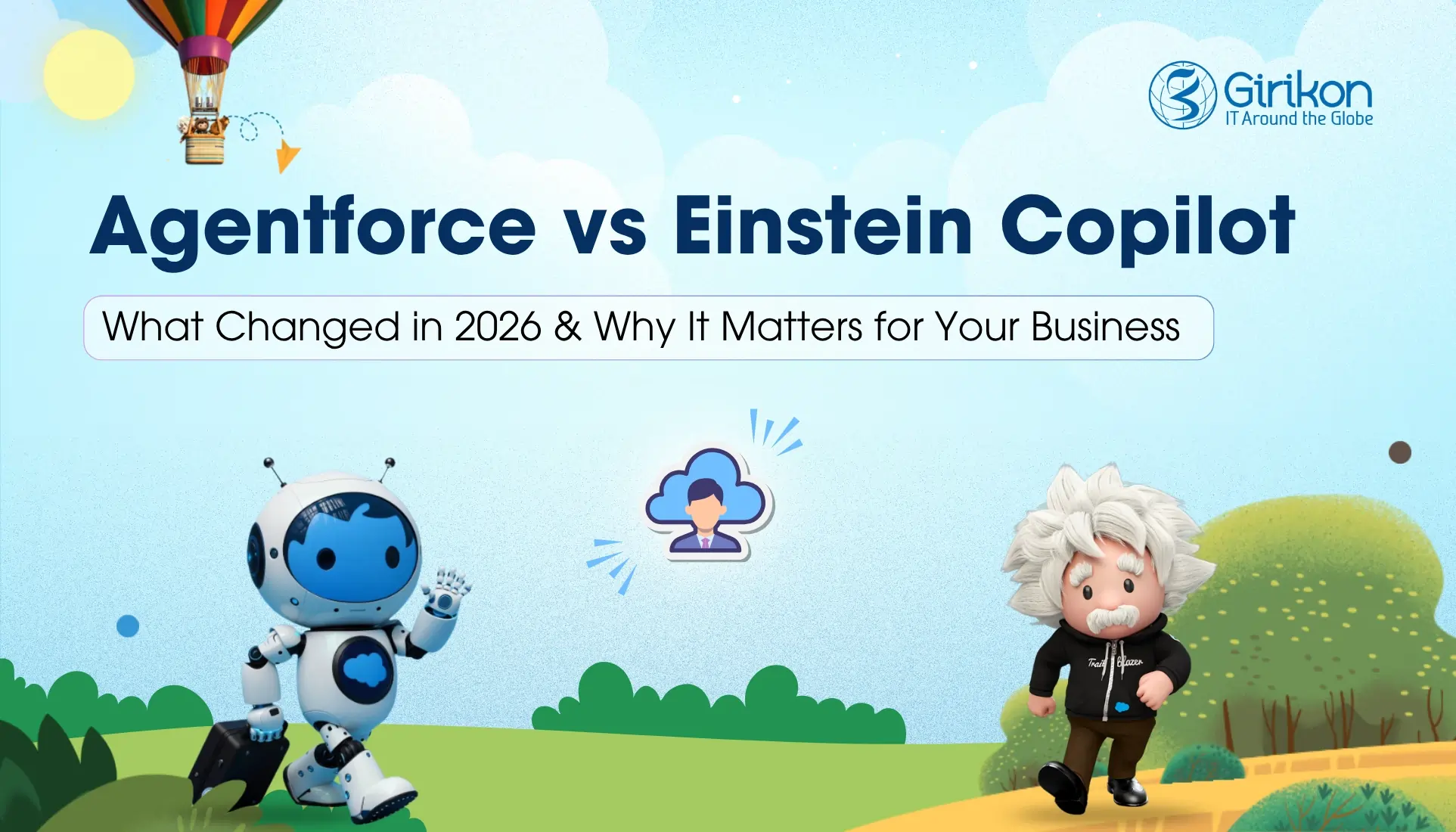
It’s been nearly a year or so since Salesforce changed its AI approach in a way that redefines how enterprises use automation with rebranding Einstein Copilot to Agentforce. Einstein Copilot, treated by most teams as a productivity layer, has been replaced by Agentforce, an architecture designed to take on execution, not just assistance. That distinction matters. Where Copilot accelerated tasks alongside teams, Agentforce now operates inside workflows, completing portions of the work itself.
It’s crucial for businesses that are investing in AI in Customer Success or AI‑driven customer engagement or planning because it changes both expectations and operating models. So, what are these changes? How does it impact your business? Or should you switch to it? If you’re also wondering about these questions, then this blog is for you. In this blog, we’ll explore the move from Einstein Copilot to Agentforce, discuss the changes, and suggest different ways you can implement Agentforce in your systems.
Background: From Einstein Copilot to Agentforce
Einstein Copilot was designed as an embedded assistant. It could draft responses, summarize interactions, suggest next steps, and support CRM users through natural language inputs. For many teams, that translate into incremental efficiency, less time spent writing, searching, or switching between tools. But it remained dependent on user prompts. It did not initiate workflows or carry them forward independently. In practice, this meant that even routine processes required manual continuity. The system could assist, but it did not own outcomes.
Salesforce’s shift toward Agentforce addresses that gap directly. The company’s positioning, outlined in its official Agentforce product overview, frames the platform around autonomous agents capable of taking action across business processes. The emphasis is no longer on interaction, but on execution. This is where the phrase Einstein Copilot renamed Agentforce becomes misleading. The change is not in name only; it shows how Salesforce itself is moving from assistive AI to building fully autonomous systems or with defined autonomy.
Agentforce Services: Key Changes in 2026
Architecture & Capabilities
Agentforce introduces a multi-agent model, so instead of a single interface responding to prompts, different agents handle specific responsibilities – customer communication, validation, and backend execution. These agents operate in coordination, which allows processes to move forward without constant user input. This layered setup is central to how Salesforce autonomous AI agents 2026 are positioned. Additionally, Benefits of Salesforce AI Services for business enables these changes.
Customization & Control
Control becomes more structured in Agentforce so teams don’t depend on prompt-level configuration. Your team can define policies that govern how agents behave — which include approval of thresholds, compliance rules, and audit visibility. This is quite useful for sectors like healthcare that are often concerned about HIPAA Compliance in Salesforce or other organizations that operate under regulatory pressure.
Business Use Cases
With Einstein Copilot, most gains were tied to productivity within existing workflows. Agentforce extends this into execution: Sales sequences can progress without manual nudges, service requests can be categorized and resolved with minimal intervention, and marketing workflows can adjust based on live data. The difference shows how much of the process is completed without human involvement.
Integration
Salesforce Agentforce consulting services let you work across systems rather than inside a single environment. It has the ability to connect CRM data, communication channels, and external platforms in a way that lets agents act across the full customer journey. Therefore, the AI layer is no longer limited to only Salesforce interfaces; it goes beyond the broader engagement stack.
Agentforce vs Einstein Copilot: Which AI Tool is Best for Salesforce?
| Factors | Einstein Copilot | Agentforce |
|---|---|---|
| Core Role | AI assistant within workflows | Autonomous system executing workflows |
| Interaction Model | Prompt-based | Goal-oriented |
| Task Ownership | Requires user continuation | Handles multi-step execution |
| Structure | Single assistant layer | Multi-agent coordination |
| Impact | Improves user productivity | Improves operational throughput |
| Governance | Limited control structures | Policy-driven governance and compliance |
| System Reach | Primarily CRM-bound | Cross-platform and omnichannel |
| Scaling Effect | Scales effort per user | Scales output at system level |
| Decision Flow | Human-dependent | Conditional autonomy within rules |
| Market Position | Comparable to copilots like Microsoft Copilot | Positioned beyond copilots as an execution layer |
Reasons Why It Matters for Your Business
1
Execution no longer depends on constant input
The shift from a Salesforce AI assistant vs autonomous agent changes how work moves. Tasks that once required repeated prompts can now proceed within defined boundaries. This reduces friction in routine operations, especially in sales and support environments where continuity often breaks down due to manual handoffs.
2
Output scales differently from effort
Einstein Copilot made individuals faster. Agentforce affects how much work gets completed overall. For teams handling high volumes — customer support, inbound sales, campaign operations — the difference shows up in throughput rather than individual efficiency.
3
Decisions happen closer to the moment
Delays in workflows often come from waiting — waiting for validation, for assignment, for follow-up. Agentforce reduces that waiting by acting within pre-set conditions. This has a direct impact on response times and conversion windows.
4
Competitive advantage shifts toward execution speed
In comparisons like Agentforce vs Microsoft Copilot, the gap is not in intelligence alone. It’s in how quickly actions are carried out. Organizations that reduce the lag between insight and execution tend to outperform those that rely on manual follow-through, which is the case with Microsoft Copilot.
Is Agentforce Really the Future of Salesforce: Should You Upgrade Now or Wait?
When to Choose Agentforce Consulting Services
- You already rely on Einstein Copilot a lot but results have stabilized
- Workflows require coordination across multiple steps and systems
- Regulatory requirements demand tighter control over AI-driven actions
- Customer engagement spans multiple channels and needs unified execution
When to Wait
- CRM usage is limited and does not depend heavily on AI
- Budget allocation is already committed to other transformation efforts
- There is a preference to evaluate early implementations before adopting
What’s important to understand is that the decision to switch should reflect operational readiness as much as technical fit. Without keeping balance between processes and ownership, the benefits of autonomy tend to stall bringing zero or nominal benefit.
How to Implement Agentforce in Salesforce?
01
Assess Current Einstein Copilot Usage
Before starting up on Agentforce journey, you need to evaluate your current Copilot ecosystem. Check where it’s integrated in the process, not where it was originally intended. This will help you detect issues like slow approvals, repeated manual fixes, or gaps in customer response. Eventually, you get to discover where Agentforce can deliver immediate results and measurable improvement.
02
Map Capabilities to Outcomes
Don’t just list features — tie each Agentforce capability to a business result. Faster lead conversion, shorter resolution times, or higher campaign response rates, these are the outcomes that matter. So, any upgrade you must keep a balance between technical capabilities and operational gains out of the process.
03
Run Test in Controlled Environments
Make a note of processes that are high volume and have regularity in transactions. This allows you to measure Agentforce’s impact without disruptions from unusual cases. A contained pilot builds confidence, generates data you can trust, and creates a clear story for scaling adoption across the organization.
04
Prepare Teams for a Different Role
The change is not only technical, it’s also cultural — with how teams shift from executing tasks to supervising systems that execute them. Without clear communication, this transition can feel like displacement. It becomes important that you project the adoption as an essential “upgrade.” In addition, offer proper training, workshops with active involvement of the workforce, especially if they have a role in monitoring, analyzing and making key decisions.
05
Establish Governance & Track Results
Set clear rules on how Agentforce will perform and on what within Salesforce, measure the results against the defined KPIs. Doing so helps you ensure autonomous execution brings efficiency, streamlines operations, and proves its value. Additionally, when you compare Salesforce Einstein vs Agentforce performance, it makes the impact after the shift more tangible and clear.
Conclusion
For businesses comparing Salesforce Einstein vs Agentforce, the question is not only about features. It’s about how much of the workflow they are prepared to hand over to systems that can operate with defined autonomy. Because, some will move early, driven by scale or complexity. Others will wait. Either way, the direction is set: Agentforce services are bringing a structural shift in how CRM operates. Therefore, it’s on businesses how they want to take this forward.
So, if you’re also wondering about the move, then we recommend seeking a Salesforce AI consulting services company, the experts will align adoption with strategy and help you gain tangible business outcomes.
FAQs
Is Einstein Copilot the same as Agentforce?
Einstein Copilot was renamed Agentforce in 2026, reflecting Salesforce’s move from assistance to autonomous execution. The shift signals a deeper role for AI agents in enterprise workflows.
What is Agentforce vs Einstein Copilot cost?
Pricing depends on Salesforce licensing tiers and deployment scale. Costs vary by integration depth, but the value lies in Agentforce’s autonomous AI agents delivering measurable business outcomes.
How does Agentforce vs Microsoft Copilot differ?
Agentforce focuses on Salesforce CRM with autonomous agents executing defined tasks, while Microsoft Copilot emphasizes productivity assistance. The distinction highlights Salesforce’s 2026 pivot toward operational autonomy.
About Author

Anjali is a technical content writer and strategist with 9 years of experience, bringing expertise in creation and strategy for IT services, software development, and Salesforce consulting companies. She excels at developing SEO-driven storytelling and technical narratives, and in crafting marketing assets that boost visibility, accelerate sales, and deliver measurable business growth.
Share this post on: