+1-480-241-8198
 +44-7428758945
 +61-1300-332-888
 +91 9811400594
In today’s cut-throat business landscape, having a robust CRM system like Salesforce in place marks the commencement of a journey. The real value, as well as challenge lies in how well the platform is optimized, managed and aligned with evolving business needs. For entrepreneurs, Salesforce support on an ongoing basis isn’t just a technical necessity; it’s a deliberate function that strongly impacts customer experience, user adoption and ROI.
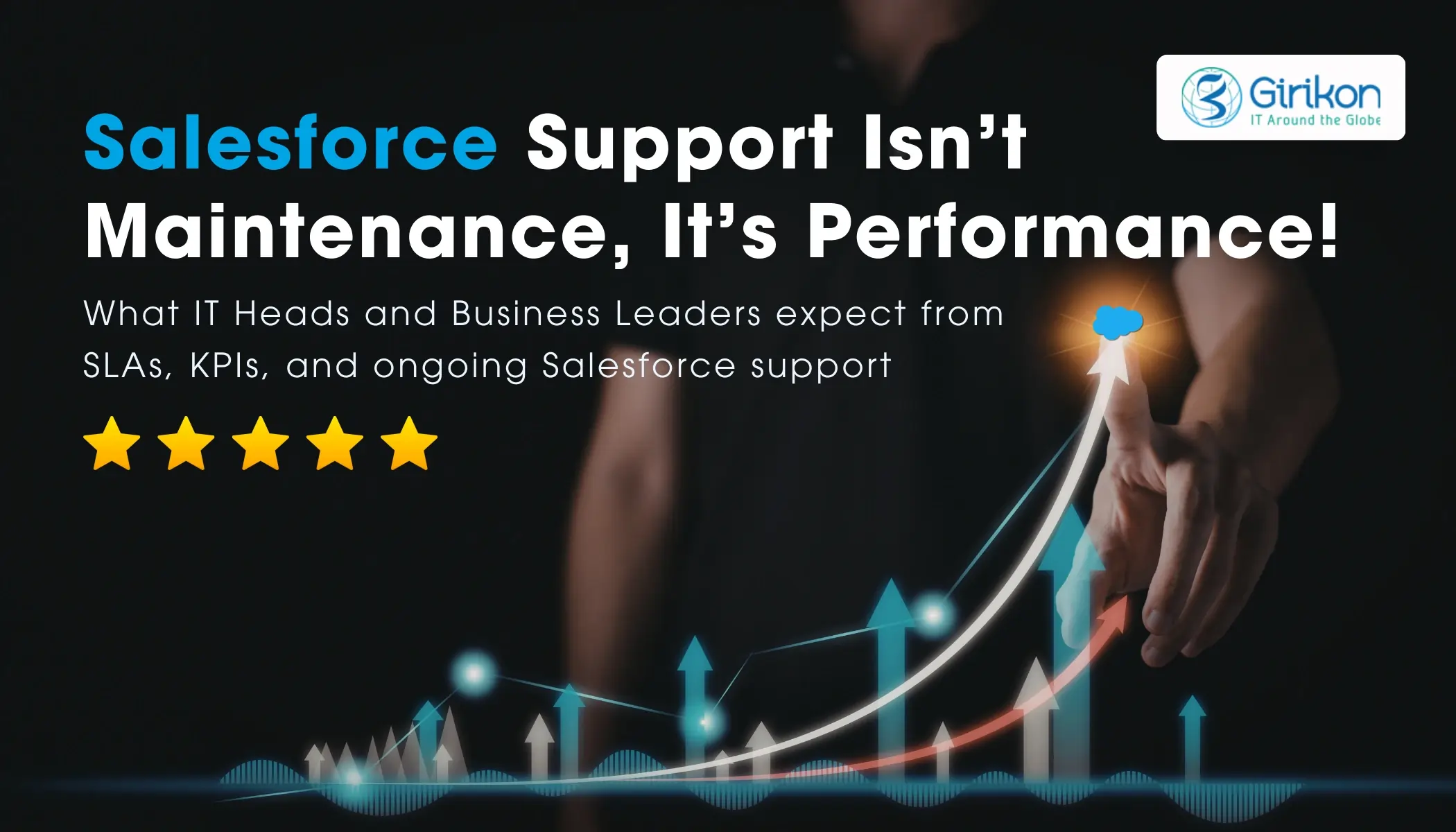
This article explores what a high-performing Salesforce support model looks like and what organizations should expect.
Why Continual Salesforce Support Matters
Being a dynamic platform, Salesforce updates itself with new features, functionalities and integrations. Businesses continue to grow as well with new processes and evolving customer expectations. Without ongoing Salesforce support, even a successfully implemented CRM platforms might become under-utilized, inefficient or misaligned. Since IT leaders prefer security, stability and scalability, their focus is on serviceability, efficiency, and tangible outcomes. Ongoing support ensures that the platform serves technical, as well as business objectives.
Ongoing Salesforce Support – What all things are Included?
Ongoing Salesforce support goes far beyond fixing bugs. It is a comprehensive service model designed to maintain, enhance, and optimize the system.
Troubleshooting Issues
A crucial aspect of this support is fixing issues, which involves addressing user issues. This includes access or login issues, process failures, data discrepancies. With an alert support team in place, companies can ensure reduced interruption to daily operations and sustain business continuity.
Change Requests
As businesses continue to evolve, organizations require change requests such as new objects, custom fields, automation, enhanced dashboards and reporting, and better user experience. Support teams handle these updates efficiently; enabling constant enhancement without the need for full-scale improvement.
Release Management
It is a critical aspect of constant support, especially when Salesforce releases updates thrice a year. Besides assessing the impact on previous customizations, testing new features, and enabling appropriate improvements, this approach ensures that businesses can take advantage of the recent advancements while ensuring system performance.
Data Management
Data is the mainstay of an efficient Salesforce environment. In this segment, ongoing support entails activities such as duplicate management, data cleansing, implementing authentication rules, and assisting with data migration. Maintaining data precision ensures reliable insights – leading to enhanced decision-making throughout the organization.
Integration Monitoring
It is a vital part of ongoing support as several Salesforce environments rely on seamless connectivity with other systems. Support teams track API performance regularly, resolve organization issues, and ensure consistency across platforms. This helps maintain reliable system interactions.
User Support & Training
These are essential for enabling greater user adoption. Ongoing support involves customer care services to handle routine queries, user onboarding, training sessions, and detailed documentation. All this to ensure users easily circumnavigate and use the system.
Understanding Salesforce Support SLAs
Service Level Agreements (SLAs) define the expected standards of service between support providers and organizations. They establish accountability, predictability, and performance benchmarks.
- Service Level Agreements (SLAs) outline the predictable standards of service between the provider of support and the company
- They establish clear outlooks for support quality, deadlines, and duties
- SLAs help business leaders safeguard responsibility across support teams
- They provide probability in resolution of issues and system performance
- SLAs act as a yardstick for gauging support efficiency and service delivery
Key SLA Components
- Response Time: Time taken to acknowledge an issue
- Resolution Time: Time required to resolve the issue
- Priority Levels: Classification based on severity and impact
- Uptime Commitments: System availability guarantees
- Escalation Procedures: Steps for handling critical issues
- Communication Protocols: Reporting frequency and updates
KPIs That Matter for Salesforce Support
While SLAs fixes the expectations, Key Performance Indicators track real performance. IT and business leaders should monitor these metrics to evaluate how efficient their Salesforce support KPI model actually is.
- First Response Time (FRT): Measures how quickly users receive initial responses
- Mean Time to Resolution (MTTR): Tracks the total time taken to resolve issues
- Ticket Volume & Trends: Identifies recurring issues and system gaps
- Recurrent issues
- Loopholes in user training
- Basic system inadequacies
- User Satisfaction (CSAT): Measures support quality through feedback
- System Uptime: Ensures reliability and business continuity
- Adoption Metrics: Tracks user engagement, feature usage, and reporting activity
- Number of active users
- Utilization of features
- Engagement with reports and dashboards
- Backlog Management: Monitors pending requests and system improvements
What Should IT & Business Leaders Expect?
1. Stability & Reliability
The system should operate smoothly with minimal downtime and disruptions.
2. Governance & Compliance
Support teams must ensure strong data security, governance, access control, and regulatory compliance.
3. Scalable Architecture
Salesforce should scale alongside business growth without performance issues.
4. Proactive Monitoring
Rather than reacting to issues, support teams should continuously monitor system health, detect risks early, and prevent failures.
5. Technical Expertise
Organizations should have access to skilled professionals with expertise in Apex, Lightning, integrations, and data architecture.
Future of Salesforce Support
As technology evolves, Salesforce managed support services is poised to become more proactive. With trends such as AI-enabled issue detection and resolution taking centerstage, predictive analytics for system performance, automated testing and augmented service capabilities are changing how support functions work. Today, support is no longer restricted to routine maintenance—it plays a significant role in driving constant optimization. This enhances user experience, and enables continuing innovation within the organization.
Key trends include:
- AI-driven issue detection and resolution
- Predictive analytics for system performance
- Automated testing and release validation
- Enhanced user support through intelligent automation
Conclusion
The role of Salesforce support services in achieving sustainable success cannot be denied. To draw the most out of their investment, organizations must establish clear SLAs, revise KPIs, and opt for the right model. Rather than considering support as a costly affair, it should be considered as a strategic imperative. This can keep the platform associated with scaling business goals and client expectations.
In a setting where client experience is a major differentiator, high-quality Salesforce support on a consistent basis can impact inclusive business performance. So, it makes sense to assess good salesforce support vs bad support.
FAQs
What is included in ongoing Salesforce support services?
Ongoing Salesforce support includes troubleshooting, change management, release updates, data management, integration monitoring, and user training. It ensures the platform remains optimized, secure, and aligned with evolving business needs.
What are SLAs in Salesforce support and why are they important?
SLAs (Service Level Agreements) define response times, resolution timelines, and service expectations. They ensure accountability, predictable support performance, and improved system reliability for business-critical operations.
Which KPIs should be tracked for Salesforce support performance?
Key KPIs include First Response Time (FRT), Mean Time to Resolution (MTTR), system uptime, user satisfaction (CSAT), ticket trends, and adoption metrics. These indicators help evaluate efficiency and identify areas for improvement.
About Author

Jaya is a technical content specialist with 14 + years of experience - especially in the B2B space. Her forte lies in changing complex technologies into compelling narratives that educate, engage and drive business growth. Over the years, she has honed her skills of creating all types of marketing copies including white papers, landing pages, thought leadership articles and website copies that support lead generation, brand positioning, and client engagement. She is also passionate about creating content strategies that outline the future of customer engagement. She is currently associated with Girikon as a Content Manager where she heads the Content function.
Share this post on: